Alle Versionen v0.1.36018 Okt 2026Darstellung, JavaScript und JIT, Tabs und Oberfläche Feed

Die Versionshinweise sind auf Englisch geschrieben.

Every byte of machine code is Floati's own, a news site that showed blank renders, Gust's code is half the size, and closures and ?? compile

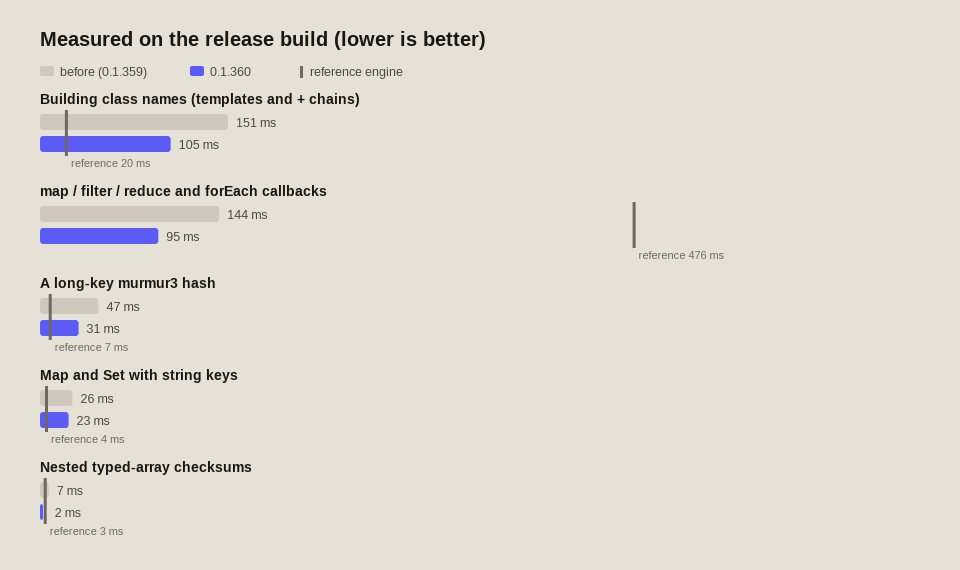
Floati now writes all of its machine code itself. The five compilers that turn hot JavaScript into machine code build Updraft IR, Floati's own compiler core, which Floati lowers to ARM64 and x86-64 code with no outside code generator in the browser any more: compiles take about half the time, the code is smaller and faster, and the browser program is 2.45 MB smaller. A large news site that showed as a blank strip in 0.1.359 renders in full again: a function's own variables were confused with a global of the same name declared inside one of its inner functions, so a framework's library read as undefined. Functions whose inner functions capture their variables, and functions that use ?? or ?., now compile instead of staying in the interpreter. Gust, the instant compiler, makes half the code it did, and its x86-64 version now runs correctly on Windows. Strings are faster and lighter (building class names 151 -> 105 ms with 3.7 times fewer allocations, a long-key hash 47 -> 31 ms), a script declaring 16,000 global functions starts in 22 ms instead of 935, callbacks over arrays run 5 times faster than in the reference engine, and a paused Map or Set iterator no longer skips an entry.

2.45 MB smallerThe browser program
64 -> 13,214 pixelsThe news site's page height
18.5 -> 9.05 MBGust code for 1,500 warm functions
Highlights4

Why Floati now writes all of its own machine code

Every compiler in Floati now builds Updraft IR, which Floati lowers itself to ARM64 and x86-64 machine code
Before, after and the reference engine for each measurement

Updraft is the machine-code compiler Floati builds for itself. Its first tiers shipped earlier this month: Gust, which turns a function into machine code in under a microsecond per operation, and Thermal, which keeps a hot loop's numbers in the processor's registers. Until this release the other five compilers (hot loops, callbacks and recursion, batch drivers, whole functions, and typed-array vector kernels) still handed their work to a general-purpose code generator written for other projects. Now all five build Updraft IR, and Floati lowers it itself: registers chosen by linear scan, repeated values merged, loop-invariant code hoisted out of loops, checks fused into the branches that read them, and 128-bit vectors on both CPUs. Why build our own: the outside generator spent about 100 times longer per operation than a page can afford on code that runs only a few times, it knew nothing about JavaScript values or Floati's page objects, it kept code memory we could not free, and it was the last large part of the engine Floati did not own. The business decision was to own the whole engine, as Floati owns its layout, network and media code, but to remove the outside generator only once ours matched or beat it on every axis we measure. It did: an integer loop 29 -> 23 ms on ARM64, callbacks over arrays 120 -> 101 ms, entry code 238 -> 216 bytes per function in half the compile time, 1.2 times faster code on x86-64, and vector sums on Windows 175 -> 4.5 ms (the old generator could not build them there at all). Every compiled program is checked against what the IR means: 100,000 random programs with 8 inputs each, plus every test map in 13 tier configurations.

The browser program2.45 MB smallerCallbacks over arrays144 -> 95 ms (reference engine 476)

A blank news site renders again, and closures compile

A news site with a front page built by a JavaScript framework showed as a 64-pixel strip in 0.1.359, with 30 copies of one error: a property read on undefined. The cause was in how a function gets its fast plan: a var declared inside one of its inner functions was counted as the outer function's own variable, so the outer function's reads of a global with the same name, the framework's library here, read that empty variable instead. Inner functions are now left out of the scan, and the fix came with a larger change: a function whose inner functions capture its variables used to stay in the interpreter, and now gets a plan. The captured variables live in one scope made when the function is called, the way a function context works, and everything else stays in registers. Functions that use ?? and ?. compile as well. On a recorded load of the same site, functions refused a plan fell from 343 to 232.

The news site's page height64 -> 13,214 pixelsFunctions refused a plan on that site343 -> 232

Gust's code halved

Gust copied every slow path at every place it could happen: each reference count drop, each stack check and each call into the runtime carried its own save, call and restore sequence. Now each kind of slow path is one routine per function, and a site makes a short jump into it, so Gust's code for 1,500 warm functions fell from 18.5 to 9.05 MB, which also means less to compile and more of it fits in the processor's cache. Gust's x86-64 version for Intel and Windows machines now uses the Windows calling convention there, and its shared routines belong to one thread each: a routine shared across threads could read another thread's view of a replaced method, a wrong answer the new test caught 241 times in 600 runs before the fix. x86-64 Gust stays behind a switch while its code is made smaller still.

Gust code for 1,500 warm functions18.5 -> 9.05 MB

Strings, start-up and iterators

A string literal in a hot function was boxed into a new string on every call: 'a' + i + 'b' made three strings where one is the answer. It is now the literal's own value, so building class names makes 3.7 times fewer allocations. Reading s.length no longer copies the string, Map and Set hash their string keys 8 bytes at a time with a seed chosen per run, and Thermal now compiles hash loops that read strings. A script declaring many global functions checked each new name against all the earlier ones, so setting up 16,000 took almost a second; it is a single pass now. And a Map or Set iterator paused while its collection was compacted many times resumed at the wrong place and skipped an entry; it now keeps an ordinal and resumes exactly.

Building class names151 -> 105 ms, 3.7 times fewer allocations16,000 global functions set up935 -> 22 msRelease checks against the reference browser8 of 8 the same

Was sich geändert hat

9 Änderungen
  1. JavaScript und JITEvery native compiler in Floati builds Updraft IR, lowered by Floati itself on ARM64 and x86-64; the outside code generator is gone and the browser program is 2.45 MB smaller.
  2. JavaScript und JITFaster code on both CPUs: an integer loop 29 -> 23 ms, callbacks over arrays 144 -> 95 ms (the reference engine 476), vector sums on Windows 175 -> 4.5 ms.
  3. DarstellungA large news site that showed as a blank strip renders in full: a variable declared in an inner function no longer hides a global from the outer one.
  4. DarstellungFunctions whose inner functions capture their variables, and functions using ?? and ?., compile instead of staying in the interpreter.
  5. Tabs und OberflächeGust makes half the code (18.5 -> 9.05 MB on 1,500 functions), and x86-64 Gust runs correctly on Windows.
  6. JavaScript und JITStrings: one value per literal (3.7 times fewer allocations building class names), length without a copy, faster string keys in Map and Set, and hash loops over strings in Thermal.
  7. DarstellungA script declaring 16,000 global functions starts in 22 ms instead of 935.
  8. DarstellungA paused Map or Set iterator keeps its place through any number of compactions.
  9. JavaScript und JITEach iterator kind has its own prototype behind Iterator.prototype, and matchAll returns an iterator, as the standard says.

Im eigenen Browser testen

Jeder Test läuft live in dem Browser, mit dem du gerade liest. Es wird nichts gesendet.

PrüfenDein BrowserFloati
a closure keeps a live binding to its function's local in a hot functionWird geprüftJa
?? and ?. give the standard answers in a hot functionWird geprüftJa
a paused Map iterator keeps its place through heavy churnWird geprüftJa
length of a string with astral characters in a hot loopWird geprüftJa
a long-key murmur3 hash gives 32-bit answers in a hot functionWird geprüftJa
strings built in a hot function from text and numbersWird geprüftJa
a nested Uint8 checksum gives the same totalWird geprüftJa
each iterator kind has its own prototype behind Iterator.prototypeWird geprüftJa
Bestanden 8 / 8
Alles seit v0.1.360 an einem Ort

Versionen

v0.1.0 - 0.1.9 · 10 Jul 2026418v0.1.427 · 25 Nov 2026

November2026 · 13 Versionen

Oktober2026 · 32 Versionen

38530 OktAhead of the reference runtime on 7 of 8 workloadsv0.1.385 · Gedächtnis und Lesen32 38429 OktSafety review, a rare crash fixed, functions compiled soonerv0.1.384 · Gedächtnis und Lesen46 38327 OktJavaScript ahead of the reference runtime on six of eight speed testsv0.1.383 · JavaScript und JIT36 38225 OktClosed tabs give their memory back, and XML pages read as XMLv0.1.382 · Gedächtnis und Lesen12 38125 OktLighter script code, and calls between scripts that run as ordinary callsv0.1.381 · Gedächtnis und Lesen15 38025 OktScrolling boxes scroll, pages look right, and scripts from other sites need permissionv0.1.380 · Darstellung16 37924 OktPages laid out the way their authors wrote them, and less memory againv0.1.379 · Darstellung22 37823 OktOther sites' data stays private, and less memory againv0.1.378 · Gedächtnis und Lesen 37723 OktAbout half the memory of the reference browser on everyday sitesv0.1.377 · Gedächtnis und Lesen15 37622 OktA minimized window stops piling up graphics memoryv0.1.376 · Gedächtnis und Lesen 37522 OktClosed pages let go, sites stay apart, and fonts stop costing memoryv0.1.375 · Gedächtnis und Lesen9 37421 OktA floating video you can move, that opens without a black flashv0.1.374 · Tabs und Oberfläche 37321 OktEvery page on our own engine, two pages side by side, videos that keep playing, and your own clockv0.1.373 · Tabs und Oberfläche17 37021 OktOpen your files, share to your phone, have pages read aloud, install sites as apps, play with a controller, and accented text drawn rightv0.1.370 · Datenschutz und Shields · testen11 36920 OktPasskeys with Touch ID and Windows Hello, sites that work offline, notifications you allow, and devices asked for first, all kept on your devicev0.1.369 · Datenschutz und Shields · testen9 36519 OktThe code-size budget fits your processor, and code that has gone cold makes room for code that is hot nowv0.1.365 · JavaScript und JIT · testen 36419 OktCompiled code that fits the processor's caches: big pages up to 1.8 times faster, and fast compiled code on Windows and Intel machinesv0.1.364 · JavaScript und JIT · testen 36319 OktThermal runs on one code generator, building strings is up to 8 times faster, and two slow paths that grew with the square of their input are linearv0.1.363 · JavaScript und JIT · testen12 35816 OktThermal, Floati's own optimizing compiler, is on: hot loops keep their numbers and strings in registersv0.1.358 · JavaScript und JIT · testen 35715 OktLoops that test a number run as machine code, more of your functions compile, and reading page nodes is three times fasterv0.1.357 · JavaScript und JIT · testen14 35614 OktRecursion makes a fraction of the calls, loops keep objects in registers, and element writes stop searchingv0.1.356 · JavaScript und JIT · testen 35514 OktA hot loop changes compiler without stopping, property writes skip the detour, and pure recursion remembers its answersv0.1.355 · JavaScript und JIT · testen 35413 OktFloati compiles JavaScript with its own compiler, Updraft: about a hundred times faster to compile, and compiled code no longer piles upv0.1.354 · JavaScript und JIT · testen 35211 OktCode that loads on demand starts at once, images decode beside their downloads, writes run compiledv0.1.352 · Darstellung · testen10 35010 OktHelpers that compile, strings that stay small, and events that fire fastv0.1.350 · JavaScript und JIT · testen14 3436 OktSign-ins that stay signed in, a real IndexedDB, and a storage button that shows what sites keepv0.1.343 · Datenschutz und Shields · testen25 3385 OktPages load faster, render truer and gain a dozen modern web features, each one checked against the reference browserv0.1.338 · Web-APIs und DOM · testen19 3352 OktA developer-docs site works like the reference browser, and every frame gets its own built-insv0.1.335 · Darstellung12 3342 OktIframes that cost what a paragraph costs, live selections, and rounder cornersv0.1.334 · Darstellung10 3331 OktFewer script errors on real sites, and finished pages give all their memory backv0.1.333 · JavaScript und JIT10 3311 OktA crash on busy news sites fixed, and pages lighter on the processorv0.1.331 · Darstellung 3301 OktJavaScript scores 100, and big pages stop stuttering when they clean upv0.1.330 · JavaScript und JIT11

September2026 · 29 Versionen

32930 SepThe JavaScript engine proves what it can skipv0.1.329 · JavaScript und JIT9 32830 SepJavaScript runs at the reference browser's speed on 41 of our 42 measured workloadsv0.1.328 · JavaScript und JIT 32528 SepDeep recursion runs like it does in the reference browserv0.1.325 · JavaScript und JIT 32327 SepJavaScript measured at 94, JSON three times faster, and a round of fixes found against the reference browserv0.1.323 · JavaScript und JIT11 32227 SepClosed pages give their memory back whole, and JavaScript measured at 87v0.1.322 · JavaScript und JIT11 32127 SepHalf the memory, and JavaScript measured at 80v0.1.321 · JavaScript und JIT14 32026 SepPages no longer freeze while a script waits on the networkv0.1.320 · JavaScript und JIT 31926 SepA PDF viewer that does what Acrobat Pro charges forv0.1.319 · Tabs und Oberfläche16 31025 SepPages stay alive, repaints never block your scroll, and type matches the reference browser'sv0.1.310 · Darstellung10 30924 SepPages arrive like they do in the reference browser, in a fraction of the memoryv0.1.309 · Netzwerk13 30824 SepPages drawn by your graphics card, and scrolling that never waitsv0.1.308 · Darstellung 30122 SepSites can no longer follow you between other sites, and the next page starts soonerv0.1.301 · Datenschutz und Shields 30019 SepReads the newest web compression, reuses secure connections, and remembers where sites livev0.1.300 · Gedächtnis und Lesen 29717 SepSetting up and filling arrays of numbers is now several times faster, and faster than the reference browserv0.1.297 · JavaScript und JIT 29116 SepA private wayback machine for pages you seal, cited answers that open where you read them, and a privacy report that is ready the instant a page loadsv0.1.291 · Gedächtnis und Lesen 29015 SepFloati spots trackers no list has caught, answers your questions from your own reading, and gets even closer to the pixelv0.1.290 · Datenschutz und Shields 28815 SepThe pages where you type a password stay out of your memory, and text renders truer to the pagev0.1.288 · Gedächtnis und Lesen 28311 SepMessages between windows now prove who sent themv0.1.283 · Darstellung 28111 SepSee a site's own rules protect you, and what it was never toldv0.1.281 · Darstellung 27410 SepFingerprint Shield: see and prove what a page tried to learn about youv0.1.274 · Gedächtnis und Lesen 2468 SepMemory: your browser remembers what you read, and can prove itv0.1.246 · Gedächtnis und Lesen 2346 SepWebAssembly SIMD lands, completing the WebAssembly platformv0.1.234 · Darstellung 2335 SepReal WebAssembly apps that share memory with the page now workv0.1.233 · Gedächtnis und Lesen 2173 SepYour passwords, the Floati wayv0.1.217 · Tabs und Oberfläche 2112 SepA correctness fix for today's list-speed improvementv0.1.211 · JavaScript und JIT 2102 SepThe most common way people work with lists of data now runs at full speedv0.1.210 · JavaScript und JIT 2092 SepBig objects are instant now, instead of getting slower the more you addv0.1.209 · Gedächtnis und Lesen 2082 SepFloati's own engine got dramatically faster at the code real pages run every framev0.1.208 · JavaScript und JIT 2061 SepExplain this page: the browser now understands what a site does, and can prove itv0.1.206 · Datenschutz und Shields

August2026 · 19 Versionen

20328 AugPages you open with the Floati engine now render on your graphics cardv0.1.203 · Darstellung 19421 AugFaster on pages that change as you use them - plus a tab-hover fixv0.1.194 · Tabs und Oberfläche 19321 AugSelect text, find on the page, and zoom - plus faster renderingv0.1.193 · Tabs und Oberfläche 18619 AugEngine tabs remember where you werev0.1.186 · Tabs und Oberfläche 14814 AugWebAssembly numbers stay exact: 64-bit integers cross as BigIntv0.1.148 · JavaScript und JIT 14714 AugWebAssembly interop rounds out: imported globals and memoryv0.1.147 · Gedächtnis und Lesen 13914 AugWebGL can texture from an image or a canvasv0.1.139 · Darstellung 13414 AugWebAssembly now runs real compiled modules, not just toy onesv0.1.134 · Gedächtnis und Lesen 13313 AugThe engine now runs WebAssemblyv0.1.133 · Gedächtnis und Lesen 12813 AugHSTS: sites that demand https are never reached over plaintext, not even oncev0.1.128 · Netzwerk 1097 AugWeb Audio convolution reverb + stereo sample playbackv0.1.109 · Medien 785 AugAsk knows when to stop, and forms can edit their fieldsv0.1.78 · Web-APIs und DOM 775 AugAsk joins the dots across sentencesv0.1.77 · JavaScript und JIT 745 AugBracket property access gets fast, and Ask follows your timelinev0.1.74 · Darstellung 735 AugBuilding a list gets fast, and Ask hears whole phrasesv0.1.73 · JavaScript und JIT 725 AugMethod calls get up to speed, and Ask spreads its sourcesv0.1.72 · Gedächtnis und Lesen 715 AugRecursion gets its speed back, and Ask reads the roomv0.1.71 · JavaScript und JIT 704 AugOne press, and you are on the new versionv0.1.70 · Tabs und Oberfläche 661 AugThe worst score on the board turned out to be a cookie bannerv0.1.66 · Darstellung9

Juli2026 · 11 Versionen