Todas las versiones v0.1.3478 Oct 2026Renderizado, JavaScript y JIT, API web y DOM, Pestañas e interfaz Feed

Las notas de versión están escritas en inglés.

Cards inside links, small print at its real size, and errors you can follow

Pages lay out more like the reference browser: a card inside a link stays a card, a block in the middle of a sentence splits the sentence around it, small print keeps its own line height, and fonts a script names after the page loads get their real faces. Errors read like the reference browser's: JSON messages say what was expected and where, and stack traces carry on through callbacks with the column of each call. Throwing and catching an error now costs far less, JSON reads long text up to five times faster, page transitions follow the standard, and the window is an event target of its own.

28% cheaper than beforeErrors 12 callbacks deep
77 of 77Messages equal to the reference browser
Destacados5

Cards inside links, blocks inside sentences
AntesDespués
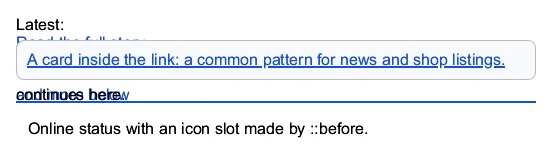
Antes: a card inside a link, and a status dot made by ::before
Antes
Después: a card inside a link, and a status dot made by ::before
Después · v0.1.347
La misma página en el navegador de referencia
Navegador de referencia

A link or span holding a block (a card in a news or shop listing, a box in the middle of a sentence) used to turn the whole thing into one block: the text before the card was painted underneath it, and the text after it lost its line. Inline content is now split around the block the way the standard describes, the link keeps its underline on every piece, and icon slots and status dots made with ::before draw again.

a card inside a link, and a status dot made by ::before

Small print at its real line height
AntesDespués
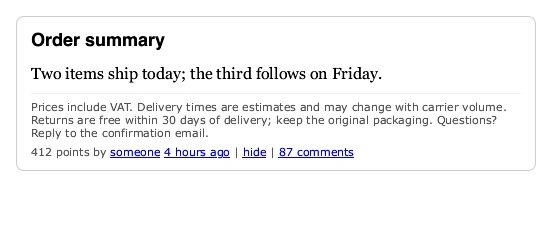
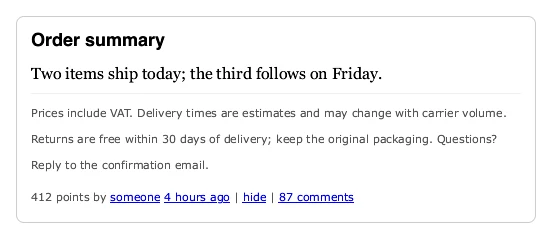
Antes: an order card with its small print and a byline
Antes
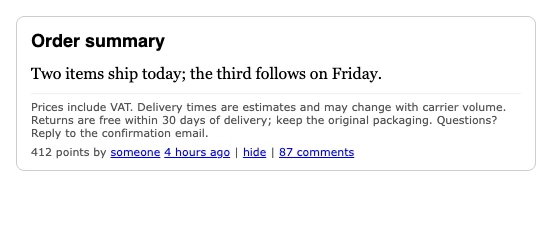
Después: an order card with its small print and a byline
Después · v0.1.347
La misma página en el navegador de referencia
Navegador de referencia

Setting a small font with the font shorthand (font: 11px Verdana) left the line height of the text around it in place, so footnotes, bylines and price notes were spread out over twice the lines they should take. The shorthand now resets the line height, as the standard says. Empty placeholders, such as anchors a page links to, now have a position on their line, and a space beside one no longer doubles.

an order card with its small print and a byline

Fonts that scripts name, with their real faces
AntesDespués
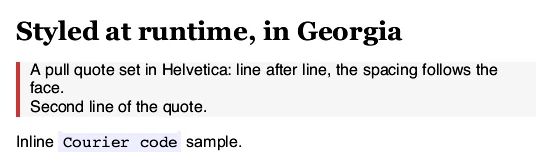
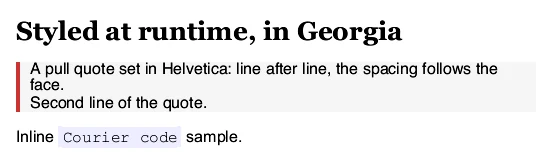
Antes: a heading, a pull quote and code styled from script
Antes
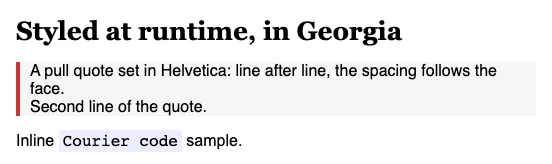
Después: a heading, a pull quote and code styled from script
Después · v0.1.347
La misma página en el navegador de referencia
Navegador de referencia

Sites that style themselves from script (a common way to build pages today) name their fonts after the page has loaded. Those families now load their real faces instead of a fallback, and classic faces such as Helvetica, Times and Courier get the same line spacing as in the reference browser.

a heading, a pull quote and code styled from script

Stack traces you can follow
AntesDespués
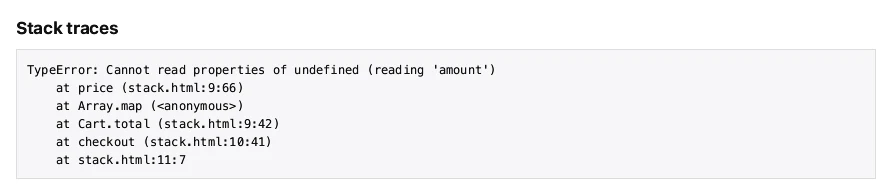
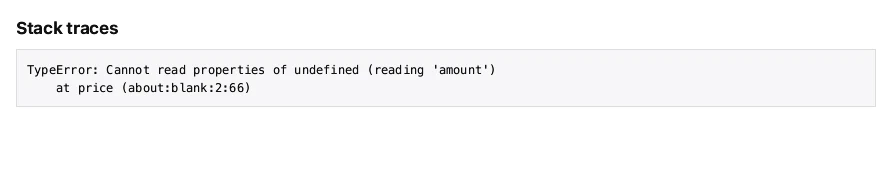
Antes: a TypeError thrown inside a map callback
Antes
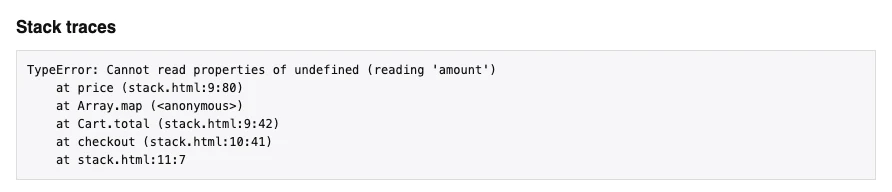
Después: a TypeError thrown inside a map callback
Después · v0.1.347
La misma página en el navegador de referencia
Navegador de referencia

An error thrown inside a callback, such as one run by map or forEach, used to show only the callback: everything that called it was lost. Stack traces now carry on through the built-in that ran it (at Array.map), name each frame the way the reference browser does (Cart.total), and point at the column of each call. The trace is only put together when a page reads it, so a page that throws and catches errors in a loop no longer pays for traces it never looks at.

a TypeError thrown inside a map callback

Errors 12 callbacks deep28% cheaper than beforeFrames kept10, as in the reference browser

JSON errors that say what went wrong
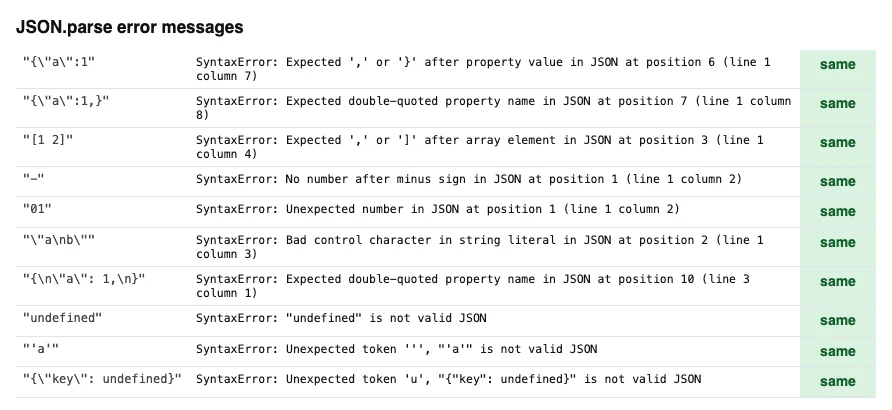
AntesDespués
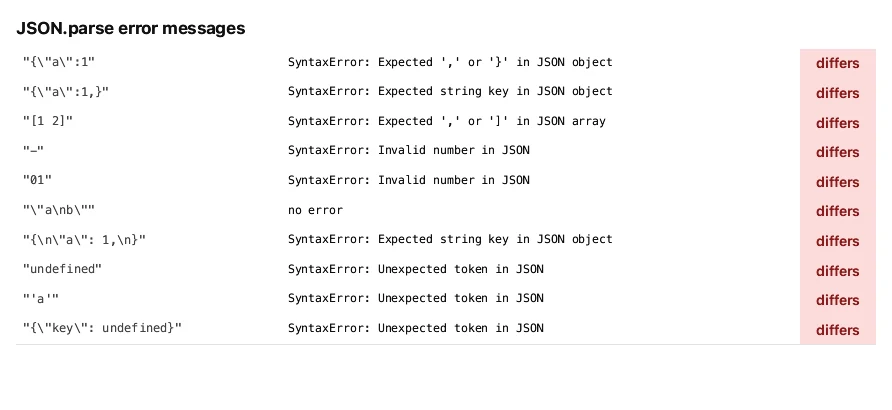
Antes: ten invalid JSON texts and their messages
Antes
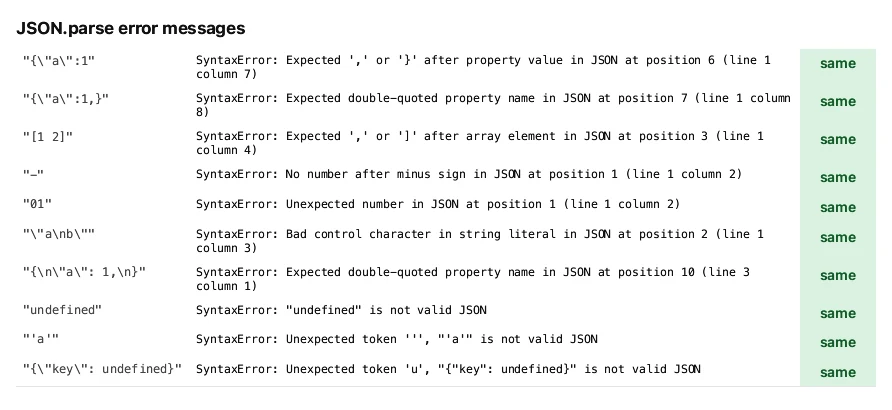
Después: ten invalid JSON texts and their messages
Después · v0.1.347
La misma página en el navegador de referencia
Navegador de referencia

When text is not valid JSON, the error now says what was expected and where, with the line and column, or quotes the part of the text around the problem, word for word as the reference browser does. Finding that out no longer costs more for longer text, and long strings inside JSON are read up to five times faster.

ten invalid JSON texts and their messages

Messages equal to the reference browser77 of 771 MB string270 -> 52 microseconds

Qué cambió

17 cambios
  1. RenderizadoA block inside a link or span splits the line around it as the standard describes, keeping the link's underline on every piece; generated ::before and ::after boxes count toward their element's size, and inline-block ones (icon slots, status dots, badges) draw.
  2. RenderizadoThe font shorthand resets the line height when it does not name one, so small print and bylines are as tight as in the reference browser.
  3. RenderizadoEmpty inline elements (anchors, placeholders) have a position on their line, so scrolling to an anchor and measuring one work; a space beside one no longer doubles.
  4. RenderizadoFonts named by a script after the page loads get their real faces; Helvetica, Times and Courier get the reference browser's line spacing; Times New Roman and Courier New use their own files.
  5. RenderizadoA page that shows its own CSS (a style element set to display: block) shows it, and head, title, script and the other metadata elements compute display: none.
  6. Pestañas e interfazTables and their parts get their table display values from the browser's own style sheet, and menu, dir, hgroup and search are blocks, so pages that read these styles get the reference browser's answers.
  7. JavaScript y JITStack traces continue through callbacks run by built-ins, name frames by their receiver (Cart.total, Array.map), point at the column of each call, and stop at ten frames as in the reference browser. They are built only when read, and the frames of a repeated error are formatted once.
  8. JavaScript y JITJSON.parse errors are worded as the reference browser words them, with the position, line and column or a quote of the text around the problem. JSON.parse and JSON.stringify call revivers and replacers in exactly the order the standard gives.
  9. JavaScript y JITJSON reads long strings up to five times faster, and an error at the end of a long text costs no more than the parse itself.
  10. JavaScript y JITPage transitions (startViewTransition): a real ViewTransition with its promises in order, skipping, transition types, waitUntil and element-scoped transitions. They finish instantly, as with reduced motion.
  11. API web y DOMThe window is its own event target: window and document listeners are separate, events reach the window after the document (never for load), and window.onclick and document.onclick are separate handlers.
  12. JavaScript y JITResponse objects are real: status checks, clone, Response.error, Response.json and Response.redirect, and fetch returns one. Request objects resolve their address, carry a signal and can be passed to fetch.
  13. API web y DOMElement attributes, form validity, custom element upgrades, Set and Map iteration, childNodes and children are live, as the standard says; editing an attribute node changes the element.
  14. API web y DOMUncaught errors fire the window's error event and window.onerror, including errors thrown in timers, listeners and microtasks.
  15. JavaScript y JITA loop over a Set or a Map runs about 2.6 times faster, and restyling after a change on a large news page touches only what the change can reach instead of the whole page.
  16. RenderizadoInserting or removing a positioned box (a tooltip, an overlay) no longer lays out the whole page again before the next measurement.
  17. API web y DOMThe measured Web APIs score rose from 51.2 to 52.8, counted over the whole platform surface against the reference browser, and all 12 test sites still run with no script error the reference browser does not also show.

Pruébalo en tu navegador

Cada prueba se ejecuta en vivo en el navegador con el que lees. No se envía nada a ningún sitio.

ComprobarTu navegadorFloati
JSON errors name what was expectedComprobandoSí
Stacks are built when read, ten frames deepComprobandoSí
Stacks carry on through callbacksComprobandoSí
Page transitions are realComprobandoSí
The window hears its own eventsComprobandoSí
Table cells compute as table cellsComprobandoSí
Superadas 6 / 6
Todo desde la v0.1.347 en un solo lugar

Versiones

v0.1.0 - 0.1.9 · 10 Jul 2026418v0.1.427 · 25 Nov 2026

octubre2026 · 33 versiones

37121 OctDrop files onto pages, dictate without your voice leaving the Mac, and controllers that rumblev0.1.371 · API web y DOM · pruébalo 37021 OctOpen your files, share to your phone, have pages read aloud, install sites as apps, play with a controller, and accented text drawn rightv0.1.370 · Privacidad y Shields · pruébalo11 36920 OctPasskeys with Touch ID and Windows Hello, sites that work offline, notifications you allow, and devices asked for first, all kept on your devicev0.1.369 · Privacidad y Shields · pruébalo9 36820 OctA site's own security rules are kept the whole time the page runs, Trusted Types, a map of every unsafe write in DevTools, and animations from scriptv0.1.368 · Privacidad y Shields · pruébalo 36720 OctEvents, form controls, performance timing, URL patterns, live streams and the newest JavaScript: the Web APIs score rises from 59 to 62v0.1.367 · API web y DOM · pruébalo10 36619 OctEvents, custom form controls, fonts and navigation work the way the web standards say: the Web APIs score rises from 53 to 59v0.1.366 · API web y DOM · pruébalo9 36519 OctThe code-size budget fits your processor, and code that has gone cold makes room for code that is hot nowv0.1.365 · JavaScript y JIT · pruébalo 36419 OctCompiled code that fits the processor's caches: big pages up to 1.8 times faster, and fast compiled code on Windows and Intel machinesv0.1.364 · JavaScript y JIT · pruébalo 36319 OctThermal runs on one code generator, building strings is up to 8 times faster, and two slow paths that grew with the square of their input are linearv0.1.363 · JavaScript y JIT · pruébalo12 36219 OctA page scheduler that stalled now runs, try / finally and spreads compile, and deleting thousands of properties is 180 times fasterv0.1.362 · Renderizado · pruébalo 36118 OctThermal runs on Windows and Intel machines, a register fix for compiled code on Windows, try / catch compiles, and reading a growing string is 200 times fasterv0.1.361 · JavaScript y JIT · pruébalo 36018 OctEvery byte of machine code is Floati's own, a news site that showed blank renders, Gust's code is half the size, and closures and ?? compilev0.1.360 · JavaScript y JIT · pruébalo9 35916 OctThermal reads object members and folds Math, string building compiles, and methods, Array subclasses and globals behave as the standard saysv0.1.359 · JavaScript y JIT · pruébalo 35816 OctThermal, Floati's own optimizing compiler, is on: hot loops keep their numbers and strings in registersv0.1.358 · JavaScript y JIT · pruébalo 35715 OctLoops that test a number run as machine code, more of your functions compile, and reading page nodes is three times fasterv0.1.357 · JavaScript y JIT · pruébalo14 35614 OctRecursion makes a fraction of the calls, loops keep objects in registers, and element writes stop searchingv0.1.356 · JavaScript y JIT · pruébalo 35514 OctA hot loop changes compiler without stopping, property writes skip the detour, and pure recursion remembers its answersv0.1.355 · JavaScript y JIT · pruébalo 35413 OctFloati compiles JavaScript with its own compiler, Updraft: about a hundred times faster to compile, and compiled code no longer piles upv0.1.354 · JavaScript y JIT · pruébalo 35311 OctStyle matching tries a third of the rules, queries prepare their selector once, sibling walks stay fastv0.1.353 · Renderizado · pruébalo 35211 OctCode that loads on demand starts at once, images decode beside their downloads, writes run compiledv0.1.352 · Renderizado · pruébalo10 35111 OctStyles read once, layouts redone only where they changed, built-ins in compiled loopsv0.1.351 · JavaScript y JIT · pruébalo12 35010 OctHelpers that compile, strings that stay small, and events that fire fastv0.1.350 · JavaScript y JIT · pruébalo14 34910 OctScripts that grow in step with their work, layouts laid out once, and colours mixed like the referencev0.1.349 · Renderizado · pruébalo13 3489 OctScripts that only compile when it pays, cards that line up, and bold that stays boldv0.1.348 · Renderizado · pruébalo14 3478 OctCards inside links, small print at its real size, and errors you can followv0.1.347 · Renderizado · pruébalo17 3467 OctA real performance timeline, site icons from the engine with a lookalike check, and forms that lay out rightv0.1.346 · Renderizado · pruébalo14 3457 OctReal WebGL, a real 2D canvas, and canvas text that matches the reference browserv0.1.345 · Renderizado · pruébalo10 3436 OctSign-ins that stay signed in, a real IndexedDB, and a storage button that shows what sites keepv0.1.343 · Privacidad y Shields · pruébalo25 3425 OctTheme switchers, chart labels sized by CSS, and SVG text you can measurev0.1.342 · API web y DOM · pruébalo 3415 OctCanvas text measured and drawn like the reference browser, and SVG shapes you can measurev0.1.341 · Renderizado · pruébalo 3405 OctScripts can read and change SVG the way they do in the reference browser, and a hidden hang is gonev0.1.340 · Renderizado · pruébalo10 3395 OctEvery computed style, real stylesheet objects and full 3D geometry, each checked against the reference browserv0.1.339 · API web y DOM · pruébalo12 3385 OctPages load faster, render truer and gain a dozen modern web features, each one checked against the reference browserv0.1.338 · API web y DOM · pruébalo19