Todas las versiones v0.1.35715 Oct 2026Renderizado, JavaScript y JIT, API web y DOM, Memoria y lectura Feed

Las notas de versión están escritas en inglés.

Loops that test a number run as machine code, more of your functions compile, and reading page nodes is three times faster

This release removes a hidden slow path that hit a very common kind of loop: one that tests a number, like if (i & 1) or if (n % 3). Floati's fastest loop tier used to turn such loops down and run them one operation at a time; now they run as machine code, 13 to 31 times faster, and one of them faster than the reference engine. Many more functions now compile: ones with block-scoped let and const, a switch, unary minus, assignments to outer variables, or a throw, and a function's first long loop moves into compiled code while it runs. Compiled code reads page nodes such as parentNode three times faster. Thermal, the optimizing tier of Floati's own compiler Updraft, has its first stages built and measured, switched off in this release. Nine correctness bugs are fixed, one of them a crash after an error in a hot function.

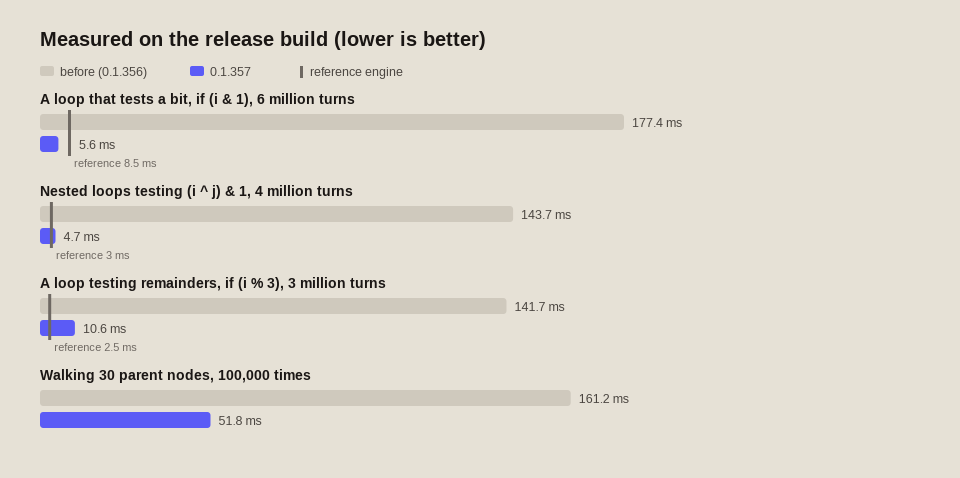
177 -> 5.6 ms (reference engine 8.5)A loop that tests a bit, 6 million turns
4.2 -> 0.9 msCompiling a 2,100-operation function
161 -> 52 msWalking 30 parent nodes, 100,000 times
Destacados4

Loops that test a number run as machine code

Before: the fastest loop tier refused a loop that tests a number and ran it one operation at a time; after: the test is a few machine instructions and the loop runs as machine code
Before, after and the reference engine for four measurements

Floati's fastest loop tier works out the type of every value in a loop before it compiles it. A test such as if (i & 1), if (n % 3) or while (k) is a number, not true or false, and the tier only accepted true or false, so it turned the whole loop down. The loop then ran in the register interpreter, one operation at a time, at about 30 nanoseconds per turn. A number is now accepted as a test, with the meaning JavaScript gives it: true unless it is 0, -0 or NaN, checked in a few machine instructions. A loop that tests a bit runs 30 times faster and now beats the reference engine.

A loop that tests a bit, 6 million turns177 -> 5.6 ms (reference engine 8.5)Nested loops testing (i ^ j) & 1, 4 million turns144 -> 4.7 ms (reference engine 3)

More of your functions compile

Floati compiles a function once it has run often enough to pay for it, but some ways of writing a function kept it in the slowest interpreter however hot it got: any block scope (let or const inside a block or a for, or a switch), unary minus, a function-level let or const, assigning a variable outside the function (a counter in a closure, a module variable), or a throw. On sampled pages, block scopes alone kept about two in five interpreted calls out of compiled code. All of these now compile, each with the interpreter's exact rules (a let read before its declaration still throws, every loop turn still gets its own binding). A function that runs once with a long loop, like a setup or main function, now moves into its compiled code in the middle of that loop. Compiled code also does bitwise operators and string methods such as charCodeAt itself instead of calling general helpers, and compiling a very large function no longer takes time that grows with the square of its size.

Compiling a 2,100-operation function4.2 -> 0.9 ms

Reading page nodes is three times faster

When compiled code reads el.parentNode or el.firstChild, it used to go through a general path that matched the property name as text, checked for SVG overrides and built a fresh value for the node every time. Now each compiled site remembers what kind of member it reads and calls the node directly, and every node keeps one value that all reads hand out, as the reference engine keeps one wrapper per node. Defining your own property on a node with Object.defineProperty also behaves as in the reference browser now: it shadows the built-in one, keeps the writable and enumerable settings you gave it, and getOwnPropertyDescriptor lists only what you defined.

Walking 30 parent nodes, 100,000 times161 -> 52 ms

Thermal, the optimizing tier, is under way

Updraft is the compiler Floati is writing for itself (0.1.354 explained why). Its first tier, Gust, compiles quickly but keeps every value boxed in memory. Thermal is the tier that keeps numbers in machine registers, and its first stages are now built: it reads the shape of each function, works out how long every value lives, assigns registers, and writes ARM64 code directly, in about half a microsecond per operation, where the general-purpose code generator Floati still uses needs 80 to 400. On a numeric benchmark Thermal's code runs 2.7 times faster than what ships today with less memory, and a numeric loop comes within a factor of two of the reference engine. It is switched off in this release: it compiles only functions made of numbers so far, and the rule stays that each part of Updraft is switched on only once it beats what it replaces on every measured axis.

A numeric benchmark, today -> Thermal (off by default)270 -> 101 ms, 16.6 -> 13.7 MB

Qué cambió

14 cambios
  1. JavaScript y JITLoops that test a number (if (i & 1), if (n % 3), while (k)) run as machine code instead of one operation at a time: 13 to 31 times faster.
  2. RenderizadoFunctions with block-scoped let and const, a switch, unary minus, assignments to outer variables or a throw now compile.
  3. JavaScript y JITA function's first long loop moves into compiled code while it runs.
  4. JavaScript y JITCompiled code does bitwise operators and string methods such as charCodeAt itself.
  5. JavaScript y JITCompiled code reads page nodes directly, and each node keeps one value for every read: a parent walk three times faster.
  6. RenderizadoCompiling a very large function takes time in proportion to its size (it grew with the square): 4.2 -> 0.9 ms.
  7. JavaScript y JITThermal, the optimizing tier of Floati's own compiler, has its first stages built and measured (switched off in this release).
  8. Memoria y lecturaFixed: a crash after an error inside a function called from compiled code.
  9. RenderizadoFixed: 1 ** NaN, (-1) ** Infinity and Math.pow(1, NaN) are NaN, as the standard says (they gave 1).
  10. RenderizadoFixed: new on an arrow function, a generator or an async function throws a TypeError.
  11. JavaScript y JITFixed: reading a switch's let before its case declares it, or writing an outer let before its declaration from a closure, throws a ReferenceError.
  12. JavaScript y JITFixed: string methods given a Symbol throw a TypeError, and deleting a built-in string or array method takes effect.
  13. JavaScript y JITFixed: indexOf on an array with a getter element finds it in hot code too.
  14. API web y DOMFixed: a property you define on a page node shadows the built-in one and keeps the settings you gave it.

Pruébalo en tu navegador

Cada prueba se ejecuta en vivo en el navegador con el que lees. No se envía nada a ningún sitio.

ComprobarTu navegadorFloati
A loop that branches on a number counts 0, -0 and NaN as falseComprobandoSí
Odd and even by a bit test add up in a hot loopComprobandoSí
1 ** NaN and (-1) ** Infinity are NaN, also in a hot functionComprobandoSí
let and const inside a hot loop keep a fresh binding per turnComprobandoSí
A hot function that assigns an outer variable updates itComprobandoSí
A throw from a hot function reaches the catch with its valueComprobandoSí
new of an arrow or a generator throws a TypeErrorComprobandoSí
A node read in a hot loop is the same node every timeComprobandoSí
Superadas 8 / 8
Todo desde la v0.1.357 en un solo lugar

Versiones

v0.1.0 - 0.1.9 · 10 Jul 2026418v0.1.427 · 25 Nov 2026

octubre2026 · 33 versiones

37121 OctDrop files onto pages, dictate without your voice leaving the Mac, and controllers that rumblev0.1.371 · API web y DOM · pruébalo 37021 OctOpen your files, share to your phone, have pages read aloud, install sites as apps, play with a controller, and accented text drawn rightv0.1.370 · Privacidad y Shields · pruébalo11 36920 OctPasskeys with Touch ID and Windows Hello, sites that work offline, notifications you allow, and devices asked for first, all kept on your devicev0.1.369 · Privacidad y Shields · pruébalo9 36820 OctA site's own security rules are kept the whole time the page runs, Trusted Types, a map of every unsafe write in DevTools, and animations from scriptv0.1.368 · Privacidad y Shields · pruébalo 36720 OctEvents, form controls, performance timing, URL patterns, live streams and the newest JavaScript: the Web APIs score rises from 59 to 62v0.1.367 · API web y DOM · pruébalo10 36619 OctEvents, custom form controls, fonts and navigation work the way the web standards say: the Web APIs score rises from 53 to 59v0.1.366 · API web y DOM · pruébalo9 36519 OctThe code-size budget fits your processor, and code that has gone cold makes room for code that is hot nowv0.1.365 · JavaScript y JIT · pruébalo 36419 OctCompiled code that fits the processor's caches: big pages up to 1.8 times faster, and fast compiled code on Windows and Intel machinesv0.1.364 · JavaScript y JIT · pruébalo 36319 OctThermal runs on one code generator, building strings is up to 8 times faster, and two slow paths that grew with the square of their input are linearv0.1.363 · JavaScript y JIT · pruébalo12 36219 OctA page scheduler that stalled now runs, try / finally and spreads compile, and deleting thousands of properties is 180 times fasterv0.1.362 · Renderizado · pruébalo 36118 OctThermal runs on Windows and Intel machines, a register fix for compiled code on Windows, try / catch compiles, and reading a growing string is 200 times fasterv0.1.361 · JavaScript y JIT · pruébalo 36018 OctEvery byte of machine code is Floati's own, a news site that showed blank renders, Gust's code is half the size, and closures and ?? compilev0.1.360 · JavaScript y JIT · pruébalo9 35916 OctThermal reads object members and folds Math, string building compiles, and methods, Array subclasses and globals behave as the standard saysv0.1.359 · JavaScript y JIT · pruébalo 35816 OctThermal, Floati's own optimizing compiler, is on: hot loops keep their numbers and strings in registersv0.1.358 · JavaScript y JIT · pruébalo 35715 OctLoops that test a number run as machine code, more of your functions compile, and reading page nodes is three times fasterv0.1.357 · JavaScript y JIT · pruébalo14 35614 OctRecursion makes a fraction of the calls, loops keep objects in registers, and element writes stop searchingv0.1.356 · JavaScript y JIT · pruébalo 35514 OctA hot loop changes compiler without stopping, property writes skip the detour, and pure recursion remembers its answersv0.1.355 · JavaScript y JIT · pruébalo 35413 OctFloati compiles JavaScript with its own compiler, Updraft: about a hundred times faster to compile, and compiled code no longer piles upv0.1.354 · JavaScript y JIT · pruébalo 35311 OctStyle matching tries a third of the rules, queries prepare their selector once, sibling walks stay fastv0.1.353 · Renderizado · pruébalo 35211 OctCode that loads on demand starts at once, images decode beside their downloads, writes run compiledv0.1.352 · Renderizado · pruébalo10 35111 OctStyles read once, layouts redone only where they changed, built-ins in compiled loopsv0.1.351 · JavaScript y JIT · pruébalo12 35010 OctHelpers that compile, strings that stay small, and events that fire fastv0.1.350 · JavaScript y JIT · pruébalo14 34910 OctScripts that grow in step with their work, layouts laid out once, and colours mixed like the referencev0.1.349 · Renderizado · pruébalo13 3489 OctScripts that only compile when it pays, cards that line up, and bold that stays boldv0.1.348 · Renderizado · pruébalo14 3478 OctCards inside links, small print at its real size, and errors you can followv0.1.347 · Renderizado · pruébalo17 3467 OctA real performance timeline, site icons from the engine with a lookalike check, and forms that lay out rightv0.1.346 · Renderizado · pruébalo14 3457 OctReal WebGL, a real 2D canvas, and canvas text that matches the reference browserv0.1.345 · Renderizado · pruébalo10 3436 OctSign-ins that stay signed in, a real IndexedDB, and a storage button that shows what sites keepv0.1.343 · Privacidad y Shields · pruébalo25 3425 OctTheme switchers, chart labels sized by CSS, and SVG text you can measurev0.1.342 · API web y DOM · pruébalo 3415 OctCanvas text measured and drawn like the reference browser, and SVG shapes you can measurev0.1.341 · Renderizado · pruébalo 3405 OctScripts can read and change SVG the way they do in the reference browser, and a hidden hang is gonev0.1.340 · Renderizado · pruébalo10 3395 OctEvery computed style, real stylesheet objects and full 3D geometry, each checked against the reference browserv0.1.339 · API web y DOM · pruébalo12 3385 OctPages load faster, render truer and gain a dozen modern web features, each one checked against the reference browserv0.1.338 · API web y DOM · pruébalo19