Todas las versiones v0.1.36018 Oct 2026Renderizado, JavaScript y JIT, Pestañas e interfaz Feed

Las notas de versión están escritas en inglés.

Every byte of machine code is Floati's own, a news site that showed blank renders, Gust's code is half the size, and closures and ?? compile

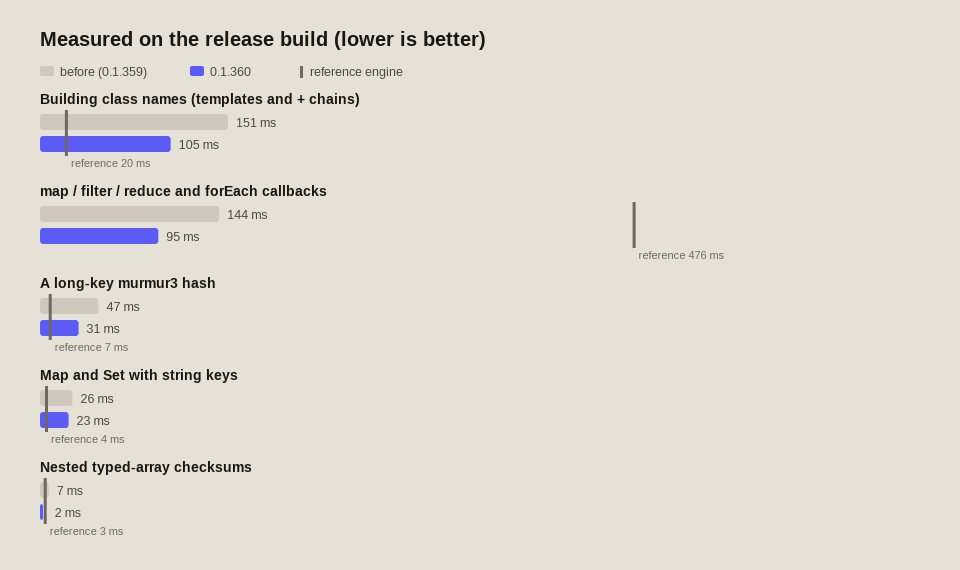
Floati now writes all of its machine code itself. The five compilers that turn hot JavaScript into machine code build Updraft IR, Floati's own compiler core, which Floati lowers to ARM64 and x86-64 code with no outside code generator in the browser any more: compiles take about half the time, the code is smaller and faster, and the browser program is 2.45 MB smaller. A large news site that showed as a blank strip in 0.1.359 renders in full again: a function's own variables were confused with a global of the same name declared inside one of its inner functions, so a framework's library read as undefined. Functions whose inner functions capture their variables, and functions that use ?? or ?., now compile instead of staying in the interpreter. Gust, the instant compiler, makes half the code it did, and its x86-64 version now runs correctly on Windows. Strings are faster and lighter (building class names 151 -> 105 ms with 3.7 times fewer allocations, a long-key hash 47 -> 31 ms), a script declaring 16,000 global functions starts in 22 ms instead of 935, callbacks over arrays run 5 times faster than in the reference engine, and a paused Map or Set iterator no longer skips an entry.

2.45 MB smallerThe browser program
64 -> 13,214 pixelsThe news site's page height
18.5 -> 9.05 MBGust code for 1,500 warm functions
Destacados4

Why Floati now writes all of its own machine code

Every compiler in Floati now builds Updraft IR, which Floati lowers itself to ARM64 and x86-64 machine code
Before, after and the reference engine for each measurement

Updraft is the machine-code compiler Floati builds for itself. Its first tiers shipped earlier this month: Gust, which turns a function into machine code in under a microsecond per operation, and Thermal, which keeps a hot loop's numbers in the processor's registers. Until this release the other five compilers (hot loops, callbacks and recursion, batch drivers, whole functions, and typed-array vector kernels) still handed their work to a general-purpose code generator written for other projects. Now all five build Updraft IR, and Floati lowers it itself: registers chosen by linear scan, repeated values merged, loop-invariant code hoisted out of loops, checks fused into the branches that read them, and 128-bit vectors on both CPUs. Why build our own: the outside generator spent about 100 times longer per operation than a page can afford on code that runs only a few times, it knew nothing about JavaScript values or Floati's page objects, it kept code memory we could not free, and it was the last large part of the engine Floati did not own. The business decision was to own the whole engine, as Floati owns its layout, network and media code, but to remove the outside generator only once ours matched or beat it on every axis we measure. It did: an integer loop 29 -> 23 ms on ARM64, callbacks over arrays 120 -> 101 ms, entry code 238 -> 216 bytes per function in half the compile time, 1.2 times faster code on x86-64, and vector sums on Windows 175 -> 4.5 ms (the old generator could not build them there at all). Every compiled program is checked against what the IR means: 100,000 random programs with 8 inputs each, plus every test map in 13 tier configurations.

The browser program2.45 MB smallerCallbacks over arrays144 -> 95 ms (reference engine 476)

A blank news site renders again, and closures compile

A news site with a front page built by a JavaScript framework showed as a 64-pixel strip in 0.1.359, with 30 copies of one error: a property read on undefined. The cause was in how a function gets its fast plan: a var declared inside one of its inner functions was counted as the outer function's own variable, so the outer function's reads of a global with the same name, the framework's library here, read that empty variable instead. Inner functions are now left out of the scan, and the fix came with a larger change: a function whose inner functions capture its variables used to stay in the interpreter, and now gets a plan. The captured variables live in one scope made when the function is called, the way a function context works, and everything else stays in registers. Functions that use ?? and ?. compile as well. On a recorded load of the same site, functions refused a plan fell from 343 to 232.

The news site's page height64 -> 13,214 pixelsFunctions refused a plan on that site343 -> 232

Gust's code halved

Gust copied every slow path at every place it could happen: each reference count drop, each stack check and each call into the runtime carried its own save, call and restore sequence. Now each kind of slow path is one routine per function, and a site makes a short jump into it, so Gust's code for 1,500 warm functions fell from 18.5 to 9.05 MB, which also means less to compile and more of it fits in the processor's cache. Gust's x86-64 version for Intel and Windows machines now uses the Windows calling convention there, and its shared routines belong to one thread each: a routine shared across threads could read another thread's view of a replaced method, a wrong answer the new test caught 241 times in 600 runs before the fix. x86-64 Gust stays behind a switch while its code is made smaller still.

Gust code for 1,500 warm functions18.5 -> 9.05 MB

Strings, start-up and iterators

A string literal in a hot function was boxed into a new string on every call: 'a' + i + 'b' made three strings where one is the answer. It is now the literal's own value, so building class names makes 3.7 times fewer allocations. Reading s.length no longer copies the string, Map and Set hash their string keys 8 bytes at a time with a seed chosen per run, and Thermal now compiles hash loops that read strings. A script declaring many global functions checked each new name against all the earlier ones, so setting up 16,000 took almost a second; it is a single pass now. And a Map or Set iterator paused while its collection was compacted many times resumed at the wrong place and skipped an entry; it now keeps an ordinal and resumes exactly.

Building class names151 -> 105 ms, 3.7 times fewer allocations16,000 global functions set up935 -> 22 msRelease checks against the reference browser8 of 8 the same

Qué cambió

9 cambios
  1. JavaScript y JITEvery native compiler in Floati builds Updraft IR, lowered by Floati itself on ARM64 and x86-64; the outside code generator is gone and the browser program is 2.45 MB smaller.
  2. JavaScript y JITFaster code on both CPUs: an integer loop 29 -> 23 ms, callbacks over arrays 144 -> 95 ms (the reference engine 476), vector sums on Windows 175 -> 4.5 ms.
  3. RenderizadoA large news site that showed as a blank strip renders in full: a variable declared in an inner function no longer hides a global from the outer one.
  4. RenderizadoFunctions whose inner functions capture their variables, and functions using ?? and ?., compile instead of staying in the interpreter.
  5. Pestañas e interfazGust makes half the code (18.5 -> 9.05 MB on 1,500 functions), and x86-64 Gust runs correctly on Windows.
  6. JavaScript y JITStrings: one value per literal (3.7 times fewer allocations building class names), length without a copy, faster string keys in Map and Set, and hash loops over strings in Thermal.
  7. RenderizadoA script declaring 16,000 global functions starts in 22 ms instead of 935.
  8. RenderizadoA paused Map or Set iterator keeps its place through any number of compactions.
  9. JavaScript y JITEach iterator kind has its own prototype behind Iterator.prototype, and matchAll returns an iterator, as the standard says.

Pruébalo en tu navegador

Cada prueba se ejecuta en vivo en el navegador con el que lees. No se envía nada a ningún sitio.

ComprobarTu navegadorFloati
a closure keeps a live binding to its function's local in a hot functionComprobandoSí
?? and ?. give the standard answers in a hot functionComprobandoSí
a paused Map iterator keeps its place through heavy churnComprobandoSí
length of a string with astral characters in a hot loopComprobandoSí
a long-key murmur3 hash gives 32-bit answers in a hot functionComprobandoSí
strings built in a hot function from text and numbersComprobandoSí
a nested Uint8 checksum gives the same totalComprobandoSí
each iterator kind has its own prototype behind Iterator.prototypeComprobandoSí
Superadas 8 / 8
Todo desde la v0.1.360 en un solo lugar

Versiones

v0.1.0 - 0.1.9 · 10 Jul 2026418v0.1.427 · 25 Nov 2026

noviembre2026 · 6 versiones

octubre2026 · 19 versiones

38631 OctReal sites render closer to the reference browserv0.1.386 · Renderizado14 38429 OctSafety review, a rare crash fixed, functions compiled soonerv0.1.384 · Memoria y lectura46 38025 OctScrolling boxes scroll, pages look right, and scripts from other sites need permissionv0.1.380 · Renderizado16 37924 OctPages laid out the way their authors wrote them, and less memory againv0.1.379 · Renderizado22 37823 OctOther sites' data stays private, and less memory againv0.1.378 · Memoria y lectura 37522 OctClosed pages let go, sites stay apart, and fonts stop costing memoryv0.1.375 · Memoria y lectura9 37321 OctEvery page on our own engine, two pages side by side, videos that keep playing, and your own clockv0.1.373 · Pestañas e interfaz17 37221 OctYour data stays put, your choices stick, and dictation that really listensv0.1.372 · Renderizado 37121 OctDrop files onto pages, dictate without your voice leaving the Mac, and controllers that rumblev0.1.371 · API web y DOM · pruébalo 37021 OctOpen your files, share to your phone, have pages read aloud, install sites as apps, play with a controller, and accented text drawn rightv0.1.370 · Privacidad y Shields · pruébalo11 36920 OctPasskeys with Touch ID and Windows Hello, sites that work offline, notifications you allow, and devices asked for first, all kept on your devicev0.1.369 · Privacidad y Shields · pruébalo9 36820 OctA site's own security rules are kept the whole time the page runs, Trusted Types, a map of every unsafe write in DevTools, and animations from scriptv0.1.368 · Privacidad y Shields · pruébalo 36619 OctEvents, custom form controls, fonts and navigation work the way the web standards say: the Web APIs score rises from 53 to 59v0.1.366 · API web y DOM · pruébalo9 3467 OctA real performance timeline, site icons from the engine with a lookalike check, and forms that lay out rightv0.1.346 · Renderizado · pruébalo14 3457 OctReal WebGL, a real 2D canvas, and canvas text that matches the reference browserv0.1.345 · Renderizado · pruébalo10 3436 OctSign-ins that stay signed in, a real IndexedDB, and a storage button that shows what sites keepv0.1.343 · Privacidad y Shields · pruébalo25 3385 OctPages load faster, render truer and gain a dozen modern web features, each one checked against the reference browserv0.1.338 · API web y DOM · pruébalo19 3362 OctSite controls that do what they say: permissions that really ask, and Shields per sitev0.1.336 · Privacidad y Shields13 3321 OctPinned tabs on the left or the right, and an honest measure of the web platformv0.1.332 · Pestañas e interfaz9

septiembre2026 · 26 versiones

31926 SepA PDF viewer that does what Acrobat Pro charges forv0.1.319 · Pestañas e interfaz16 31725 SepCloser to the reference browser, and no more address bar tricksv0.1.317 · API web y DOM 30924 SepPages arrive like they do in the reference browser, in a fraction of the memoryv0.1.309 · Redes13 30423 SepSound and video, decoded by our own codev0.1.304 · Multimedia 30322 SepHTTP/3 is on, and it is ours: the fastest web protocol, built from scratchv0.1.303 · Redes 30222 SepThe site you open stays your business, and the browser checks every certificate itselfv0.1.302 · Privacidad y Shields 30122 SepSites can no longer follow you between other sites, and the next page starts soonerv0.1.301 · Privacidad y Shields 29116 SepA private wayback machine for pages you seal, cited answers that open where you read them, and a privacy report that is ready the instant a page loadsv0.1.291 · Memoria y lectura 29015 SepFloati spots trackers no list has caught, answers your questions from your own reading, and gets even closer to the pixelv0.1.290 · Privacidad y Shields 28915 SepA wave of rendering fixes: images, text wrapping, margins and flexible layouts closer to the pixelv0.1.289 · Renderizado 28815 SepThe pages where you type a password stay out of your memory, and text renders truer to the pagev0.1.288 · Memoria y lectura 28711 SepA downloads manager that looks out for you, and scan-free QR that reads any code on a pagev0.1.287 · Pestañas e interfaz 28211 SepOne tracker can't follow you between the sites it sits on, and insecure content shown and healedv0.1.282 · Privacidad y Shields 28011 SepAn honest block count, and font fingerprinting defeatedv0.1.280 · Privacidad y Shields 27911 SepSee your protection at a glance, tap for the detailv0.1.279 · Renderizado 27811 SepA tracker can no longer follow you from one site to the nextv0.1.278 · Renderizado 27710 SepSee the security, do not just trust itv0.1.277 · Renderizado 27610 SepSecurity you can check: an honest ledger, a referrer firewall, and mixed content shut downv0.1.276 · Privacidad y Shields 27510 SepTiming Shield and a cleaner device surfacev0.1.275 · Renderizado 27410 SepFingerprint Shield: see and prove what a page tried to learn about youv0.1.274 · Memoria y lectura 2549 SepDialogs and popovers: modern overlays that layer correctlyv0.1.254 · Renderizado 2468 SepMemory: your browser remembers what you read, and can prove itv0.1.246 · Memoria y lectura 2183 SepA calmer launch and a tidier browserv0.1.218 · Pestañas e interfaz 2173 SepYour passwords, the Floati wayv0.1.217 · Pestañas e interfaz 2143 SepUpdates that put you back exactly where you left off, and tab groups that finally behavev0.1.214 · Pestañas e interfaz 2061 SepExplain this page: the browser now understands what a site does, and can prove itv0.1.206 · Privacidad y Shields

agosto2026 · 23 versiones

20328 AgoPages you open with the Floati engine now render on your graphics cardv0.1.203 · Renderizado 18418 AgoArticles with a sidebar box now flow around it, the way they shouldv0.1.184 · Privacidad y Shields 18318 AgoOne report: what did this page actually do to me?v0.1.183 · Privacidad y Shields 18218 AgoNow it also spots the audio version of that tracking trickv0.1.182 · Privacidad y Shields 18118 AgoSee when a page tries to fingerprint you (and know it failed)v0.1.181 · Privacidad y Shields 18018 AgoSee how much of a whole page's download actually showed up on screenv0.1.180 · Privacidad y Shields 17718 AgoBytes-to-Pixels Ledger: which of a page's downloaded bytes actually painted anythingv0.1.177 · Privacidad y Shields 17618 AgoWitness Mode: cryptographic, offline proof of what a site showed you (a world-first)v0.1.176 · Privacidad y Shields 17418 AgoCounterfactual Browsing: see exactly what a script did to your page (a world-first)v0.1.174 · Privacidad y Shields 17318 AgoPixel Provenance: a click can only reach what you actually see (a world-first)v0.1.173 · Privacidad y Shields 17218 AgoSplit-motion video decodes: the VP8 inter path is complete, real WebM streams bit-exactv0.1.172 · Multimedia 17016 AgoRender Receipts: seal a page into proof the reference browser structurally cannot offerv0.1.170 · API web y DOM 14314 AgoUnmodified Puppeteer drives the engine end to endv0.1.143 · JavaScript y JIT 12813 AgoHSTS: sites that demand https are never reached over plaintext, not even oncev0.1.128 · Redes 12713 AgoEncrypted DNS (DoH) inside the engine, so your network cannot see which sites you look upv0.1.127 · Redes 12013 AgoDevTools: a WebSocket transport, so external tools can attachv0.1.120 · DevTools 1057 AgoHTTP/2: the modern web transport, from scratchv0.1.105 · Multimedia 1017 AgoAES-GCM: the authenticated encryption the real web actually usesv0.1.101 · Privacidad y Shields 1006 AgoThe browser can be driven, not just watched: a DevTools Protocol that mutates the real pagev0.1.100 · DevTools 956 AgoReal, deterministic Web Audio (it used to be a silent stub)v0.1.95 · Multimedia 926 AgoReal encryption in the browser, and the fix that made it usablev0.1.92 · Renderizado 916 AgoMethod calls run at machine speed - and a real crash fixed on the wayv0.1.91 · JavaScript y JIT 704 AgoOne press, and you are on the new versionv0.1.70 · Pestañas e interfaz

julio2026 · 7 versiones