Todas las versiones v0.1.36419 Oct 2026Renderizado, JavaScript y JIT, Memoria y lectura Feed

Las notas de versión están escritas en inglés.

Compiled code that fits the processor's caches: big pages up to 1.8 times faster, and fast compiled code on Windows and Intel machines
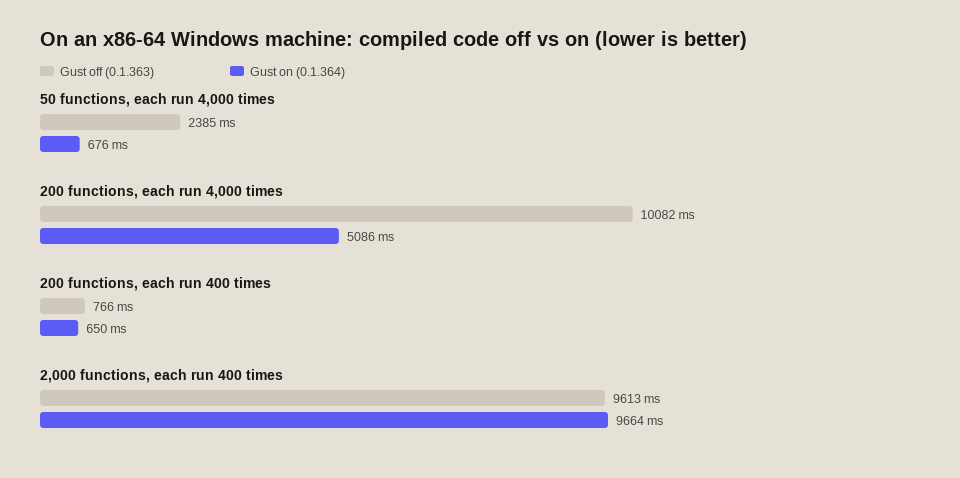
Floati compiles a function to machine code once it has run often enough to pay for the compile. On a large page that is thousands of functions, and past a point their machine code no longer fits the processor's instruction caches: every call then waits on memory, and compiled code ran slower than not compiling at all (1.7 times slower for 2,000 functions run 400 times). Floati now keeps a code-size budget. It estimates how much other code runs between two calls of a function (its reuse distance), and compiles it only while the code would still be in the cache when it comes back. Hot loops and their helpers still compile; code that runs once per pass stays in the fast interpreter. On an ARM64 Mac, 2,000 functions run 400 times went from 3,609 to 2,020 ms in a page, and 1,000 functions from 1,180 to 790 ms, with less memory. With the budget in place, Gust, Floati's fast compiler, is on by default on x86-64 too: on a Windows machine, a set of 50 hot functions went from 2,385 to 676 ms and 200 from 10,082 to 5,086 ms, and large sets are no slower than before. Its x86-64 code is also 40 percent smaller.

3,609 -> 2,020 ms2,000 functions x 400 runs
2,385 -> 676 ms50 hot functions, x86-64
Destacados2

A code-size budget

Page-shaped code in a page on an ARM64 Mac: before, after and the reference engine

A processor runs machine code fastest when it is already in its instruction cache, a few megabytes at most. A compiler that compiles every warm function fills that space on a big page, and the code it made evicts itself: each call reads from memory again. We measured it on generated pages of many small functions run in a shuffled order. With 200 functions compiling won 4 times over; with 2,000 it lost 1.7 times. The budget borrows from how caches themselves are modelled: a piece of code stays cached if the code that runs between two of its uses fits in the cache (its reuse distance). Floati measures that distance for every function as it runs, keeps a running count of compiled bytes, and compiles a function only while it and the code around it fit, about 4 MB on Apple silicon and 2 MB on x86-64, where the caches are smaller. Code that stops being used gives its bytes back. Other engines bound their compiled code too, mostly by flushing code once it has gone cold; Floati decides before compiling, from the reuse it measured.

2,000 functions x 400 runs3,609 -> 2,020 msCompiled code on that pageabout 4 MB, was over 36 MB

Fast compiled code on Windows and Intel machines

Gust off and on, with the code-size budget, on an x86-64 Windows machine

Gust compiles a warm function in under a microsecond per operation. On x86-64 it was off by default because its code was twice the size of the ARM64 code and big pages ran slower with it. The code is now 40 percent smaller (registers held in real x86 registers, short branches, constants shared from a pool, slow paths moved out of line) and the budget keeps it inside the cache, so it is on by default on Windows and Intel machines. Compiled frames on Windows are registered with the system's unwinder, so crash reports and debuggers can walk through them.

50 hot functions, x86-642,385 -> 676 msRelease checks against the reference browser6 of 6 the same

Qué cambió

5 cambios
  1. JavaScript y JITA code-size budget: functions are compiled only while their code still fits the processor's caches.
  2. RenderizadoBig pages: 2,000 functions run 400 times 3,609 -> 2,020 ms, 1,000 functions 1,180 -> 790 ms (ARM64 Mac, in a page).
  3. Memoria y lecturaLess memory on big pages: compiled code capped at about 4 MB instead of growing past 90 MB.
  4. JavaScript y JITGust, the fast compiler, is on by default on x86-64: 50 hot functions 2,385 -> 676 ms on a Windows machine.
  5. JavaScript y JITx86-64 compiled code is 40 percent smaller.

Pruébalo en tu navegador

Cada prueba se ejecuta en vivo en el navegador con el que lees. No se envía nada a ningún sitio.

ComprobarTu navegadorFloati
two thousand distinct functions, each called hot, all answer rightComprobandoSí
a hot set of functions changes halfway and both halves stay correctComprobandoSí
a hot helper with try / catch and for...of returns the same as when coldComprobandoSí
string building through hot helpers keeps every characterComprobandoSí
integer arithmetic in a hot loop wraps exactly at 32 bitsComprobandoSí
a method replaced while hot is the one called afterwardsComprobandoSí
Superadas 6 / 6
Todo desde la v0.1.364 en un solo lugar

Versiones

v0.1.0 - 0.1.9 · 10 Jul 2026418v0.1.427 · 25 Nov 2026

noviembre2026 · 4 versiones

octubre2026 · 7 versiones

septiembre2026 · 10 versiones

agosto2026 · 26 versiones

18218 AgoNow it also spots the audio version of that tracking trickv0.1.182 · Privacidad y Shields 17918 AgoLonger videos now play all the way throughv0.1.179 · Multimedia 17518 AgoThe browser you install now plays video, built entirely from its own codev0.1.175 · Multimedia 17218 AgoSplit-motion video decodes: the VP8 inter path is complete, real WebM streams bit-exactv0.1.172 · Multimedia 17116 AgoThe engine decodes real video: VP8 interframes land, bit-exact against libvpxv0.1.171 · Multimedia 16916 AgoDecoded frames reach the screen: drawImage(VideoFrame) paints real video + animated GIF onto a canvasv0.1.169 · Multimedia 16816 AgoThe engine decodes video: WebCodecs VideoDecoder gets real VP8 keyframe teethv0.1.168 · Multimedia 16715 AgoMore real media formats: FLAC-in-Ogg, an ImageDecoder, and an MSE timelinev0.1.167 · Multimedia 16615 AgoWebCodecs and a real FLAC decoder: the engine decodes audio on its ownv0.1.166 · Multimedia 16115 AgoGPU 3D transforms: every container renders on the devicev0.1.161 · Renderizado 16015 AgoGPU drop-shadow: the CSS filter set is complete on the devicev0.1.160 · API web y DOM 13113 AgoBrotli, from scratch: the engine now speaks the web's best compressionv0.1.131 · Renderizado 12913 AgoVP9 video in fragmented MP4 now actually plays, not just parsesv0.1.129 · Multimedia 12513 AgofMP4 / MP4 streaming: the engine parses the container the web actually servesv0.1.125 · Multimedia 1117 AgoWeb Audio dynamics compression (DynamicsCompressorNode)v0.1.111 · Multimedia 1107 AgoWeb Audio 3D spatial panning (PannerNode) - synthesis surface completev0.1.110 · Multimedia 1097 AgoWeb Audio convolution reverb + stereo sample playbackv0.1.109 · Multimedia 1087 AgoStereo Web Audio: real panning and per-channel routingv0.1.108 · Multimedia 1057 AgoHTTP/2: the modern web transport, from scratchv0.1.105 · Multimedia 1027 AgoModern JS built-ins, and an honest look at where the whole thing stands: 50v0.1.102 · JavaScript y JIT 976 AgoReal captionsv0.1.97 · Renderizado 966 AgoStateful audio DSP: filters, delay and waveshapingv0.1.96 · Multimedia 956 AgoReal, deterministic Web Audio (it used to be a silent stub)v0.1.95 · Multimedia 866 AgoReal cryptographic hashing, and twenty more Web APIs that actually do somethingv0.1.86 · Renderizado 815 AgoBuilding an object stopped re-allocating its keysv0.1.81 · JavaScript y JIT 661 AgoThe worst score on the board turned out to be a cookie bannerv0.1.66 · Renderizado9

julio2026 · 10 versiones





