Toutes les versions v0.1.35514 Oct 2026Rendu, JavaScript et JIT, Mémoire et lecture Flux

Les notes de version sont rédigées en anglais.

A hot loop changes compiler without stopping, property writes skip the detour, and pure recursion remembers its answers

This release builds on Updraft, the compiler Floati wrote for itself. A long loop can now move between the interpreter, Gust and the optimizing compiler in the middle of a run, on one shared frame, so hot code reaches fast code sooner; and because a Gust compile costs about a microsecond per operation, Floati now compiles warm code much earlier, which makes eleven real pages about 1% faster. Compiled code writes object properties itself instead of calling a general helper, one array with a named property no longer slows down every other array on the page, and functions that only compute from their arguments remember the answers they have already worked out.

123 -> 77 msWarm-up runs with 20,000-step loops
25 -> 9.5 nsA function that writes a property, per call
7 -> under 1 ms (reference engine 3 ms)fib(30)
Points forts3

A loop changes compiler without stopping

A hot loop moves from the interpreter to Gust to the optimizing compiler, on one frame

Floati runs new code in its interpreter, compiles warm code with Gust, and moves code that stays hot to its optimizing compiler. Until now a function could only change compiler between calls: a long loop that started in the interpreter, or in Gust, stayed there until it finished. Because all three tiers keep a function's state in the same frame, a loop can now switch at the top of an iteration with nothing to translate: a loop in a function that is still warming up enters Gust there, and once it has run long enough to pay for the bigger compile, Gust hands the same frame to the optimizing compiler at a loop edge. Floati also prices the first compile at what a Gust compile really costs, about a microsecond per operation instead of the hundred the old code generator needed, so warm code is compiled far sooner.

Warm-up runs with 20,000-step loops123 -> 77 msScript time on eleven real pages1.0% lower, no page slower

Property writes without the detour

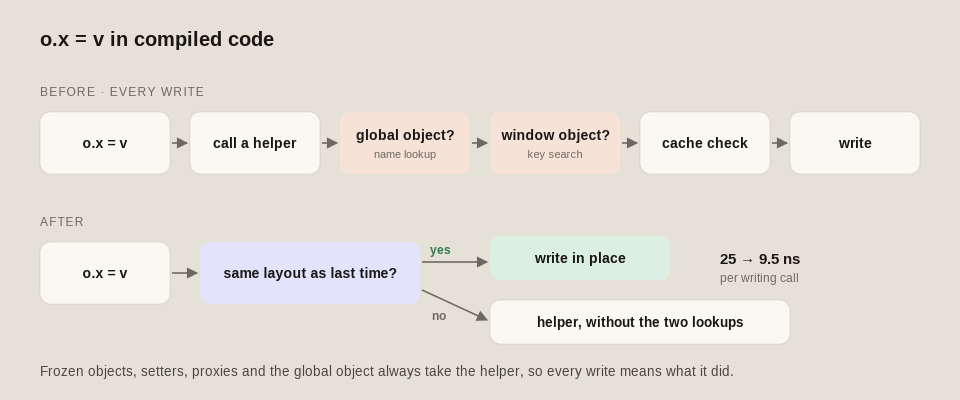
A property write before (six steps) and after (a layout check and a write)

Every o.x = v in compiled code used to call a general helper, and that helper first looked up the global object by name and searched the object for a window marker before it even reached its cache. Compiled code now checks that the object has the layout this write saw last time and writes the value in place. Anything unusual (a frozen or sealed object, a read-only property, a setter, a proxy, the global object) still takes the helper, so every write means exactly what it did, and the helper itself now skips the two lookups. A second slowdown is gone too: as soon as one array anywhere on a page got a named property, as some libraries do, push, pop and the other array methods lost their fast path on every array for the rest of the session. Now only that array is treated differently.

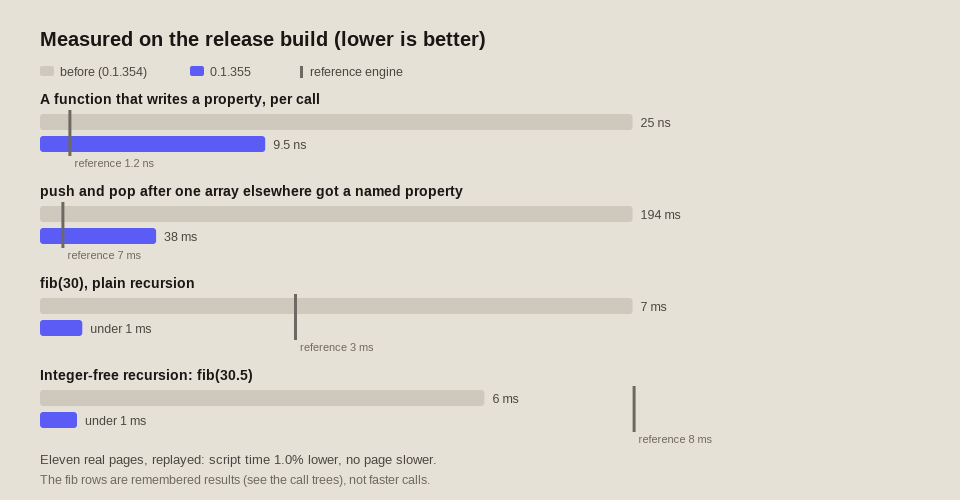
A function that writes a property, per call25 -> 9.5 nspush and pop after one array elsewhere got a named property194 -> 38 ms

Pure recursion remembers its answers

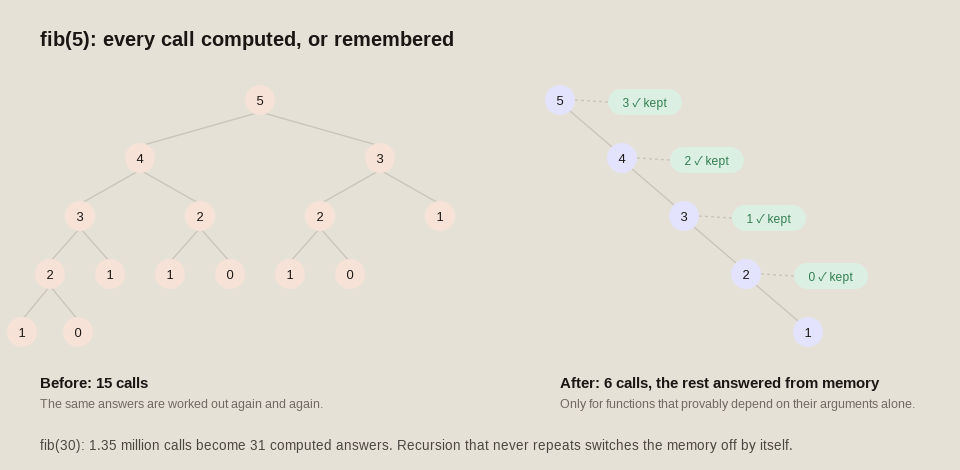
fib(5) without memory: 15 calls; with remembered answers: 6
Before, after and the reference engine for four measurements

Some recursive functions compute their result from their arguments and nothing else: no writes, no objects, no random numbers. Floati's recursion tier can prove that, and for such a function it now remembers each result for the arguments it was computed for, within one run. Asking again for an answer it already has costs a lookup instead of a whole subtree of calls, so a naive fib(30) does 31 computations instead of 1.35 million. The answers are exactly the ones recomputing would give, and the call stack goes as deep as before, so a runaway recursion still stops where it did. The memory resets on every new call into the function, so a value it captures can change between runs, and a recursion that never repeats a call switches the memory off by itself after a few thousand calls. This is a different kind of speed from faster calls: recursion that does not repeat work, such as walking a tree, runs as before.

fib(30)7 -> under 1 ms (reference engine 3 ms)Recursion that never repeats a callunchanged

Ce qui a changé

6 changements
  1. JavaScript et JITA long loop in a function that is still warming up continues in compiled code from the top of the loop, and a hot loop moves on to the optimizing compiler at a loop edge instead of waiting for the next call.
  2. JavaScript et JITThe first compile is priced at what it really costs (about a microsecond per operation), so warm code is compiled much sooner: script time on eleven real pages is 1.0% lower, with no page slower.
  3. JavaScript et JITCompiled code writes an object property in place when the object has the layout the write saw before: a function that writes a property costs 9.5 instead of 25 nanoseconds.
  4. RenduWrites that still need the general path skip two lookups they never needed.
  5. JavaScript et JITGiving one array a named property no longer slows push, pop and other array methods on every other array: 194 -> 38 ms in a test loop.
  6. Mémoire et lectureRecursive functions that compute only from their arguments remember their answers within a run; a recursion that never repeats a call turns this off by itself.

À tester dans votre navigateur

Chaque test tourne en direct dans le navigateur avec lequel vous lisez. Rien n’est envoyé nulle part.


VérifierVotre navigateurFloati
A loop handed between compilers mid-run keeps its stateVérificationOui
A remembered recursive result follows a changed captured valueVérificationOui
A remembered result tells -0 from 0VérificationOui
Math.random is never rememberedVérificationOui
A frozen object refuses a compiled write in strict codeVérificationOui
A setter defined after warm-up runs on a compiled writeVérificationOui
An array that overrides push keeps its own after compileVérificationOui
Réussis 7 / 7
Tout depuis la v0.1.355 au même endroit

Versions

v0.1.0 - 0.1.9 · 10 Jul 2026418v0.1.427 · 25 Nov 2026

novembre2026 · 40 versions

42725 NovLayouts that remember their workPlus récente · v0.1.427 · Rendu9 42625 NovCompiled with what real pages runv0.1.426 · JavaScript et JIT 42525 NovBuilt with whole-program optimizationv0.1.425 · Rendu 42425 NovMore layout reused after a script changes the pagev0.1.424 · Rendu 42324 NovThe optimizing compiler works off the main threadv0.1.423 · Rendu 42222 NovText-reading loops and element-tree builders run fasterv0.1.422 · JavaScript et JIT14 42122 NovCalls from loops run inside the loop's own machine codev0.1.421 · JavaScript et JIT9 42021 NovPages you come back to run their scripts soonerv0.1.420 · Rendu17 41918 NovA faster interpreter runs the page's codev0.1.419 · JavaScript et JIT12 41815 NovScripts run faster on busy pagesv0.1.418 · JavaScript et JIT34 41711 NovPages wait less for their own scripts and stylesv0.1.417 · JavaScript et JIT13 41611 NovWebGPU loops run 2 to 3 times faster on Macsv0.1.416 · JavaScript et JIT 41510 NovWebGPU loops count right on Macsv0.1.415 · JavaScript et JIT 41410 NovWebGPU runs in its own graphics processv0.1.414 · Rendu 41310 NovA graphics card reset no longer takes the browser downv0.1.413 · Rendu 4129 NovVideo moves to the graphics cardv0.1.412 · Médias 4119 NovNo canvas stall on Windows, patterns and every blend mode on the graphics cardv0.1.411 · Rendu 4109 NovCanvas drawing moves to the graphics cardv0.1.410 · Rendu27 4098 NovEvery tile on the GPUv0.1.409 · Rendu26 4088 Nov3D at 120 frames a secondv0.1.408 · Rendu23 4077 NovWebGL 2v0.1.407 · Rendu36 4066 NovA stuck tab stops at oncev0.1.406 · Rendu16 4055 NovSmall WebGL drawings get smooth edgesv0.1.405 · Rendu 4045 NovWebGL pages finally movev0.1.404 · Rendu25 4035 NovWebGPU is herev0.1.403 · Rendu35 4024 NovA canvas that moves itself to the GPUv0.1.402 · Rendu 4014 Nov99% of real pages decided by the GPUv0.1.401 · Rendu9 4004 NovSmooth turns, the same bytes on every chip, and fields that keep their textv0.1.400 · Rendu15 3994 NovAnimations on the GPU compositor, and text that stays in its boxv0.1.399 · Rendu22 3984 NovGradient patterns that tile, animations that keep up, and a much faster canvasv0.1.398 · Rendu14 3973 NovTransitions that ease, and a GPU that draws 94% of real pages itselfv0.1.397 · Rendu 3963 NovAnimations on the GPU compositor, and spinners that spin as arcsv0.1.396 · Rendu 3953 NovCarousels that fade, badges that stay put, and floats that stay insidev0.1.395 · Rendu12 3943 NovBackground images over their colour, interlaced pictures, and borders in every colourv0.1.394 · Rendu 3932 NovStyle sheets in page order, and symbols that fall back like macOSv0.1.393 · Rendu 3922 NovIcon fonts loaded by script, and colour emoji on Windowsv0.1.392 · Onglets et interface 3911 NovEmoji in colour, sized as in the reference browserv0.1.391 · JavaScript et JIT 3901 NovA classified ads site's front page: blank before, whole nowv0.1.390 · JavaScript et JIT12 3891 NovA computer maker's home page: navigation labels back, buttons apartv0.1.389 · Rendu 3881 NovA space agency's home page, a news section and a language site's header now match the referencev0.1.388 · Rendu18

octobre2026 · 58 versions

Afficher 57 de plus
septembre2026124 versions août2026140 versions juillet202656 versions