Tutte le versioni v0.1.3478 Ott 2026Rendering, JavaScript e JIT, API web e DOM, Schede e interfaccia Feed

Le note di rilascio sono scritte in inglese.

Cards inside links, small print at its real size, and errors you can follow

Pages lay out more like the reference browser: a card inside a link stays a card, a block in the middle of a sentence splits the sentence around it, small print keeps its own line height, and fonts a script names after the page loads get their real faces. Errors read like the reference browser's: JSON messages say what was expected and where, and stack traces carry on through callbacks with the column of each call. Throwing and catching an error now costs far less, JSON reads long text up to five times faster, page transitions follow the standard, and the window is an event target of its own.

28% cheaper than beforeErrors 12 callbacks deep
77 of 77Messages equal to the reference browser
In evidenza5

Cards inside links, blocks inside sentences
PrimaDopo
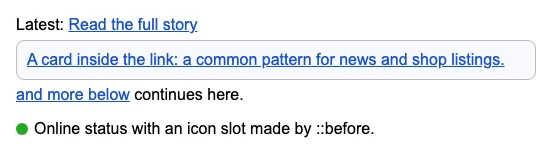
Prima: a card inside a link, and a status dot made by ::before
Prima
Dopo: a card inside a link, and a status dot made by ::before
Dopo · v0.1.347
La stessa pagina nel browser di riferimento
Browser di riferimento

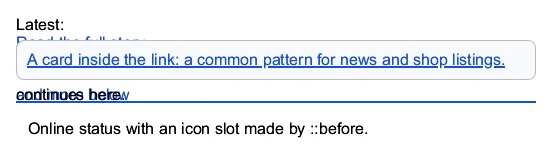
A link or span holding a block (a card in a news or shop listing, a box in the middle of a sentence) used to turn the whole thing into one block: the text before the card was painted underneath it, and the text after it lost its line. Inline content is now split around the block the way the standard describes, the link keeps its underline on every piece, and icon slots and status dots made with ::before draw again.

a card inside a link, and a status dot made by ::before

Small print at its real line height
PrimaDopo
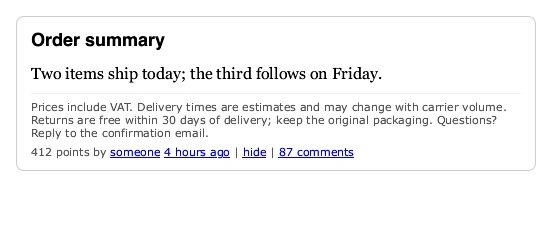
Prima: an order card with its small print and a byline
Prima
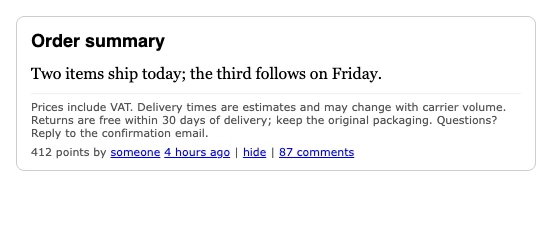
Dopo: an order card with its small print and a byline
Dopo · v0.1.347
La stessa pagina nel browser di riferimento
Browser di riferimento

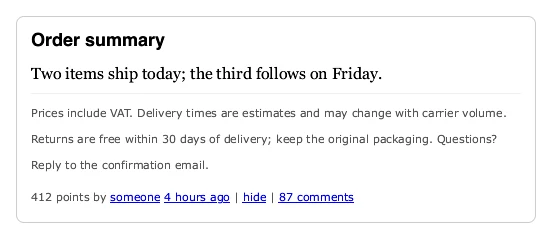
Setting a small font with the font shorthand (font: 11px Verdana) left the line height of the text around it in place, so footnotes, bylines and price notes were spread out over twice the lines they should take. The shorthand now resets the line height, as the standard says. Empty placeholders, such as anchors a page links to, now have a position on their line, and a space beside one no longer doubles.

an order card with its small print and a byline

Fonts that scripts name, with their real faces
PrimaDopo
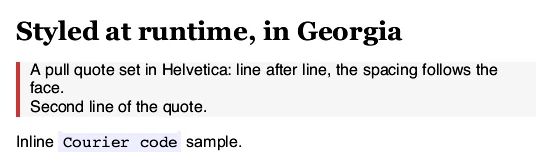
Prima: a heading, a pull quote and code styled from script
Prima
Dopo: a heading, a pull quote and code styled from script
Dopo · v0.1.347
La stessa pagina nel browser di riferimento
Browser di riferimento

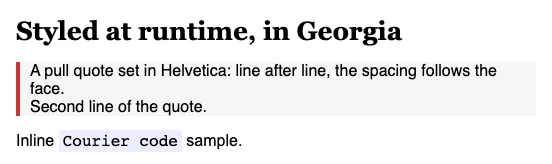
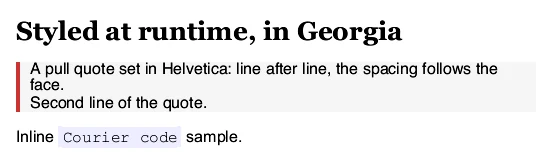
Sites that style themselves from script (a common way to build pages today) name their fonts after the page has loaded. Those families now load their real faces instead of a fallback, and classic faces such as Helvetica, Times and Courier get the same line spacing as in the reference browser.

a heading, a pull quote and code styled from script

Stack traces you can follow
PrimaDopo
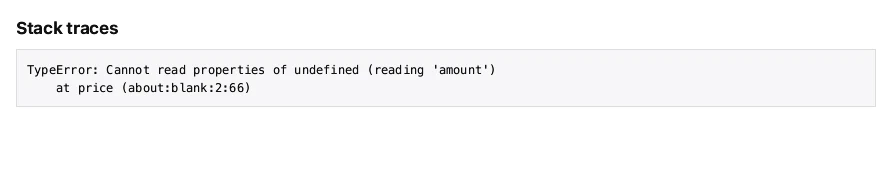
Prima: a TypeError thrown inside a map callback
Prima
Dopo: a TypeError thrown inside a map callback
Dopo · v0.1.347
La stessa pagina nel browser di riferimento
Browser di riferimento

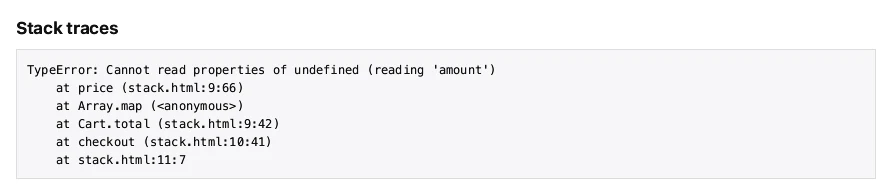
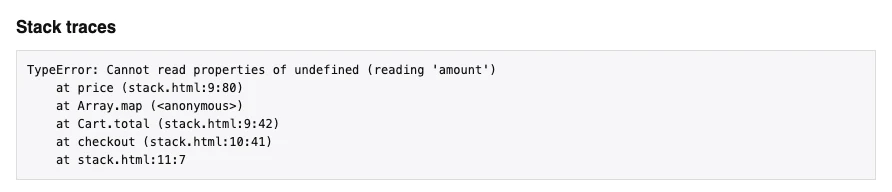
An error thrown inside a callback, such as one run by map or forEach, used to show only the callback: everything that called it was lost. Stack traces now carry on through the built-in that ran it (at Array.map), name each frame the way the reference browser does (Cart.total), and point at the column of each call. The trace is only put together when a page reads it, so a page that throws and catches errors in a loop no longer pays for traces it never looks at.

a TypeError thrown inside a map callback

Errors 12 callbacks deep28% cheaper than beforeFrames kept10, as in the reference browser

JSON errors that say what went wrong
PrimaDopo
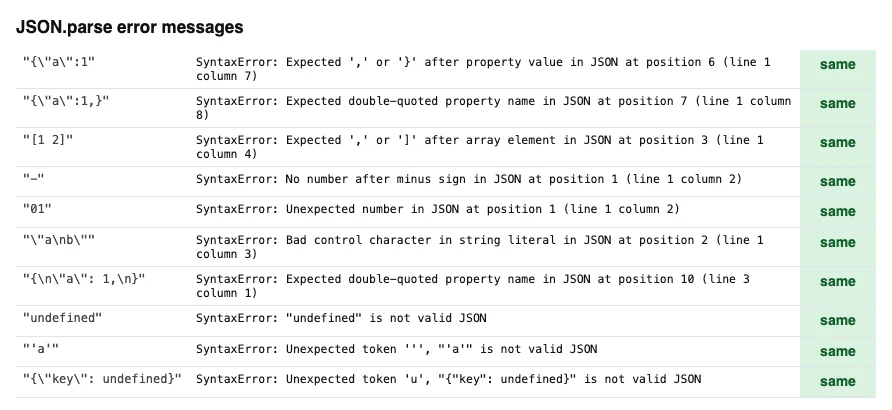
Prima: ten invalid JSON texts and their messages
Prima
Dopo: ten invalid JSON texts and their messages
Dopo · v0.1.347
La stessa pagina nel browser di riferimento
Browser di riferimento

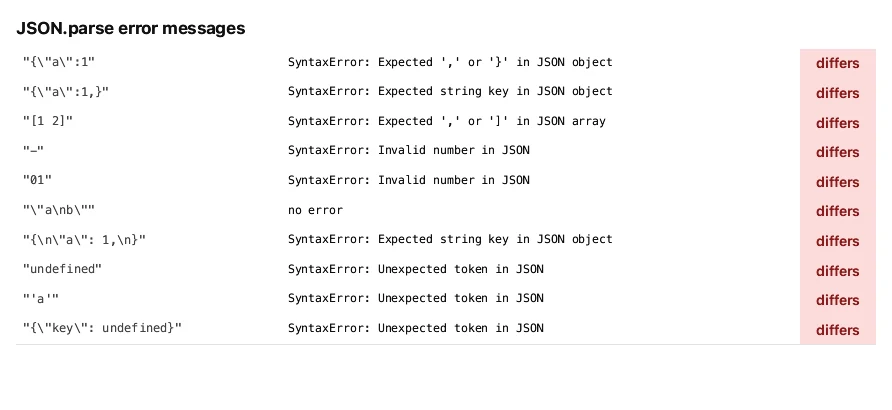
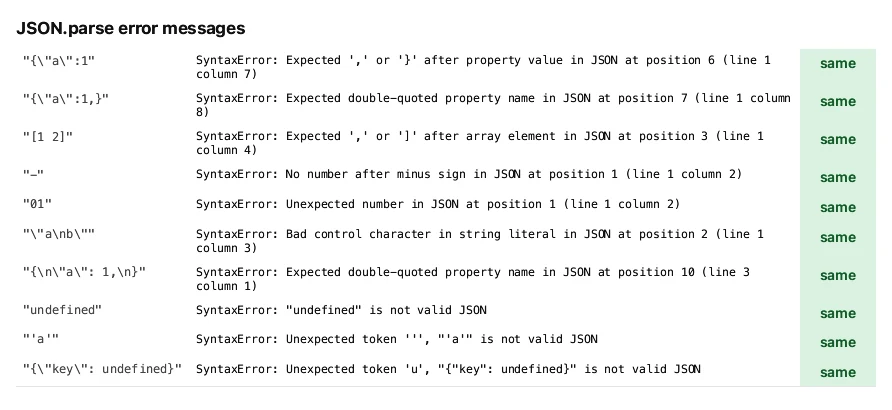
When text is not valid JSON, the error now says what was expected and where, with the line and column, or quotes the part of the text around the problem, word for word as the reference browser does. Finding that out no longer costs more for longer text, and long strings inside JSON are read up to five times faster.

ten invalid JSON texts and their messages

Messages equal to the reference browser77 of 771 MB string270 -> 52 microseconds

Cosa è cambiato

17 modifiche
  1. RenderingA block inside a link or span splits the line around it as the standard describes, keeping the link's underline on every piece; generated ::before and ::after boxes count toward their element's size, and inline-block ones (icon slots, status dots, badges) draw.
  2. RenderingThe font shorthand resets the line height when it does not name one, so small print and bylines are as tight as in the reference browser.
  3. RenderingEmpty inline elements (anchors, placeholders) have a position on their line, so scrolling to an anchor and measuring one work; a space beside one no longer doubles.
  4. RenderingFonts named by a script after the page loads get their real faces; Helvetica, Times and Courier get the reference browser's line spacing; Times New Roman and Courier New use their own files.
  5. RenderingA page that shows its own CSS (a style element set to display: block) shows it, and head, title, script and the other metadata elements compute display: none.
  6. Schede e interfacciaTables and their parts get their table display values from the browser's own style sheet, and menu, dir, hgroup and search are blocks, so pages that read these styles get the reference browser's answers.
  7. JavaScript e JITStack traces continue through callbacks run by built-ins, name frames by their receiver (Cart.total, Array.map), point at the column of each call, and stop at ten frames as in the reference browser. They are built only when read, and the frames of a repeated error are formatted once.
  8. JavaScript e JITJSON.parse errors are worded as the reference browser words them, with the position, line and column or a quote of the text around the problem. JSON.parse and JSON.stringify call revivers and replacers in exactly the order the standard gives.
  9. JavaScript e JITJSON reads long strings up to five times faster, and an error at the end of a long text costs no more than the parse itself.
  10. JavaScript e JITPage transitions (startViewTransition): a real ViewTransition with its promises in order, skipping, transition types, waitUntil and element-scoped transitions. They finish instantly, as with reduced motion.
  11. API web e DOMThe window is its own event target: window and document listeners are separate, events reach the window after the document (never for load), and window.onclick and document.onclick are separate handlers.
  12. JavaScript e JITResponse objects are real: status checks, clone, Response.error, Response.json and Response.redirect, and fetch returns one. Request objects resolve their address, carry a signal and can be passed to fetch.
  13. API web e DOMElement attributes, form validity, custom element upgrades, Set and Map iteration, childNodes and children are live, as the standard says; editing an attribute node changes the element.
  14. API web e DOMUncaught errors fire the window's error event and window.onerror, including errors thrown in timers, listeners and microtasks.
  15. JavaScript e JITA loop over a Set or a Map runs about 2.6 times faster, and restyling after a change on a large news page touches only what the change can reach instead of the whole page.
  16. RenderingInserting or removing a positioned box (a tooltip, an overlay) no longer lays out the whole page again before the next measurement.
  17. API web e DOMThe measured Web APIs score rose from 51.2 to 52.8, counted over the whole platform surface against the reference browser, and all 12 test sites still run with no script error the reference browser does not also show.

Prova nel tuo browser

Ogni test gira dal vivo nel browser con cui stai leggendo. Non viene inviato nulla.

VerificaIl tuo browserFloati
JSON errors name what was expectedVerifica in corsoSì
Stacks are built when read, ten frames deepVerifica in corsoSì
Stacks carry on through callbacksVerifica in corsoSì
Page transitions are realVerifica in corsoSì
The window hears its own eventsVerifica in corsoSì
Table cells compute as table cellsVerifica in corsoSì
Superati 6 / 6
Tutto dalla v0.1.347 in un unico posto

Versioni

v0.1.0 - 0.1.9 · 10 Lug 2026418v0.1.427 · 25 Nov 2026

Ottobre2026 · 33 versioni

37121 OttDrop files onto pages, dictate without your voice leaving the Mac, and controllers that rumblev0.1.371 · API web e DOM · provalo 37021 OttOpen your files, share to your phone, have pages read aloud, install sites as apps, play with a controller, and accented text drawn rightv0.1.370 · Privacy e Shields · provalo11 36920 OttPasskeys with Touch ID and Windows Hello, sites that work offline, notifications you allow, and devices asked for first, all kept on your devicev0.1.369 · Privacy e Shields · provalo9 36820 OttA site's own security rules are kept the whole time the page runs, Trusted Types, a map of every unsafe write in DevTools, and animations from scriptv0.1.368 · Privacy e Shields · provalo 36720 OttEvents, form controls, performance timing, URL patterns, live streams and the newest JavaScript: the Web APIs score rises from 59 to 62v0.1.367 · API web e DOM · provalo10 36619 OttEvents, custom form controls, fonts and navigation work the way the web standards say: the Web APIs score rises from 53 to 59v0.1.366 · API web e DOM · provalo9 36519 OttThe code-size budget fits your processor, and code that has gone cold makes room for code that is hot nowv0.1.365 · JavaScript e JIT · provalo 36419 OttCompiled code that fits the processor's caches: big pages up to 1.8 times faster, and fast compiled code on Windows and Intel machinesv0.1.364 · JavaScript e JIT · provalo 36319 OttThermal runs on one code generator, building strings is up to 8 times faster, and two slow paths that grew with the square of their input are linearv0.1.363 · JavaScript e JIT · provalo12 36219 OttA page scheduler that stalled now runs, try / finally and spreads compile, and deleting thousands of properties is 180 times fasterv0.1.362 · Rendering · provalo 36118 OttThermal runs on Windows and Intel machines, a register fix for compiled code on Windows, try / catch compiles, and reading a growing string is 200 times fasterv0.1.361 · JavaScript e JIT · provalo 36018 OttEvery byte of machine code is Floati's own, a news site that showed blank renders, Gust's code is half the size, and closures and ?? compilev0.1.360 · JavaScript e JIT · provalo9 35916 OttThermal reads object members and folds Math, string building compiles, and methods, Array subclasses and globals behave as the standard saysv0.1.359 · JavaScript e JIT · provalo 35816 OttThermal, Floati's own optimizing compiler, is on: hot loops keep their numbers and strings in registersv0.1.358 · JavaScript e JIT · provalo 35715 OttLoops that test a number run as machine code, more of your functions compile, and reading page nodes is three times fasterv0.1.357 · JavaScript e JIT · provalo14 35614 OttRecursion makes a fraction of the calls, loops keep objects in registers, and element writes stop searchingv0.1.356 · JavaScript e JIT · provalo 35514 OttA hot loop changes compiler without stopping, property writes skip the detour, and pure recursion remembers its answersv0.1.355 · JavaScript e JIT · provalo 35413 OttFloati compiles JavaScript with its own compiler, Updraft: about a hundred times faster to compile, and compiled code no longer piles upv0.1.354 · JavaScript e JIT · provalo 35311 OttStyle matching tries a third of the rules, queries prepare their selector once, sibling walks stay fastv0.1.353 · Rendering · provalo 35211 OttCode that loads on demand starts at once, images decode beside their downloads, writes run compiledv0.1.352 · Rendering · provalo10 35111 OttStyles read once, layouts redone only where they changed, built-ins in compiled loopsv0.1.351 · JavaScript e JIT · provalo12 35010 OttHelpers that compile, strings that stay small, and events that fire fastv0.1.350 · JavaScript e JIT · provalo14 34910 OttScripts that grow in step with their work, layouts laid out once, and colours mixed like the referencev0.1.349 · Rendering · provalo13 3489 OttScripts that only compile when it pays, cards that line up, and bold that stays boldv0.1.348 · Rendering · provalo14 3478 OttCards inside links, small print at its real size, and errors you can followv0.1.347 · Rendering · provalo17 3467 OttA real performance timeline, site icons from the engine with a lookalike check, and forms that lay out rightv0.1.346 · Rendering · provalo14 3457 OttReal WebGL, a real 2D canvas, and canvas text that matches the reference browserv0.1.345 · Rendering · provalo10 3436 OttSign-ins that stay signed in, a real IndexedDB, and a storage button that shows what sites keepv0.1.343 · Privacy e Shields · provalo25 3425 OttTheme switchers, chart labels sized by CSS, and SVG text you can measurev0.1.342 · API web e DOM · provalo 3415 OttCanvas text measured and drawn like the reference browser, and SVG shapes you can measurev0.1.341 · Rendering · provalo 3405 OttScripts can read and change SVG the way they do in the reference browser, and a hidden hang is gonev0.1.340 · Rendering · provalo10 3395 OttEvery computed style, real stylesheet objects and full 3D geometry, each checked against the reference browserv0.1.339 · API web e DOM · provalo12 3385 OttPages load faster, render truer and gain a dozen modern web features, each one checked against the reference browserv0.1.338 · API web e DOM · provalo19