Tutte le versioni v0.1.35514 Ott 2026Rendering, JavaScript e JIT, Memoria e lettura Feed

Le note di rilascio sono scritte in inglese.

A hot loop changes compiler without stopping, property writes skip the detour, and pure recursion remembers its answers

This release builds on Updraft, the compiler Floati wrote for itself. A long loop can now move between the interpreter, Gust and the optimizing compiler in the middle of a run, on one shared frame, so hot code reaches fast code sooner; and because a Gust compile costs about a microsecond per operation, Floati now compiles warm code much earlier, which makes eleven real pages about 1% faster. Compiled code writes object properties itself instead of calling a general helper, one array with a named property no longer slows down every other array on the page, and functions that only compute from their arguments remember the answers they have already worked out.

123 -> 77 msWarm-up runs with 20,000-step loops
25 -> 9.5 nsA function that writes a property, per call
7 -> under 1 ms (reference engine 3 ms)fib(30)
In evidenza3

A loop changes compiler without stopping

A hot loop moves from the interpreter to Gust to the optimizing compiler, on one frame

Floati runs new code in its interpreter, compiles warm code with Gust, and moves code that stays hot to its optimizing compiler. Until now a function could only change compiler between calls: a long loop that started in the interpreter, or in Gust, stayed there until it finished. Because all three tiers keep a function's state in the same frame, a loop can now switch at the top of an iteration with nothing to translate: a loop in a function that is still warming up enters Gust there, and once it has run long enough to pay for the bigger compile, Gust hands the same frame to the optimizing compiler at a loop edge. Floati also prices the first compile at what a Gust compile really costs, about a microsecond per operation instead of the hundred the old code generator needed, so warm code is compiled far sooner.

Warm-up runs with 20,000-step loops123 -> 77 msScript time on eleven real pages1.0% lower, no page slower

Property writes without the detour

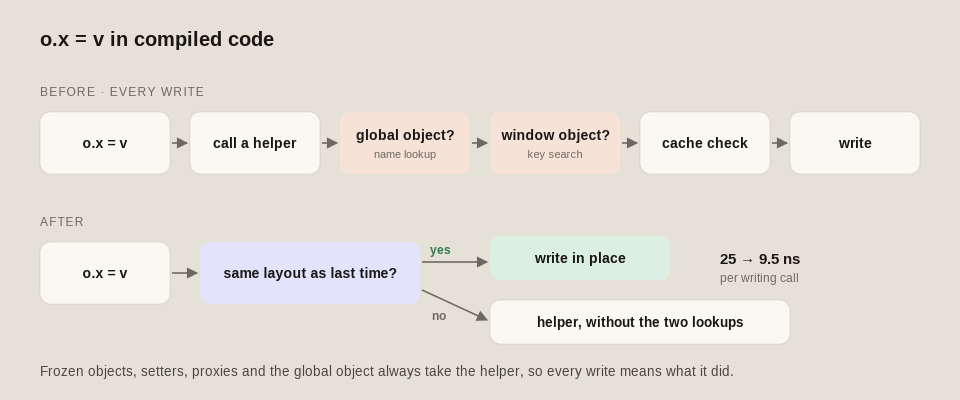
A property write before (six steps) and after (a layout check and a write)

Every o.x = v in compiled code used to call a general helper, and that helper first looked up the global object by name and searched the object for a window marker before it even reached its cache. Compiled code now checks that the object has the layout this write saw last time and writes the value in place. Anything unusual (a frozen or sealed object, a read-only property, a setter, a proxy, the global object) still takes the helper, so every write means exactly what it did, and the helper itself now skips the two lookups. A second slowdown is gone too: as soon as one array anywhere on a page got a named property, as some libraries do, push, pop and the other array methods lost their fast path on every array for the rest of the session. Now only that array is treated differently.

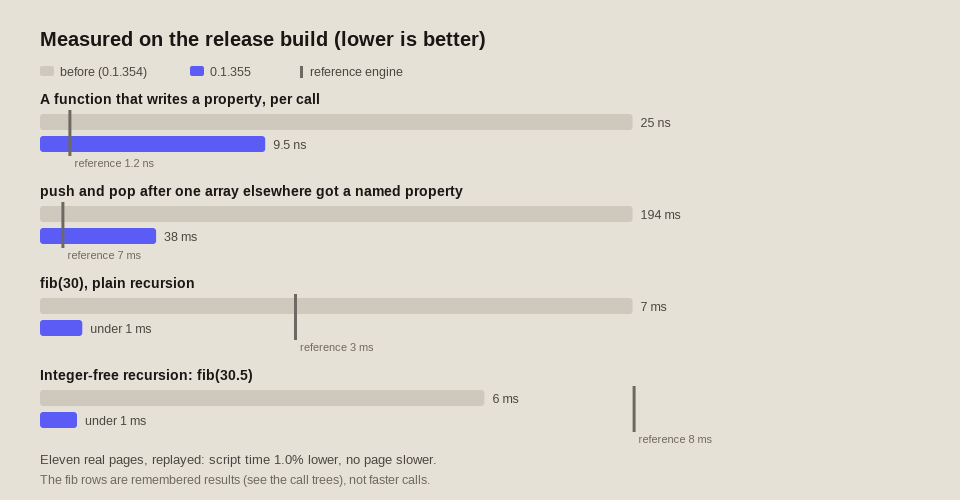
A function that writes a property, per call25 -> 9.5 nspush and pop after one array elsewhere got a named property194 -> 38 ms

Pure recursion remembers its answers

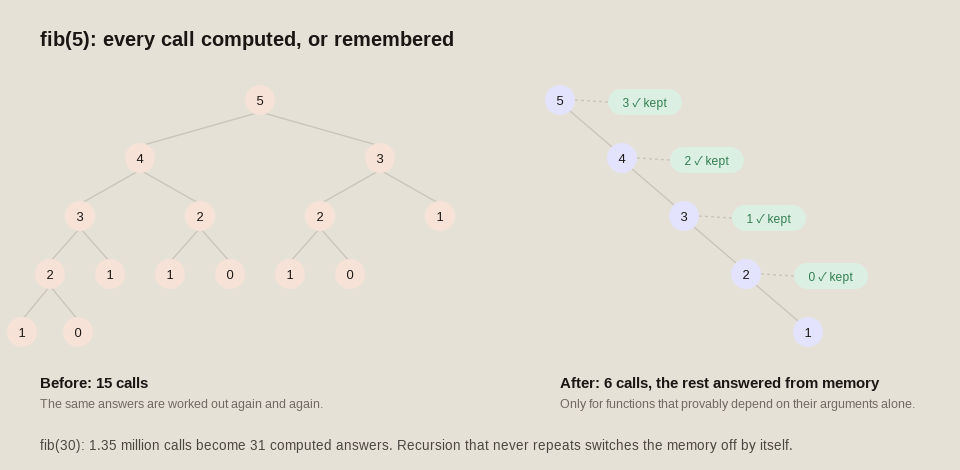
fib(5) without memory: 15 calls; with remembered answers: 6
Before, after and the reference engine for four measurements

Some recursive functions compute their result from their arguments and nothing else: no writes, no objects, no random numbers. Floati's recursion tier can prove that, and for such a function it now remembers each result for the arguments it was computed for, within one run. Asking again for an answer it already has costs a lookup instead of a whole subtree of calls, so a naive fib(30) does 31 computations instead of 1.35 million. The answers are exactly the ones recomputing would give, and the call stack goes as deep as before, so a runaway recursion still stops where it did. The memory resets on every new call into the function, so a value it captures can change between runs, and a recursion that never repeats a call switches the memory off by itself after a few thousand calls. This is a different kind of speed from faster calls: recursion that does not repeat work, such as walking a tree, runs as before.

fib(30)7 -> under 1 ms (reference engine 3 ms)Recursion that never repeats a callunchanged

Cosa è cambiato

6 modifiche
  1. JavaScript e JITA long loop in a function that is still warming up continues in compiled code from the top of the loop, and a hot loop moves on to the optimizing compiler at a loop edge instead of waiting for the next call.
  2. JavaScript e JITThe first compile is priced at what it really costs (about a microsecond per operation), so warm code is compiled much sooner: script time on eleven real pages is 1.0% lower, with no page slower.
  3. JavaScript e JITCompiled code writes an object property in place when the object has the layout the write saw before: a function that writes a property costs 9.5 instead of 25 nanoseconds.
  4. RenderingWrites that still need the general path skip two lookups they never needed.
  5. JavaScript e JITGiving one array a named property no longer slows push, pop and other array methods on every other array: 194 -> 38 ms in a test loop.
  6. Memoria e letturaRecursive functions that compute only from their arguments remember their answers within a run; a recursion that never repeats a call turns this off by itself.

Prova nel tuo browser

Ogni test gira dal vivo nel browser con cui stai leggendo. Non viene inviato nulla.

VerificaIl tuo browserFloati
A loop handed between compilers mid-run keeps its stateVerifica in corsoSì
A remembered recursive result follows a changed captured valueVerifica in corsoSì
A remembered result tells -0 from 0Verifica in corsoSì
Math.random is never rememberedVerifica in corsoSì
A frozen object refuses a compiled write in strict codeVerifica in corsoSì
A setter defined after warm-up runs on a compiled writeVerifica in corsoSì
An array that overrides push keeps its own after compileVerifica in corsoSì
Superati 7 / 7
Tutto dalla v0.1.355 in un unico posto

Versioni

v0.1.0 - 0.1.9 · 10 Lug 2026418v0.1.427 · 25 Nov 2026

Novembre2026 · 40 versioni

42725 NovLayouts that remember their workPiù recente · v0.1.427 · Rendering9 42625 NovCompiled with what real pages runv0.1.426 · JavaScript e JIT 42525 NovBuilt with whole-program optimizationv0.1.425 · Rendering 42425 NovMore layout reused after a script changes the pagev0.1.424 · Rendering 42324 NovThe optimizing compiler works off the main threadv0.1.423 · Rendering 42222 NovText-reading loops and element-tree builders run fasterv0.1.422 · JavaScript e JIT14 42122 NovCalls from loops run inside the loop's own machine codev0.1.421 · JavaScript e JIT9 42021 NovPages you come back to run their scripts soonerv0.1.420 · Rendering17 41918 NovA faster interpreter runs the page's codev0.1.419 · JavaScript e JIT12 41815 NovScripts run faster on busy pagesv0.1.418 · JavaScript e JIT34 41711 NovPages wait less for their own scripts and stylesv0.1.417 · JavaScript e JIT13 41611 NovWebGPU loops run 2 to 3 times faster on Macsv0.1.416 · JavaScript e JIT 41510 NovWebGPU loops count right on Macsv0.1.415 · JavaScript e JIT 41410 NovWebGPU runs in its own graphics processv0.1.414 · Rendering 41310 NovA graphics card reset no longer takes the browser downv0.1.413 · Rendering 4129 NovVideo moves to the graphics cardv0.1.412 · Media 4119 NovNo canvas stall on Windows, patterns and every blend mode on the graphics cardv0.1.411 · Rendering 4109 NovCanvas drawing moves to the graphics cardv0.1.410 · Rendering27 4098 NovEvery tile on the GPUv0.1.409 · Rendering26 4088 Nov3D at 120 frames a secondv0.1.408 · Rendering23 4077 NovWebGL 2v0.1.407 · Rendering36 4066 NovA stuck tab stops at oncev0.1.406 · Rendering16 4055 NovSmall WebGL drawings get smooth edgesv0.1.405 · Rendering 4045 NovWebGL pages finally movev0.1.404 · Rendering25 4035 NovWebGPU is herev0.1.403 · Rendering35 4024 NovA canvas that moves itself to the GPUv0.1.402 · Rendering 4014 Nov99% of real pages decided by the GPUv0.1.401 · Rendering9 4004 NovSmooth turns, the same bytes on every chip, and fields that keep their textv0.1.400 · Rendering15 3994 NovAnimations on the GPU compositor, and text that stays in its boxv0.1.399 · Rendering22 3984 NovGradient patterns that tile, animations that keep up, and a much faster canvasv0.1.398 · Rendering14 3973 NovTransitions that ease, and a GPU that draws 94% of real pages itselfv0.1.397 · Rendering 3963 NovAnimations on the GPU compositor, and spinners that spin as arcsv0.1.396 · Rendering 3953 NovCarousels that fade, badges that stay put, and floats that stay insidev0.1.395 · Rendering12 3943 NovBackground images over their colour, interlaced pictures, and borders in every colourv0.1.394 · Rendering 3932 NovStyle sheets in page order, and symbols that fall back like macOSv0.1.393 · Rendering 3922 NovIcon fonts loaded by script, and colour emoji on Windowsv0.1.392 · Schede e interfaccia 3911 NovEmoji in colour, sized as in the reference browserv0.1.391 · JavaScript e JIT 3901 NovA classified ads site's front page: blank before, whole nowv0.1.390 · JavaScript e JIT12 3891 NovA computer maker's home page: navigation labels back, buttons apartv0.1.389 · Rendering 3881 NovA space agency's home page, a news section and a language site's header now match the referencev0.1.388 · Rendering18

Ottobre2026 · 58 versioni

Mostra altre 57
Settembre2026124 versioni Agosto2026140 versioni

Luglio2026 · 56 versioni

6531 LugWe started grading the engine on real websites, and five things broke immediatelyv0.1.65 · Rendering 6431 LugAn ad and tracker blocker built into the engine, not bolted onto itv0.1.64 · Privacy e Shields 6331 LugFour real sites stopped breaking, and the engine learned to explain itselfv0.1.63 · Rendering 6230 LugScripts get much faster, and two of the speed-ups turned out to be switched offv0.1.62 · JavaScript e JIT13 6130 LugTwenty rendering fixes found by scoring every test page against the reference browserv0.1.61 · Rendering20 6030 LugText that measures like the reference browser, an accessibility tree, web security, and animationsv0.1.60 · Rendering11 5825 LugRounded outlines, disclosure widgets, and a border reset fixv0.1.58 · Rendering 5725 LugForm fieldsets render their legend properlyv0.1.57 · Rendering 5624 LugData tables and dropdowns render rightv0.1.56 · Rendering 5524 LugRounder corners, fixed card grids, numbered lists, decorated underlinesv0.1.55 · Rendering 5424 LugReal 3D transforms, and the modern web renders faithfullyv0.1.54 · Rendering 5323 LugLayout is essentially complete, and modern visual styling arrivesv0.1.53 · Rendering 5223 LugFloati now reads HTML and CSS selectors exactly like the reference browserv0.1.52 · Rendering 5123 LugRendering a real page with Floati's own engine no longer hangsv0.1.51 · Media 5023 LugYou can see when Floati is drawing the page itselfv0.1.50 · JavaScript e JIT 4923 LugSites you click start responding, and the web lays out like the reference browserv0.1.49 · Rendering15 4822 LugText breathes like the reference browser, and the old web settles into placev0.1.48 · Rendering9 4722 LugCards, columns and grids stop landing on top of each otherv0.1.47 · Rendering 4622 LugPages sit where they should on the screenv0.1.46 · Rendering 4522 LugThe websites that used to come out broken now come out rightv0.1.45 · Rendering10 4421 LugA large encyclopedia works properly, and icons stop coming out as blobsv0.1.44 · Rendering 4321 LugThe heavy pages get another three to six times fasterv0.1.43 · Rendering 4221 LugReal pages render three to twelve times fasterv0.1.42 · Rendering 4121 LugPages lay out faster, and even more JavaScript becomes machine codev0.1.41 · JavaScript e JIT 4021 LugJavaScript now runs in machine codev0.1.40 · JavaScript e JIT 3921 LugSecond windows work, and loops with real helpers get compiledv0.1.39 · Schede e interfaccia 3820 LugLoops that call a helper get compiledv0.1.38 · JavaScript e JIT 3720 LugText-scanning loops get much fasterv0.1.37 · JavaScript e JIT 3620 LugFaster field reads, and loops over binary datav0.1.36 · API web e DOM 3520 LugLoops over objects get compiledv0.1.35 · JavaScript e JIT 3420 LugThe everyday array loop gets compiledv0.1.34 · JavaScript e JIT 3319 LugMath in loops gets compiledv0.1.33 · JavaScript e JIT 3219 LugBit-twiddling loops get compiledv0.1.32 · Rendering 3119 LugFaster loops over listsv0.1.31 · JavaScript e JIT 3019 LugHot loops get compiledv0.1.30 · JavaScript e JIT 2919 LugFaster JavaScriptv0.1.29 · JavaScript e JIT 2819 LugMore of the modern web lays out rightv0.1.28 · Rendering 2719 LugPages that lay out the way they shouldv0.1.27 · Rendering 2618 LugHighlight what you read, and find it againv0.1.26 · Memoria e lettura 2518 LugColumns line up, and Floati reads more closelyv0.1.25 · Rendering 2418 LugFormulas at the right sizev0.1.24 · Rendering 2318 LugMath formulas, and pages that refused to loadv0.1.23 · Rendering 2218 LugNavigation bars get their spacing backv0.1.22 · Rendering 2118 LugPrint sheets stay on paper, navs stop gluingv0.1.21 · Rendering 2017 LugThe whole font familyv0.1.20 · Rendering 1917 LugTypography and icons, pixel for pixelv0.1.19 · Rendering 1817 LugReal fonts, real picturesv0.1.18 · Rendering 1717 LugEngine pages become real tabsv0.1.17 · Schede e interfaccia 1617 LugSix times faster, and jQuery worksv0.1.16 · API web e DOM 1516 LugReal sites render rightv0.1.15 · Rendering 1415 LugVideo plays on our own enginev0.1.14 · Media 1315 LugTabs that know each otherv0.1.13 · Schede e interfaccia 1214 LugThe engine starts taking overv0.1.12 · Rendering 1112 LugPick your engine per sitev0.1.11 · Rendering 1012 LugYour browsing, remembered locallyv0.1.10 · Memoria e lettura 0-910 LugFirst public releasesv0.1.0 - 0.1.9 · Memoria e lettura