Tutte le versioni v0.1.35614 Ott 2026JavaScript e JIT, Memoria e lettura, Schede e interfaccia Feed

Le note di rilascio sono scritte in inglese.

Recursion makes a fraction of the calls, loops keep objects in registers, and element writes stop searching

This release makes three kinds of everyday JavaScript faster. Recursive functions now answer their simplest cases where they are called and run every other level inside their parent, so walking a tree makes a fraction of the calls, and recursion whose last step returns a property now compiles at all. Long loops that walk a list, keep the best object seen so far, copy objects, compare them or ask typeof now run in Floati's fastest loop tier, 20 to 40 times faster than before. Setting a property on page elements no longer searches every element prototype each time, so building elements is almost three times faster, and a getter a page puts on an element prototype now answers reads as it does in the reference browser. One crash is fixed: freeing a long linked list made inside a function no longer overflows the stack.

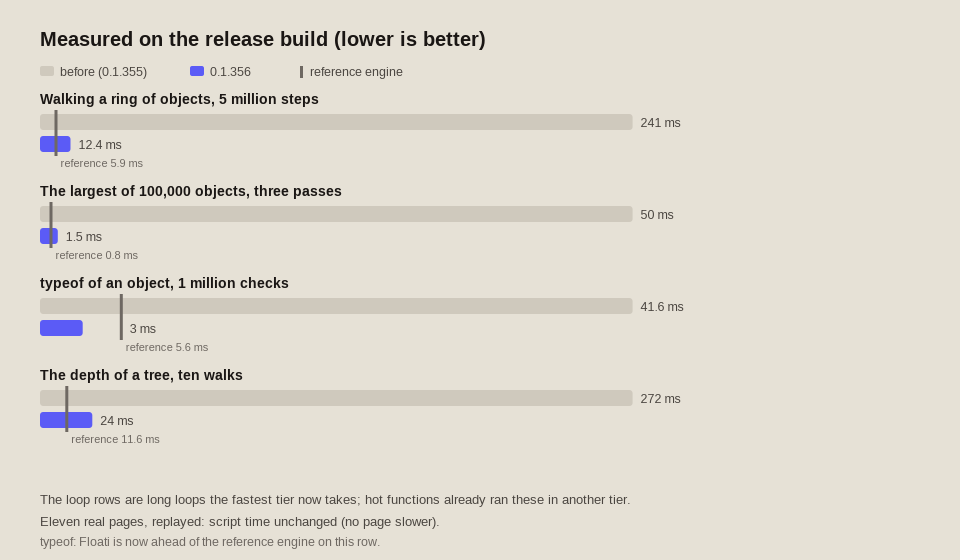
272 -> 24 msThe depth of a tree, ten walks
241 -> 12.4 ms (reference engine 5.9)Walking a ring of objects, 5 million steps
10 -> 3.5 msBuilding 3,000 elements, twenty times
In evidenza3

Recursion makes a fraction of the calls

A tree sum before and after: 31 calls become 5

A recursive function usually starts with its simplest case: if the tree is empty, return 0; if n is below 2, return n. Floati's recursion tier now runs that test where the call is made, so a call that would only answer the simple case is never made, and it copies one level of the function into its parent, so every other level of a tree runs without a call at all (a technique from research on divide-and-conquer programs). Each copy still counts toward the call-depth limit and the work budget exactly as a call would, so a runaway recursion stops where it did. Once a recursive function has run, its property reads are compiled again with the object layouts they saw built in. Recursion whose last step returns a property, like the depth of a tree that returns a leaf's value, used to fall back to slower code because one path returned a number and the other a value of any type; now the two paths meet as a number, and anything else hands the work back to the interpreter.

The depth of a tree, ten walks272 -> 24 msA count whose base case returns a property80 -> 4.7 ms

Loops keep objects in registers

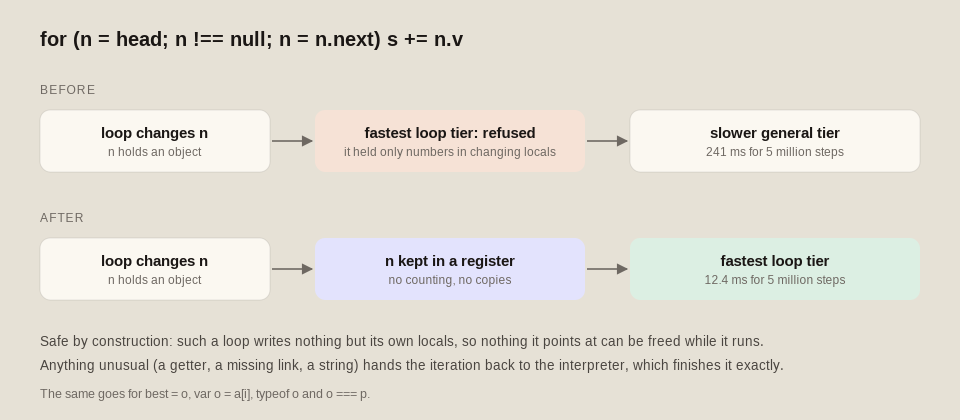
A list walk before and after: refused by the fastest loop tier, then run there with the object in a register
Before, after and the reference engine for four measurements

Floati's fastest loop tier kept numbers in registers, and objects only when the loop never changed which object a variable held. A loop like for (n = head; n !== null; n = n.next), or one that remembers the largest object seen so far, was refused and ran in a slower tier. Now such a variable holds the object directly, with no counting or copying, because these loops write nothing but their own variables: nothing they point at can be freed while they run. They can read properties, compare with null and with each other, copy, ask typeof and test truthiness; anything unusual, a getter, a missing link or a string compared by identity, hands that iteration back to the interpreter, which finishes it exactly. These are long loops the fastest tier now takes; a function that is already hot ran them in another tier and is unchanged.

Walking a ring of objects, 5 million steps241 -> 12.4 ms (reference engine 5.9)typeof of an object, 1 million checks41.6 -> 3 ms (reference engine 5.6)

Element writes stop searching

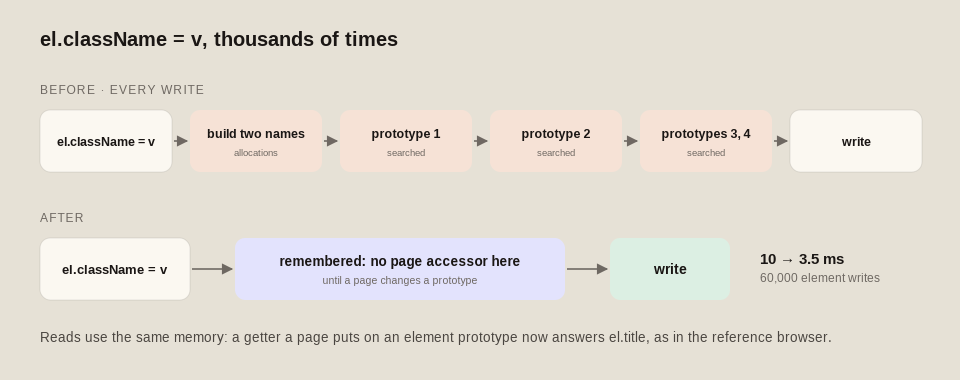
An element property write before and after: from a search of four prototypes to a remembered answer

Every el.className = v or el.textContent = v checked whether a page script had defined that property as an accessor on one of the element's prototypes: it built two names and searched four prototypes, every time, to learn that nothing was there. On a page that builds elements this was most of its script time. Floati now remembers the answer per element type until a page changes a prototype, which makes element-building three times faster. Reads use the same memory, which fixed a gap: a getter a page defines on an element prototype, as some monitoring and compatibility scripts do, now answers reads of that property as it does in the reference browser; before, Floati answered from its own value.

Building 3,000 elements, twenty times10 -> 3.5 msA getter on an element prototypenow answers reads

Cosa è cambiato

8 modifiche
  1. JavaScript e JITRecursive functions answer their simple case where they are called and run alternate levels inside their parent: a tree walk makes a fraction of the calls.
  2. JavaScript e JITRecursion whose last step returns a property (a tree's depth, a count) now compiles: a tree depth 272 -> 24 ms.
  3. JavaScript e JITOnce a recursive function has run, its property reads are compiled again with the layouts they saw built in.
  4. JavaScript e JITLong loops that walk a list, keep the best object so far, copy or compare objects, or ask typeof run in the fastest loop tier: a 5 million step walk 241 -> 12.4 ms.
  5. Memoria e letturaSetting properties on page elements remembers that no page accessor intercepts them: building elements is three times faster.
  6. JavaScript e JITA getter a page defines on an element prototype now answers reads of that property, as in the reference browser.
  7. Memoria e letturaFixed: freeing a long linked list built inside a function no longer overflows the stack and closes the page.
  8. Schede e interfacciaFloati's pages and update notes now open at browser.floati.life.

Prova nel tuo browser

Ogni test gira dal vivo nel browser con cui stai leggendo. Non viene inviato nulla.

VerificaIl tuo browserFloati
A recursive base case that returns a property still adds upVerifica in corsoSì
An unrolled recursion keeps its arguments in orderVerifica in corsoSì
A setter added to an element prototype after many writes runsVerifica in corsoSì
A long walk around a ring of objects keeps its placeVerifica in corsoSì
The largest object found in a loop is that very objectVerifica in corsoSì
Equal strings compare equal in a hot loopVerifica in corsoSì
Typeof in a hot loop tells functions, arrays and null apartVerifica in corsoSì
A long list built in a function is freed when it returnsVerifica in corsoSì
Superati 8 / 8
Tutto dalla v0.1.356 in un unico posto

Versioni

v0.1.0 - 0.1.9 · 10 Lug 2026418v0.1.427 · 25 Nov 2026

Novembre2026 · 40 versioni

42725 NovLayouts that remember their workPiù recente · v0.1.427 · Rendering9 42625 NovCompiled with what real pages runv0.1.426 · JavaScript e JIT 42525 NovBuilt with whole-program optimizationv0.1.425 · Rendering 42425 NovMore layout reused after a script changes the pagev0.1.424 · Rendering 42324 NovThe optimizing compiler works off the main threadv0.1.423 · Rendering 42222 NovText-reading loops and element-tree builders run fasterv0.1.422 · JavaScript e JIT14 42122 NovCalls from loops run inside the loop's own machine codev0.1.421 · JavaScript e JIT9 42021 NovPages you come back to run their scripts soonerv0.1.420 · Rendering17 41918 NovA faster interpreter runs the page's codev0.1.419 · JavaScript e JIT12 41815 NovScripts run faster on busy pagesv0.1.418 · JavaScript e JIT34 41711 NovPages wait less for their own scripts and stylesv0.1.417 · JavaScript e JIT13 41611 NovWebGPU loops run 2 to 3 times faster on Macsv0.1.416 · JavaScript e JIT 41510 NovWebGPU loops count right on Macsv0.1.415 · JavaScript e JIT 41410 NovWebGPU runs in its own graphics processv0.1.414 · Rendering 41310 NovA graphics card reset no longer takes the browser downv0.1.413 · Rendering 4129 NovVideo moves to the graphics cardv0.1.412 · Media 4119 NovNo canvas stall on Windows, patterns and every blend mode on the graphics cardv0.1.411 · Rendering 4109 NovCanvas drawing moves to the graphics cardv0.1.410 · Rendering27 4098 NovEvery tile on the GPUv0.1.409 · Rendering26 4088 Nov3D at 120 frames a secondv0.1.408 · Rendering23 4077 NovWebGL 2v0.1.407 · Rendering36 4066 NovA stuck tab stops at oncev0.1.406 · Rendering16 4055 NovSmall WebGL drawings get smooth edgesv0.1.405 · Rendering 4045 NovWebGL pages finally movev0.1.404 · Rendering25 4035 NovWebGPU is herev0.1.403 · Rendering35 4024 NovA canvas that moves itself to the GPUv0.1.402 · Rendering 4014 Nov99% of real pages decided by the GPUv0.1.401 · Rendering9 4004 NovSmooth turns, the same bytes on every chip, and fields that keep their textv0.1.400 · Rendering15 3994 NovAnimations on the GPU compositor, and text that stays in its boxv0.1.399 · Rendering22 3984 NovGradient patterns that tile, animations that keep up, and a much faster canvasv0.1.398 · Rendering14 3973 NovTransitions that ease, and a GPU that draws 94% of real pages itselfv0.1.397 · Rendering 3963 NovAnimations on the GPU compositor, and spinners that spin as arcsv0.1.396 · Rendering 3953 NovCarousels that fade, badges that stay put, and floats that stay insidev0.1.395 · Rendering12 3943 NovBackground images over their colour, interlaced pictures, and borders in every colourv0.1.394 · Rendering 3932 NovStyle sheets in page order, and symbols that fall back like macOSv0.1.393 · Rendering 3922 NovIcon fonts loaded by script, and colour emoji on Windowsv0.1.392 · Schede e interfaccia 3911 NovEmoji in colour, sized as in the reference browserv0.1.391 · JavaScript e JIT 3901 NovA classified ads site's front page: blank before, whole nowv0.1.390 · JavaScript e JIT12 3891 NovA computer maker's home page: navigation labels back, buttons apartv0.1.389 · Rendering 3881 NovA space agency's home page, a news section and a language site's header now match the referencev0.1.388 · Rendering18

Ottobre2026 · 58 versioni

38731 OttNews pages line up: a news site from 19.9% to 10.9% differentv0.1.387 · Rendering 38631 OttReal sites render closer to the reference browserv0.1.386 · Rendering14 38530 OttAhead of the reference runtime on 7 of 8 workloadsv0.1.385 · Memoria e lettura32 38429 OttSafety review, a rare crash fixed, functions compiled soonerv0.1.384 · Memoria e lettura46 38327 OttJavaScript ahead of the reference runtime on six of eight speed testsv0.1.383 · JavaScript e JIT36 38225 OttClosed tabs give their memory back, and XML pages read as XMLv0.1.382 · Memoria e lettura12 38125 OttLighter script code, and calls between scripts that run as ordinary callsv0.1.381 · Memoria e lettura15 38025 OttScrolling boxes scroll, pages look right, and scripts from other sites need permissionv0.1.380 · Rendering16 37924 OttPages laid out the way their authors wrote them, and less memory againv0.1.379 · Rendering22 37823 OttOther sites' data stays private, and less memory againv0.1.378 · Memoria e lettura 37723 OttAbout half the memory of the reference browser on everyday sitesv0.1.377 · Memoria e lettura15 37622 OttA minimized window stops piling up graphics memoryv0.1.376 · Memoria e lettura 37522 OttClosed pages let go, sites stay apart, and fonts stop costing memoryv0.1.375 · Memoria e lettura9 37421 OttA floating video you can move, that opens without a black flashv0.1.374 · Schede e interfaccia 37321 OttEvery page on our own engine, two pages side by side, videos that keep playing, and your own clockv0.1.373 · Schede e interfaccia17 37221 OttYour data stays put, your choices stick, and dictation that really listensv0.1.372 · Rendering 37121 OttDrop files onto pages, dictate without your voice leaving the Mac, and controllers that rumblev0.1.371 · API web e DOM · provalo 37021 OttOpen your files, share to your phone, have pages read aloud, install sites as apps, play with a controller, and accented text drawn rightv0.1.370 · Privacy e Shields · provalo11 36920 OttPasskeys with Touch ID and Windows Hello, sites that work offline, notifications you allow, and devices asked for first, all kept on your devicev0.1.369 · Privacy e Shields · provalo9 36820 OttA site's own security rules are kept the whole time the page runs, Trusted Types, a map of every unsafe write in DevTools, and animations from scriptv0.1.368 · Privacy e Shields · provalo 36720 OttEvents, form controls, performance timing, URL patterns, live streams and the newest JavaScript: the Web APIs score rises from 59 to 62v0.1.367 · API web e DOM · provalo10 36619 OttEvents, custom form controls, fonts and navigation work the way the web standards say: the Web APIs score rises from 53 to 59v0.1.366 · API web e DOM · provalo9 36519 OttThe code-size budget fits your processor, and code that has gone cold makes room for code that is hot nowv0.1.365 · JavaScript e JIT · provalo 36419 OttCompiled code that fits the processor's caches: big pages up to 1.8 times faster, and fast compiled code on Windows and Intel machinesv0.1.364 · JavaScript e JIT · provalo 36319 OttThermal runs on one code generator, building strings is up to 8 times faster, and two slow paths that grew with the square of their input are linearv0.1.363 · JavaScript e JIT · provalo12 36219 OttA page scheduler that stalled now runs, try / finally and spreads compile, and deleting thousands of properties is 180 times fasterv0.1.362 · Rendering · provalo 36118 OttThermal runs on Windows and Intel machines, a register fix for compiled code on Windows, try / catch compiles, and reading a growing string is 200 times fasterv0.1.361 · JavaScript e JIT · provalo 36018 OttEvery byte of machine code is Floati's own, a news site that showed blank renders, Gust's code is half the size, and closures and ?? compilev0.1.360 · JavaScript e JIT · provalo9 35916 OttThermal reads object members and folds Math, string building compiles, and methods, Array subclasses and globals behave as the standard saysv0.1.359 · JavaScript e JIT · provalo 35816 OttThermal, Floati's own optimizing compiler, is on: hot loops keep their numbers and strings in registersv0.1.358 · JavaScript e JIT · provalo 35715 OttLoops that test a number run as machine code, more of your functions compile, and reading page nodes is three times fasterv0.1.357 · JavaScript e JIT · provalo14 35614 OttRecursion makes a fraction of the calls, loops keep objects in registers, and element writes stop searchingv0.1.356 · JavaScript e JIT · provalo 35514 OttA hot loop changes compiler without stopping, property writes skip the detour, and pure recursion remembers its answersv0.1.355 · JavaScript e JIT · provalo 35413 OttFloati compiles JavaScript with its own compiler, Updraft: about a hundred times faster to compile, and compiled code no longer piles upv0.1.354 · JavaScript e JIT · provalo 35311 OttStyle matching tries a third of the rules, queries prepare their selector once, sibling walks stay fastv0.1.353 · Rendering · provalo 35211 OttCode that loads on demand starts at once, images decode beside their downloads, writes run compiledv0.1.352 · Rendering · provalo10 35111 OttStyles read once, layouts redone only where they changed, built-ins in compiled loopsv0.1.351 · JavaScript e JIT · provalo12 35010 OttHelpers that compile, strings that stay small, and events that fire fastv0.1.350 · JavaScript e JIT · provalo14 34910 OttScripts that grow in step with their work, layouts laid out once, and colours mixed like the referencev0.1.349 · Rendering · provalo13 3489 OttScripts that only compile when it pays, cards that line up, and bold that stays boldv0.1.348 · Rendering · provalo14 3478 OttCards inside links, small print at its real size, and errors you can followv0.1.347 · Rendering · provalo17 3467 OttA real performance timeline, site icons from the engine with a lookalike check, and forms that lay out rightv0.1.346 · Rendering · provalo14 3457 OttReal WebGL, a real 2D canvas, and canvas text that matches the reference browserv0.1.345 · Rendering · provalo10 3446 OttRetina text that keeps its spacing, embeds at their real size, and an address bar that keeps upv0.1.344 · Rendering 3436 OttSign-ins that stay signed in, a real IndexedDB, and a storage button that shows what sites keepv0.1.343 · Privacy e Shields · provalo25 3425 OttTheme switchers, chart labels sized by CSS, and SVG text you can measurev0.1.342 · API web e DOM · provalo 3415 OttCanvas text measured and drawn like the reference browser, and SVG shapes you can measurev0.1.341 · Rendering · provalo 3405 OttScripts can read and change SVG the way they do in the reference browser, and a hidden hang is gonev0.1.340 · Rendering · provalo10 3395 OttEvery computed style, real stylesheet objects and full 3D geometry, each checked against the reference browserv0.1.339 · API web e DOM · provalo12 3385 OttPages load faster, render truer and gain a dozen modern web features, each one checked against the reference browserv0.1.338 · API web e DOM · provalo19 3373 OttSites load like they do in the reference browser: every test site runs its scripts cleanlyv0.1.337 · API web e DOM11 3362 OttSite controls that do what they say: permissions that really ask, and Shields per sitev0.1.336 · Privacy e Shields13 3352 OttA developer-docs site works like the reference browser, and every frame gets its own built-insv0.1.335 · Rendering12 3342 OttIframes that cost what a paragraph costs, live selections, and rounder cornersv0.1.334 · Rendering10 3331 OttFewer script errors on real sites, and finished pages give all their memory backv0.1.333 · JavaScript e JIT10 3321 OttPinned tabs on the left or the right, and an honest measure of the web platformv0.1.332 · Schede e interfaccia9 3311 OttA crash on busy news sites fixed, and pages lighter on the processorv0.1.331 · Rendering 3301 OttJavaScript scores 100, and big pages stop stuttering when they clean upv0.1.330 · JavaScript e JIT11
Settembre2026124 versioni Agosto2026140 versioni Luglio202656 versioni