همه نسخه‌ها v0.1.35614 اکتبر 2026JavaScript و JIT, حافظه و خواندن, زبانه‌ها و رابط خوراک

یادداشت‌های انتشار به انگلیسی نوشته شده‌اند.

Recursion makes a fraction of the calls, loops keep objects in registers, and element writes stop searching

This release makes three kinds of everyday JavaScript faster. Recursive functions now answer their simplest cases where they are called and run every other level inside their parent, so walking a tree makes a fraction of the calls, and recursion whose last step returns a property now compiles at all. Long loops that walk a list, keep the best object seen so far, copy objects, compare them or ask typeof now run in Floati's fastest loop tier, 20 to 40 times faster than before. Setting a property on page elements no longer searches every element prototype each time, so building elements is almost three times faster, and a getter a page puts on an element prototype now answers reads as it does in the reference browser. One crash is fixed: freeing a long linked list made inside a function no longer overflows the stack.

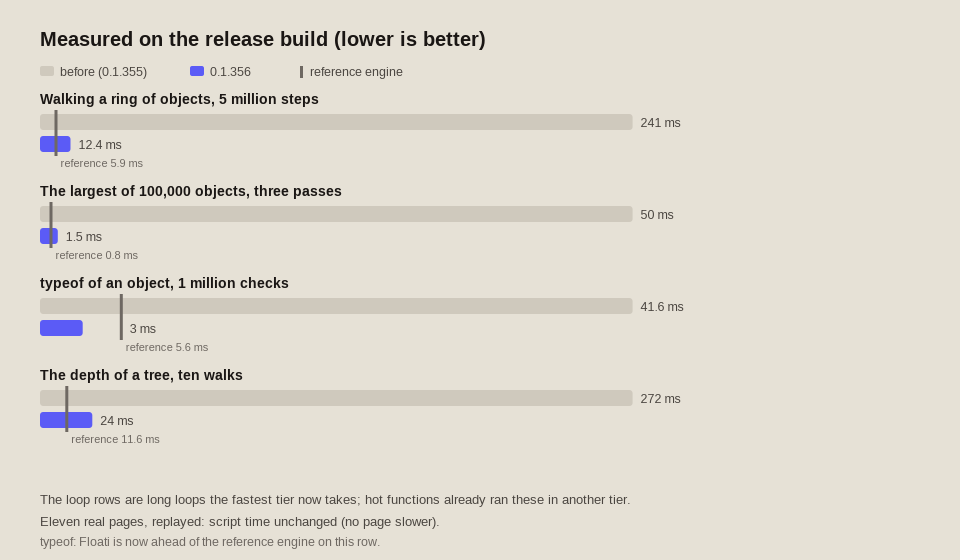
272 -> 24 msThe depth of a tree, ten walks
241 -> 12.4 ms (reference engine 5.9)Walking a ring of objects, 5 million steps
10 -> 3.5 msBuilding 3,000 elements, twenty times
نکته‌های برجسته3

Recursion makes a fraction of the calls

A tree sum before and after: 31 calls become 5

A recursive function usually starts with its simplest case: if the tree is empty, return 0; if n is below 2, return n. Floati's recursion tier now runs that test where the call is made, so a call that would only answer the simple case is never made, and it copies one level of the function into its parent, so every other level of a tree runs without a call at all (a technique from research on divide-and-conquer programs). Each copy still counts toward the call-depth limit and the work budget exactly as a call would, so a runaway recursion stops where it did. Once a recursive function has run, its property reads are compiled again with the object layouts they saw built in. Recursion whose last step returns a property, like the depth of a tree that returns a leaf's value, used to fall back to slower code because one path returned a number and the other a value of any type; now the two paths meet as a number, and anything else hands the work back to the interpreter.

The depth of a tree, ten walks272 -> 24 msA count whose base case returns a property80 -> 4.7 ms

Loops keep objects in registers

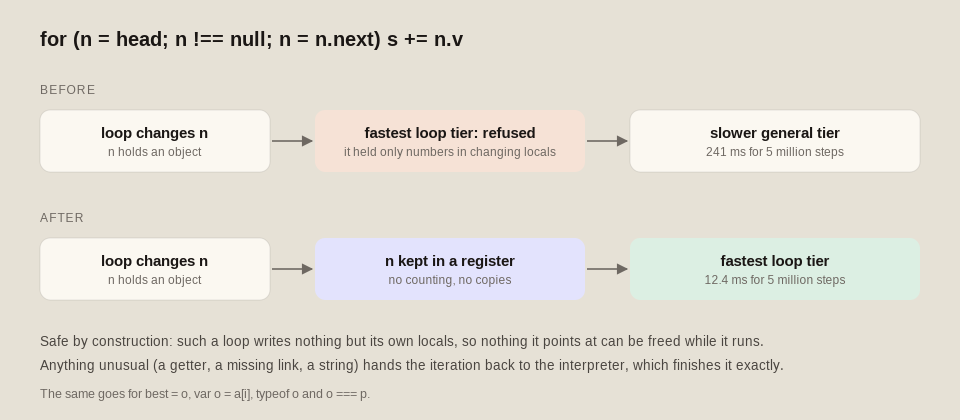
A list walk before and after: refused by the fastest loop tier, then run there with the object in a register
Before, after and the reference engine for four measurements

Floati's fastest loop tier kept numbers in registers, and objects only when the loop never changed which object a variable held. A loop like for (n = head; n !== null; n = n.next), or one that remembers the largest object seen so far, was refused and ran in a slower tier. Now such a variable holds the object directly, with no counting or copying, because these loops write nothing but their own variables: nothing they point at can be freed while they run. They can read properties, compare with null and with each other, copy, ask typeof and test truthiness; anything unusual, a getter, a missing link or a string compared by identity, hands that iteration back to the interpreter, which finishes it exactly. These are long loops the fastest tier now takes; a function that is already hot ran them in another tier and is unchanged.

Walking a ring of objects, 5 million steps241 -> 12.4 ms (reference engine 5.9)typeof of an object, 1 million checks41.6 -> 3 ms (reference engine 5.6)

Element writes stop searching

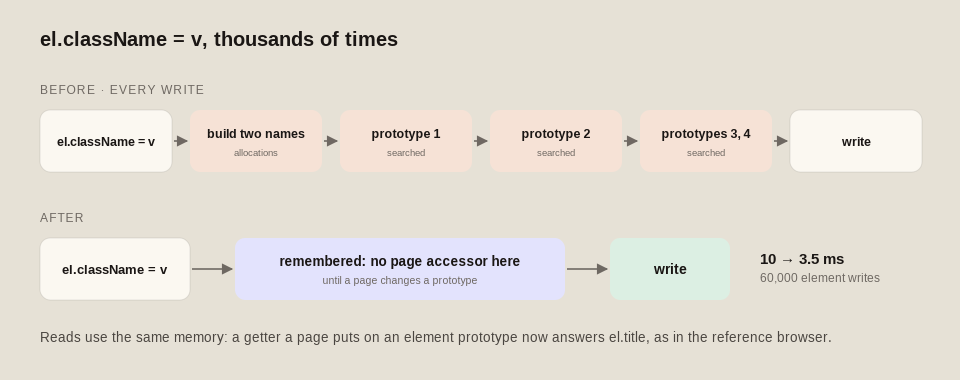
An element property write before and after: from a search of four prototypes to a remembered answer

Every el.className = v or el.textContent = v checked whether a page script had defined that property as an accessor on one of the element's prototypes: it built two names and searched four prototypes, every time, to learn that nothing was there. On a page that builds elements this was most of its script time. Floati now remembers the answer per element type until a page changes a prototype, which makes element-building three times faster. Reads use the same memory, which fixed a gap: a getter a page defines on an element prototype, as some monitoring and compatibility scripts do, now answers reads of that property as it does in the reference browser; before, Floati answered from its own value.

Building 3,000 elements, twenty times10 -> 3.5 msA getter on an element prototypenow answers reads

چه چیزی تغییر کرد

8 تغییر
  1. JavaScript و JITRecursive functions answer their simple case where they are called and run alternate levels inside their parent: a tree walk makes a fraction of the calls.
  2. JavaScript و JITRecursion whose last step returns a property (a tree's depth, a count) now compiles: a tree depth 272 -> 24 ms.
  3. JavaScript و JITOnce a recursive function has run, its property reads are compiled again with the layouts they saw built in.
  4. JavaScript و JITLong loops that walk a list, keep the best object so far, copy or compare objects, or ask typeof run in the fastest loop tier: a 5 million step walk 241 -> 12.4 ms.
  5. حافظه و خواندنSetting properties on page elements remembers that no page accessor intercepts them: building elements is three times faster.
  6. JavaScript و JITA getter a page defines on an element prototype now answers reads of that property, as in the reference browser.
  7. حافظه و خواندنFixed: freeing a long linked list built inside a function no longer overflows the stack and closes the page.
  8. زبانه‌ها و رابطFloati's pages and update notes now open at browser.floati.life.

در مرورگر خودتان امتحان کنید

هر آزمون همین حالا در مرورگری که با آن می‌خوانید اجرا می‌شود. چیزی به جایی فرستاده نمی‌شود.

بررسیمرورگر شماFloati
A recursive base case that returns a property still adds upدر حال بررسیبله
An unrolled recursion keeps its arguments in orderدر حال بررسیبله
A setter added to an element prototype after many writes runsدر حال بررسیبله
A long walk around a ring of objects keeps its placeدر حال بررسیبله
The largest object found in a loop is that very objectدر حال بررسیبله
Equal strings compare equal in a hot loopدر حال بررسیبله
Typeof in a hot loop tells functions, arrays and null apartدر حال بررسیبله
A long list built in a function is freed when it returnsدر حال بررسیبله
قبول 8 / 8
همه چیز از v0.1.356 به بعد در یک جا

نسخه‌ها

v0.1.0 - 0.1.9 · 10 ژوئیه 2026418v0.1.427 · 25 نوامبر 2026

نوامبر2026 · 40 نسخه

42725 نوامبرLayouts that remember their workتازه‌ترین · v0.1.427 · نمایش صفحه9 42625 نوامبرCompiled with what real pages runv0.1.426 · JavaScript و JIT 42525 نوامبرBuilt with whole-program optimizationv0.1.425 · نمایش صفحه 42425 نوامبرMore layout reused after a script changes the pagev0.1.424 · نمایش صفحه 42324 نوامبرThe optimizing compiler works off the main threadv0.1.423 · نمایش صفحه 42222 نوامبرText-reading loops and element-tree builders run fasterv0.1.422 · JavaScript و JIT14 42122 نوامبرCalls from loops run inside the loop's own machine codev0.1.421 · JavaScript و JIT9 42021 نوامبرPages you come back to run their scripts soonerv0.1.420 · نمایش صفحه17 41918 نوامبرA faster interpreter runs the page's codev0.1.419 · JavaScript و JIT12 41815 نوامبرScripts run faster on busy pagesv0.1.418 · JavaScript و JIT34 41711 نوامبرPages wait less for their own scripts and stylesv0.1.417 · JavaScript و JIT13 41611 نوامبرWebGPU loops run 2 to 3 times faster on Macsv0.1.416 · JavaScript و JIT 41510 نوامبرWebGPU loops count right on Macsv0.1.415 · JavaScript و JIT 41410 نوامبرWebGPU runs in its own graphics processv0.1.414 · نمایش صفحه 41310 نوامبرA graphics card reset no longer takes the browser downv0.1.413 · نمایش صفحه 4129 نوامبرVideo moves to the graphics cardv0.1.412 · رسانه 4119 نوامبرNo canvas stall on Windows, patterns and every blend mode on the graphics cardv0.1.411 · نمایش صفحه 4109 نوامبرCanvas drawing moves to the graphics cardv0.1.410 · نمایش صفحه27 4098 نوامبرEvery tile on the GPUv0.1.409 · نمایش صفحه26 4088 نوامبر3D at 120 frames a secondv0.1.408 · نمایش صفحه23 4077 نوامبرWebGL 2v0.1.407 · نمایش صفحه36 4066 نوامبرA stuck tab stops at oncev0.1.406 · نمایش صفحه16 4055 نوامبرSmall WebGL drawings get smooth edgesv0.1.405 · نمایش صفحه 4045 نوامبرWebGL pages finally movev0.1.404 · نمایش صفحه25 4035 نوامبرWebGPU is herev0.1.403 · نمایش صفحه35 4024 نوامبرA canvas that moves itself to the GPUv0.1.402 · نمایش صفحه 4014 نوامبر99% of real pages decided by the GPUv0.1.401 · نمایش صفحه9 4004 نوامبرSmooth turns, the same bytes on every chip, and fields that keep their textv0.1.400 · نمایش صفحه15 3994 نوامبرAnimations on the GPU compositor, and text that stays in its boxv0.1.399 · نمایش صفحه22 3984 نوامبرGradient patterns that tile, animations that keep up, and a much faster canvasv0.1.398 · نمایش صفحه14 3973 نوامبرTransitions that ease, and a GPU that draws 94% of real pages itselfv0.1.397 · نمایش صفحه 3963 نوامبرAnimations on the GPU compositor, and spinners that spin as arcsv0.1.396 · نمایش صفحه 3953 نوامبرCarousels that fade, badges that stay put, and floats that stay insidev0.1.395 · نمایش صفحه12 3943 نوامبرBackground images over their colour, interlaced pictures, and borders in every colourv0.1.394 · نمایش صفحه 3932 نوامبرStyle sheets in page order, and symbols that fall back like macOSv0.1.393 · نمایش صفحه 3922 نوامبرIcon fonts loaded by script, and colour emoji on Windowsv0.1.392 · زبانه‌ها و رابط 3911 نوامبرEmoji in colour, sized as in the reference browserv0.1.391 · JavaScript و JIT 3901 نوامبرA classified ads site's front page: blank before, whole nowv0.1.390 · JavaScript و JIT12 3891 نوامبرA computer maker's home page: navigation labels back, buttons apartv0.1.389 · نمایش صفحه 3881 نوامبرA space agency's home page, a news section and a language site's header now match the referencev0.1.388 · نمایش صفحه18

اکتبر2026 · 58 نسخه

57 مورد دیگر
سپتامبر2026124 نسخه اوت2026140 نسخه ژوئیه202656 نسخه