همه نسخه‌ها v0.1.36219 اکتبر 2026نمایش صفحه, JavaScript و JIT خوراک

یادداشت‌های انتشار به انگلیسی نوشته شده‌اند.

A page scheduler that stalled now runs, try / finally and spreads compile, and deleting thousands of properties is 180 times faster

A break or continue that left a try block skipped its finally block. That broke more than tidy-up code: a widely used UI library's scheduler clears its "busy" flag in a finally that it leaves with break, so in Floati the flag stayed set after the first batch of work and every later batch waited forever. Pages built with that library looked right but never ran their later work (effects, an embedded code editor). break and continue now run every finally they leave, innermost first, as the standard says, and those pages do all their startup work, as in the reference browser. try / finally, object and array spread, destructuring from a Set, a Map or a generator, unary plus and regular-expression literals now run on the plan interpreter instead of the slowest tier, and so do for (let x of ..) loops over anything that is not an array. Deleting 64,000 properties one by one went from 5,993 to 33 ms, a function with try / finally called 2 million times from 430 to 243 ms, and on x86-64 Thermal keeps values in registers across calls in rarely run code (a float loop 315 -> 160 ms). Object spread now runs getters before converting a later computed key, and spreading null into an array throws a TypeError, as the standard says.

9 of 9 the sameRelease checks against the reference browser
5,993 -> 33 ms (reference engine 19)Delete 64,000 properties
نکته‌های برجسته2

break, continue and finally

A scheduler that leaves a labelled block with break: before, its finally never ran; now it does

A finally block runs however its try block ends: normally, by return, by a throw, or by break and continue. Floati handled the first three, but a break or continue out of a try jumped straight to its target and skipped the finally. That mattered on real pages. A widely used UI library runs queued work inside a labelled block, sets a "busy" flag, and clears it in a finally it leaves with break. In Floati the flag was never cleared, so after the first batch the scheduler believed it was still working and never started another: effects never ran, and an embedded code editor never parsed its text. The pages still looked complete, which is why the page checks did not catch it. Now a break or continue that crosses finally blocks runs each one, innermost first, with its own state restored, then lands where it was going. Each finally body resumes its own completion, so a try / finally inside a finally no longer takes an outer return or throw at its end, and a return routed into a finally closes the try's handlers first. The two pages built with that library now spend more time in JavaScript, because they do the work the reference browser does. The code they now run is compiled: a for (let x of ..) loop over a Set, a Map, a generator or a string used to be refused a plan because of the jump that ends it when the iterator is done, and now it is planned.

Release checks against the reference browser9 of 9 the same

More of every page compiles, and deletes are linear
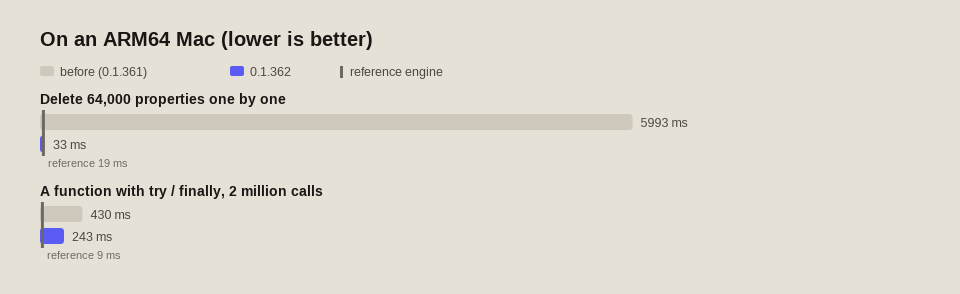
Before, after and the reference engine on an ARM64 Mac

The plan interpreter runs most hot functions. Several common constructs kept a function out of it, in the bytecode interpreter: try / finally, object and array spread ({ ...a, ...b }, [...set]), destructuring from anything iterable, unary plus on objects, and regular-expression literals (the most common refusal on a news site's load). Each is now a plan operation, checked against the interpreter in every tier on new test maps. Deleting a property from a large object shifted every property after it, so deleting n properties took time proportional to n squared. Deletes now leave a marker that is cleaned up in bulk, so the remaining properties keep their order and deleting 64,000 takes 33 ms instead of 5,993. On x86-64, Updraft IR's register allocator now keeps values in registers that a call may change, across calls in rarely run blocks, saving them only around those calls; a float loop with a rare slow path went from 315 to 160 ms.

Delete 64,000 properties5,993 -> 33 ms (reference engine 19)try / finally, 2 million calls430 -> 243 ms (reference engine 9)

چه چیزی تغییر کرد

7 تغییر
  1. نمایش صفحهbreak and continue out of a try run its finally block; a UI library's scheduler no longer stalls after its first batch.
  2. نمایش صفحهEach finally body resumes its own completion, and a throw in a finally after a return is no longer caught by its own try.
  3. JavaScript و JITtry / finally, spread, destructuring from iterables, unary plus and regex literals run on the plan interpreter.
  4. JavaScript و JITfor (let x of ..) over a Set, a Map, a generator or a string is compiled instead of interpreted.
  5. نمایش صفحهDeleting many properties from one object is linear: 64,000 deletes 5,993 -> 33 ms.
  6. JavaScript و JITx86-64: values stay in registers across calls in rarely run code (a float loop 315 -> 160 ms).
  7. نمایش صفحهObject spread runs getters before a later computed key is converted, and [...null] throws a TypeError.

در مرورگر خودتان امتحان کنید

هر آزمون همین حالا در مرورگری که با آن می‌خوانید اجرا می‌شود. چیزی به جایی فرستاده نمی‌شود.

بررسیمرورگر شماFloati
a break out of a labelled block runs its finally (a page scheduler no longer stalls)در حال بررسیبله
break and continue out of try run the finally blockدر حال بررسیبله
a finally that returns overrides a throw, in a hot functionدر حال بررسیبله
object spread runs getters before a later computed key is convertedدر حال بررسیبله
spreading null into an array throws a TypeErrorدر حال بررسیبله
destructuring and spread from Set, Map and generators in a hot functionدر حال بررسیبله
a regex literal is a new object each evaluationدر حال بررسیبله
deleting thousands of properties keeps the remaining orderدر حال بررسیبله
unary plus converts objects through valueOf and Symbol.toPrimitiveدر حال بررسیبله
قبول 9 / 9
همه چیز از v0.1.362 به بعد در یک جا

نسخه‌ها

v0.1.0 - 0.1.9 · 10 ژوئیه 2026418v0.1.427 · 25 نوامبر 2026

نوامبر2026 · 40 نسخه

42725 نوامبرLayouts that remember their workتازه‌ترین · v0.1.427 · نمایش صفحه9 42625 نوامبرCompiled with what real pages runv0.1.426 · JavaScript و JIT 42525 نوامبرBuilt with whole-program optimizationv0.1.425 · نمایش صفحه 42425 نوامبرMore layout reused after a script changes the pagev0.1.424 · نمایش صفحه 42324 نوامبرThe optimizing compiler works off the main threadv0.1.423 · نمایش صفحه 42222 نوامبرText-reading loops and element-tree builders run fasterv0.1.422 · JavaScript و JIT14 42122 نوامبرCalls from loops run inside the loop's own machine codev0.1.421 · JavaScript و JIT9 42021 نوامبرPages you come back to run their scripts soonerv0.1.420 · نمایش صفحه17 41918 نوامبرA faster interpreter runs the page's codev0.1.419 · JavaScript و JIT12 41815 نوامبرScripts run faster on busy pagesv0.1.418 · JavaScript و JIT34 41711 نوامبرPages wait less for their own scripts and stylesv0.1.417 · JavaScript و JIT13 41611 نوامبرWebGPU loops run 2 to 3 times faster on Macsv0.1.416 · JavaScript و JIT 41510 نوامبرWebGPU loops count right on Macsv0.1.415 · JavaScript و JIT 41410 نوامبرWebGPU runs in its own graphics processv0.1.414 · نمایش صفحه 41310 نوامبرA graphics card reset no longer takes the browser downv0.1.413 · نمایش صفحه 4129 نوامبرVideo moves to the graphics cardv0.1.412 · رسانه 4119 نوامبرNo canvas stall on Windows, patterns and every blend mode on the graphics cardv0.1.411 · نمایش صفحه 4109 نوامبرCanvas drawing moves to the graphics cardv0.1.410 · نمایش صفحه27 4098 نوامبرEvery tile on the GPUv0.1.409 · نمایش صفحه26 4088 نوامبر3D at 120 frames a secondv0.1.408 · نمایش صفحه23 4077 نوامبرWebGL 2v0.1.407 · نمایش صفحه36 4066 نوامبرA stuck tab stops at oncev0.1.406 · نمایش صفحه16 4055 نوامبرSmall WebGL drawings get smooth edgesv0.1.405 · نمایش صفحه 4045 نوامبرWebGL pages finally movev0.1.404 · نمایش صفحه25 4035 نوامبرWebGPU is herev0.1.403 · نمایش صفحه35 4024 نوامبرA canvas that moves itself to the GPUv0.1.402 · نمایش صفحه 4014 نوامبر99% of real pages decided by the GPUv0.1.401 · نمایش صفحه9 4004 نوامبرSmooth turns, the same bytes on every chip, and fields that keep their textv0.1.400 · نمایش صفحه15 3994 نوامبرAnimations on the GPU compositor, and text that stays in its boxv0.1.399 · نمایش صفحه22 3984 نوامبرGradient patterns that tile, animations that keep up, and a much faster canvasv0.1.398 · نمایش صفحه14 3973 نوامبرTransitions that ease, and a GPU that draws 94% of real pages itselfv0.1.397 · نمایش صفحه 3963 نوامبرAnimations on the GPU compositor, and spinners that spin as arcsv0.1.396 · نمایش صفحه 3953 نوامبرCarousels that fade, badges that stay put, and floats that stay insidev0.1.395 · نمایش صفحه12 3943 نوامبرBackground images over their colour, interlaced pictures, and borders in every colourv0.1.394 · نمایش صفحه 3932 نوامبرStyle sheets in page order, and symbols that fall back like macOSv0.1.393 · نمایش صفحه 3922 نوامبرIcon fonts loaded by script, and colour emoji on Windowsv0.1.392 · زبانه‌ها و رابط 3911 نوامبرEmoji in colour, sized as in the reference browserv0.1.391 · JavaScript و JIT 3901 نوامبرA classified ads site's front page: blank before, whole nowv0.1.390 · JavaScript و JIT12 3891 نوامبرA computer maker's home page: navigation labels back, buttons apartv0.1.389 · نمایش صفحه 3881 نوامبرA space agency's home page, a news section and a language site's header now match the referencev0.1.388 · نمایش صفحه18

اکتبر2026 · 58 نسخه

57 مورد دیگر
سپتامبر2026124 نسخه اوت2026140 نسخه ژوئیه202656 نسخه



















