همه نسخه‌ها v0.1.35614 اکتبر 2026JavaScript و JIT, حافظه و خواندن, زبانه‌ها و رابط خوراک

یادداشت‌های انتشار به انگلیسی نوشته شده‌اند.

Recursion makes a fraction of the calls, loops keep objects in registers, and element writes stop searching

This release makes three kinds of everyday JavaScript faster. Recursive functions now answer their simplest cases where they are called and run every other level inside their parent, so walking a tree makes a fraction of the calls, and recursion whose last step returns a property now compiles at all. Long loops that walk a list, keep the best object seen so far, copy objects, compare them or ask typeof now run in Floati's fastest loop tier, 20 to 40 times faster than before. Setting a property on page elements no longer searches every element prototype each time, so building elements is almost three times faster, and a getter a page puts on an element prototype now answers reads as it does in the reference browser. One crash is fixed: freeing a long linked list made inside a function no longer overflows the stack.

272 -> 24 msThe depth of a tree, ten walks
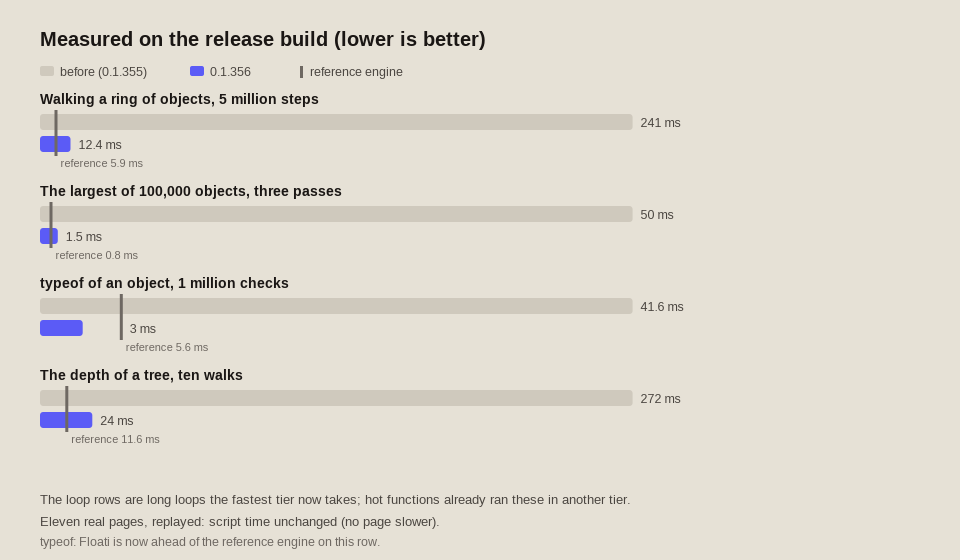
241 -> 12.4 ms (reference engine 5.9)Walking a ring of objects, 5 million steps
10 -> 3.5 msBuilding 3,000 elements, twenty times
نکته‌های برجسته3

Recursion makes a fraction of the calls

A tree sum before and after: 31 calls become 5

A recursive function usually starts with its simplest case: if the tree is empty, return 0; if n is below 2, return n. Floati's recursion tier now runs that test where the call is made, so a call that would only answer the simple case is never made, and it copies one level of the function into its parent, so every other level of a tree runs without a call at all (a technique from research on divide-and-conquer programs). Each copy still counts toward the call-depth limit and the work budget exactly as a call would, so a runaway recursion stops where it did. Once a recursive function has run, its property reads are compiled again with the object layouts they saw built in. Recursion whose last step returns a property, like the depth of a tree that returns a leaf's value, used to fall back to slower code because one path returned a number and the other a value of any type; now the two paths meet as a number, and anything else hands the work back to the interpreter.

The depth of a tree, ten walks272 -> 24 msA count whose base case returns a property80 -> 4.7 ms

Loops keep objects in registers

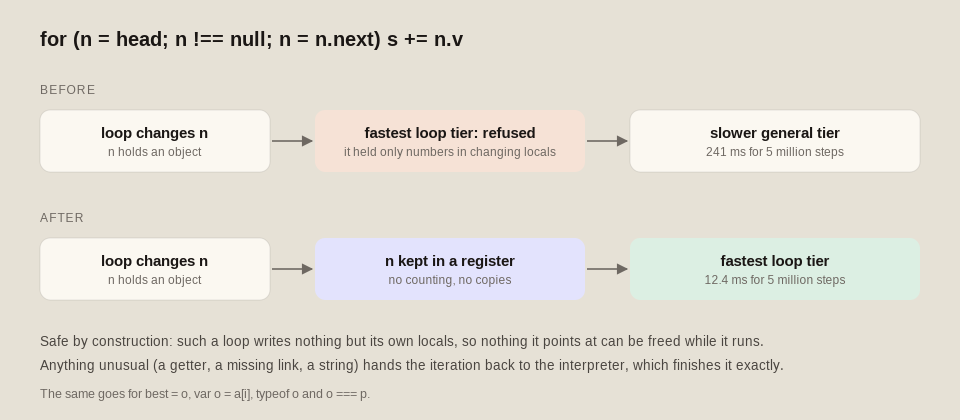
A list walk before and after: refused by the fastest loop tier, then run there with the object in a register
Before, after and the reference engine for four measurements

Floati's fastest loop tier kept numbers in registers, and objects only when the loop never changed which object a variable held. A loop like for (n = head; n !== null; n = n.next), or one that remembers the largest object seen so far, was refused and ran in a slower tier. Now such a variable holds the object directly, with no counting or copying, because these loops write nothing but their own variables: nothing they point at can be freed while they run. They can read properties, compare with null and with each other, copy, ask typeof and test truthiness; anything unusual, a getter, a missing link or a string compared by identity, hands that iteration back to the interpreter, which finishes it exactly. These are long loops the fastest tier now takes; a function that is already hot ran them in another tier and is unchanged.

Walking a ring of objects, 5 million steps241 -> 12.4 ms (reference engine 5.9)typeof of an object, 1 million checks41.6 -> 3 ms (reference engine 5.6)

Element writes stop searching

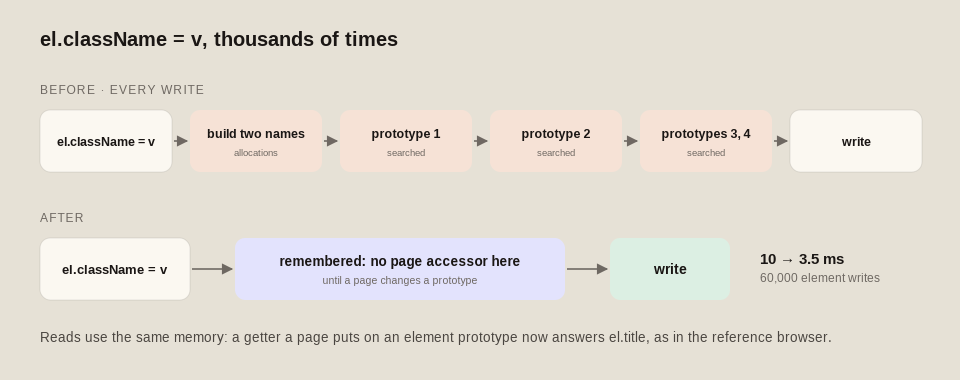
An element property write before and after: from a search of four prototypes to a remembered answer

Every el.className = v or el.textContent = v checked whether a page script had defined that property as an accessor on one of the element's prototypes: it built two names and searched four prototypes, every time, to learn that nothing was there. On a page that builds elements this was most of its script time. Floati now remembers the answer per element type until a page changes a prototype, which makes element-building three times faster. Reads use the same memory, which fixed a gap: a getter a page defines on an element prototype, as some monitoring and compatibility scripts do, now answers reads of that property as it does in the reference browser; before, Floati answered from its own value.

Building 3,000 elements, twenty times10 -> 3.5 msA getter on an element prototypenow answers reads

چه چیزی تغییر کرد

8 تغییر
  1. JavaScript و JITRecursive functions answer their simple case where they are called and run alternate levels inside their parent: a tree walk makes a fraction of the calls.
  2. JavaScript و JITRecursion whose last step returns a property (a tree's depth, a count) now compiles: a tree depth 272 -> 24 ms.
  3. JavaScript و JITOnce a recursive function has run, its property reads are compiled again with the layouts they saw built in.
  4. JavaScript و JITLong loops that walk a list, keep the best object so far, copy or compare objects, or ask typeof run in the fastest loop tier: a 5 million step walk 241 -> 12.4 ms.
  5. حافظه و خواندنSetting properties on page elements remembers that no page accessor intercepts them: building elements is three times faster.
  6. JavaScript و JITA getter a page defines on an element prototype now answers reads of that property, as in the reference browser.
  7. حافظه و خواندنFixed: freeing a long linked list built inside a function no longer overflows the stack and closes the page.
  8. زبانه‌ها و رابطFloati's pages and update notes now open at browser.floati.life.

در مرورگر خودتان امتحان کنید

هر آزمون همین حالا در مرورگری که با آن می‌خوانید اجرا می‌شود. چیزی به جایی فرستاده نمی‌شود.

بررسیمرورگر شماFloati
A recursive base case that returns a property still adds upدر حال بررسیبله
An unrolled recursion keeps its arguments in orderدر حال بررسیبله
A setter added to an element prototype after many writes runsدر حال بررسیبله
A long walk around a ring of objects keeps its placeدر حال بررسیبله
The largest object found in a loop is that very objectدر حال بررسیبله
Equal strings compare equal in a hot loopدر حال بررسیبله
Typeof in a hot loop tells functions, arrays and null apartدر حال بررسیبله
A long list built in a function is freed when it returnsدر حال بررسیبله
قبول 8 / 8
همه چیز از v0.1.356 به بعد در یک جا

نسخه‌ها

v0.1.0 - 0.1.9 · 10 ژوئیه 2026418v0.1.427 · 25 نوامبر 2026

نوامبر2026 · 3 نسخه

اکتبر2026 · 7 نسخه

سپتامبر2026 · 14 نسخه

32026 سپتامبرPages no longer freeze while a script waits on the networkv0.1.320 · JavaScript و JIT 31725 سپتامبرCloser to the reference browser, and no more address bar tricksv0.1.317 · APIهای وب و DOM 30924 سپتامبرPages arrive like they do in the reference browser, in a fraction of the memoryv0.1.309 · شبکه13 30322 سپتامبرHTTP/3 is on, and it is ours: the fastest web protocol, built from scratchv0.1.303 · شبکه 30222 سپتامبرThe site you open stays your business, and the browser checks every certificate itselfv0.1.302 · حریم خصوصی و Shields 30019 سپتامبرReads the newest web compression, reuses secure connections, and remembers where sites livev0.1.300 · حافظه و خواندن 29919 سپتامبرPages start loading sooner: smarter connections and a faster path onto slow networksv0.1.299 · شبکه 29516 سپتامبرClass-based JavaScript runs dramatically faster: calling a method through a list of objects is now many times quickerv0.1.295 · JavaScript و JIT 29416 سپتامبرInteger, bitwise and pixel-processing JavaScript runs a lot faster, and the browser still proves every shortcut before it trusts itv0.1.294 · JavaScript و JIT 29316 سپتامبرClass-based and object-heavy JavaScript runs dramatically faster, with speed the browser proves before it trustsv0.1.293 · JavaScript و JIT 29216 سپتامبرRecursive JavaScript runs dramatically faster, so the heaviest in-page computation feels quickv0.1.292 · JavaScript و JIT 27811 سپتامبرA tracker can no longer follow you from one site to the nextv0.1.278 · نمایش صفحه 27610 سپتامبرSecurity you can check: an honest ledger, a referrer firewall, and mixed content shut downv0.1.276 · حریم خصوصی و Shields 2122 سپتامبرPages you render with Floati's own engine appear right away nowv0.1.212 · نمایش صفحه

اوت2026 · 14 نسخه

19421 اوتFaster on pages that change as you use them - plus a tab-hover fixv0.1.194 · زبانه‌ها و رابط 19321 اوتSelect text, find on the page, and zoom - plus faster renderingv0.1.193 · زبانه‌ها و رابط 19220 اوتCrisp, high-resolution rendering on retina screensv0.1.192 · نمایش صفحه 18018 اوتSee how much of a whole page's download actually showed up on screenv0.1.180 · حریم خصوصی و Shields 17618 اوتWitness Mode: cryptographic, offline proof of what a site showed you (a world-first)v0.1.176 · حریم خصوصی و Shields 17418 اوتCounterfactual Browsing: see exactly what a script did to your page (a world-first)v0.1.174 · حریم خصوصی و Shields 17016 اوتRender Receipts: seal a page into proof the reference browser structurally cannot offerv0.1.170 · APIهای وب و DOM 12813 اوتHSTS: sites that demand https are never reached over plaintext, not even oncev0.1.128 · شبکه 12713 اوتEncrypted DNS (DoH) inside the engine, so your network cannot see which sites you look upv0.1.127 · شبکه 12613 اوتReal HTTP/2 multiplexing: many streams share one connectionv0.1.126 · شبکه 1067 اوتA real, deterministic AnalyserNode FFTv0.1.106 · نمایش صفحه 1057 اوتHTTP/2: the modern web transport, from scratchv0.1.105 · رسانه 966 اوتStateful audio DSP: filters, delay and waveshapingv0.1.96 · رسانه 661 اوتThe worst score on the board turned out to be a cookie bannerv0.1.66 · نمایش صفحه9

ژوئیه2026 · 4 نسخه