Tutte le versioni v0.1.35916 Ott 2026Rendering, JavaScript e JIT, Schede e interfaccia Feed

Le note di rilascio sono scritte in inglese.

Thermal reads object members and folds Math, string building compiles, and methods, Array subclasses and globals behave as the standard says

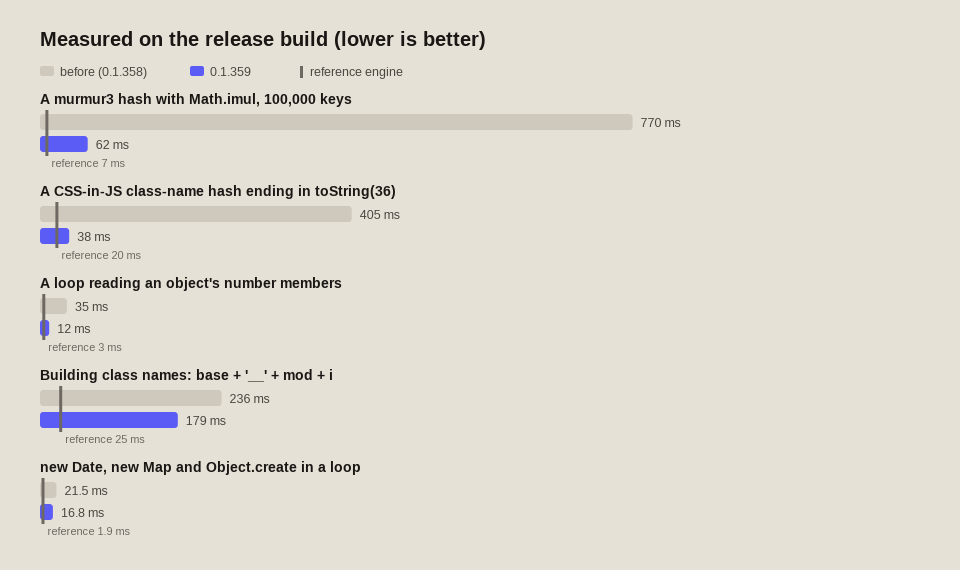
Thermal, the optimizing compiler Floati writes for itself, now compiles three kinds of code it used to refuse a whole function for: Math.imul, floor, ceil, sqrt, abs, min and max, each folded into one instruction; number members of an object a function is given (p.x), checked against the layout the page has been using; and a step after the loop it cannot compile, such as turning a hash into text with toString(36), which it now hands to the interpreter instead of giving up on the loop. A murmur3 hash runs 12 times faster than in 0.1.358 and a CSS-in-JS class-name hash 11 times faster, with less memory. Functions that build strings from template literals or 'text' + value, and functions that use new, now compile too. Four differences from the standard are fixed: methods and getters can no longer be called with new, class X extends Array makes real arrays, a global created by a plain assignment is a property of window, and an object in a template literal converts the way the standard says. Real pages measure the same as before, and Floati can now write x86-64 code for Intel and Windows machines behind a switch while that code is made smaller.

770 -> 62 ms (reference engine 7)A murmur3 hash with Math.imul
236 -> 179 msBuilding class names
8 of 8 the sameRelease checks against the reference browser
In evidenza3

Three things Thermal no longer refuses a function for

Three things Thermal compiles now: folded Math methods, object member reads with a layout check, and a hand-over after the loop
Before, after and the reference engine for five measurements

Thermal compiles a hot loop with its numbers kept in the processor's registers, but until now one operation it did not understand anywhere in a function meant the whole function stayed on Gust. Math methods are now folded: Math.imul becomes one 32-bit multiply and Math.min one instruction, behind a single check when the function starts that Math and its methods are still the built-ins, so a page that replaces Math.imul still gets its own function called. A member read like p.x of an object the function was given checks the object's layout against the one that site has seen, loads the value from its slot, and makes sure it is a number. And an operation after the loop that Thermal does not compile, the toString(36) that ends a CSS-in-JS hash for example, no longer refuses the function: the loop runs in registers, then the values are written into the frame the interpreter uses and the interpreter runs the last few steps. Every one of these leaves for the interpreter in the same way when its check fails, and every test map also runs with Thermal forced to leave at every third operation.

A murmur3 hash with Math.imul770 -> 62 ms (reference engine 7)A CSS-in-JS class-name hash405 -> 38 ms, peak memory 33.7 -> 18.9 MB

String building and new compile

A function with a template literal (`${a}-${b}`) or a concatenation that starts with text ('id-' + n) used to stay in the interpreter, because the compiled tiers had no operation for turning a value into text. They have one now, shared with the interpreter so both convert the same way, and a chain like base + '__' + mod + i that does not start with text is now built in one step once its first piece of text is reached, instead of making a new string at every plus. Functions that use new compile too: built-in constructors such as Date and Map now remember what kind of constructor they are instead of searching their own properties on every new, which made a loop creating dates and maps a fifth faster.

Building class names236 -> 179 msnew Date, new Map, Object.create in a loop21.5 -> 16.8 ms

Closer to the standard

A method written as m() {} or a getter can no longer be called with new, and has no prototype, as the standard requires. class X extends Array now makes real arrays: new X(3) has length 3, Array.isArray says true, X.from and X.of make an X, and map, filter, slice and concat on an X give an X back. A variable created by assigning to an undeclared name in sloppy code is now a property of window, so 'x' in window, Object.keys(window), its property descriptor and delete window.x all see it. And `${obj}` now asks the object for a primitive the standard way: toString first, valueOf if toString is missing, and a TypeError for a Symbol wrapper. Fixing the third one also fixed how a global's value and window's copy of it stay in step when there is more than one script realm, such as frames.

Release checks against the reference browser8 of 8 the same

Cosa è cambiato

7 modifiche
  1. RenderingThermal folds Math.imul, floor, ceil, sqrt, abs, min and max into single instructions, behind one check that they are still the built-ins: a murmur3 hash 12 times faster.
  2. JavaScript e JITThermal reads number members of an object a function is given (p.x), checked against the layout the page has been using: a member-heavy loop nearly 3 times faster.
  3. JavaScript e JITA step after a loop that Thermal cannot compile no longer refuses the whole function: a CSS-in-JS class-name hash 11 times faster, with 15 MB less at the peak.
  4. RenderingTemplate literals and 'text' + value concatenation compile; chains build their string once instead of at every plus.
  5. RenderingFunctions that use new compile, and built-in constructors no longer search their own properties on every new.
  6. JavaScript e JITMethods and getters are not constructors; class X extends Array makes real arrays; a plain assignment's global is a property of window; template literals convert objects as the standard says.
  7. Schede e interfacciaFloati can write x86-64 code for Intel and Windows machines (Gust), behind a switch for now: it is correct on every test, but its code is too large to be faster yet.

Prova nel tuo browser

Ogni test gira dal vivo nel browser con cui stai leggendo. Non viene inviato nulla.

VerificaIl tuo browserFloati
Math.imul in a hot hash loop gives 32-bit answersVerifica in corsoSì
a hash loop whose answer ends in toString(36) is the same in a hot functionVerifica in corsoSì
new of a method or a getter throws a TypeErrorVerifica in corsoSì
class extends Array makes real arraysVerifica in corsoSì
a global made by a plain assignment is a property of windowVerifica in corsoSì
a template literal converts an object with toString first, then valueOfVerifica in corsoSì
new Date and new Map in a hot function stay correctVerifica in corsoSì
a hot loop reading an object parameter follows a changed layoutVerifica in corsoSì
Superati 8 / 8
Tutto dalla v0.1.359 in un unico posto

Versioni

v0.1.0 - 0.1.9 · 10 Lug 2026418v0.1.427 · 25 Nov 2026

Ottobre2026 · 33 versioni

37121 OttDrop files onto pages, dictate without your voice leaving the Mac, and controllers that rumblev0.1.371 · API web e DOM · provalo 37021 OttOpen your files, share to your phone, have pages read aloud, install sites as apps, play with a controller, and accented text drawn rightv0.1.370 · Privacy e Shields · provalo11 36920 OttPasskeys with Touch ID and Windows Hello, sites that work offline, notifications you allow, and devices asked for first, all kept on your devicev0.1.369 · Privacy e Shields · provalo9 36820 OttA site's own security rules are kept the whole time the page runs, Trusted Types, a map of every unsafe write in DevTools, and animations from scriptv0.1.368 · Privacy e Shields · provalo 36720 OttEvents, form controls, performance timing, URL patterns, live streams and the newest JavaScript: the Web APIs score rises from 59 to 62v0.1.367 · API web e DOM · provalo10 36619 OttEvents, custom form controls, fonts and navigation work the way the web standards say: the Web APIs score rises from 53 to 59v0.1.366 · API web e DOM · provalo9 36519 OttThe code-size budget fits your processor, and code that has gone cold makes room for code that is hot nowv0.1.365 · JavaScript e JIT · provalo 36419 OttCompiled code that fits the processor's caches: big pages up to 1.8 times faster, and fast compiled code on Windows and Intel machinesv0.1.364 · JavaScript e JIT · provalo 36319 OttThermal runs on one code generator, building strings is up to 8 times faster, and two slow paths that grew with the square of their input are linearv0.1.363 · JavaScript e JIT · provalo12 36219 OttA page scheduler that stalled now runs, try / finally and spreads compile, and deleting thousands of properties is 180 times fasterv0.1.362 · Rendering · provalo 36118 OttThermal runs on Windows and Intel machines, a register fix for compiled code on Windows, try / catch compiles, and reading a growing string is 200 times fasterv0.1.361 · JavaScript e JIT · provalo 36018 OttEvery byte of machine code is Floati's own, a news site that showed blank renders, Gust's code is half the size, and closures and ?? compilev0.1.360 · JavaScript e JIT · provalo9 35916 OttThermal reads object members and folds Math, string building compiles, and methods, Array subclasses and globals behave as the standard saysv0.1.359 · JavaScript e JIT · provalo 35816 OttThermal, Floati's own optimizing compiler, is on: hot loops keep their numbers and strings in registersv0.1.358 · JavaScript e JIT · provalo 35715 OttLoops that test a number run as machine code, more of your functions compile, and reading page nodes is three times fasterv0.1.357 · JavaScript e JIT · provalo14 35614 OttRecursion makes a fraction of the calls, loops keep objects in registers, and element writes stop searchingv0.1.356 · JavaScript e JIT · provalo 35514 OttA hot loop changes compiler without stopping, property writes skip the detour, and pure recursion remembers its answersv0.1.355 · JavaScript e JIT · provalo 35413 OttFloati compiles JavaScript with its own compiler, Updraft: about a hundred times faster to compile, and compiled code no longer piles upv0.1.354 · JavaScript e JIT · provalo 35311 OttStyle matching tries a third of the rules, queries prepare their selector once, sibling walks stay fastv0.1.353 · Rendering · provalo 35211 OttCode that loads on demand starts at once, images decode beside their downloads, writes run compiledv0.1.352 · Rendering · provalo10 35111 OttStyles read once, layouts redone only where they changed, built-ins in compiled loopsv0.1.351 · JavaScript e JIT · provalo12 35010 OttHelpers that compile, strings that stay small, and events that fire fastv0.1.350 · JavaScript e JIT · provalo14 34910 OttScripts that grow in step with their work, layouts laid out once, and colours mixed like the referencev0.1.349 · Rendering · provalo13 3489 OttScripts that only compile when it pays, cards that line up, and bold that stays boldv0.1.348 · Rendering · provalo14 3478 OttCards inside links, small print at its real size, and errors you can followv0.1.347 · Rendering · provalo17 3467 OttA real performance timeline, site icons from the engine with a lookalike check, and forms that lay out rightv0.1.346 · Rendering · provalo14 3457 OttReal WebGL, a real 2D canvas, and canvas text that matches the reference browserv0.1.345 · Rendering · provalo10 3436 OttSign-ins that stay signed in, a real IndexedDB, and a storage button that shows what sites keepv0.1.343 · Privacy e Shields · provalo25 3425 OttTheme switchers, chart labels sized by CSS, and SVG text you can measurev0.1.342 · API web e DOM · provalo 3415 OttCanvas text measured and drawn like the reference browser, and SVG shapes you can measurev0.1.341 · Rendering · provalo 3405 OttScripts can read and change SVG the way they do in the reference browser, and a hidden hang is gonev0.1.340 · Rendering · provalo10 3395 OttEvery computed style, real stylesheet objects and full 3D geometry, each checked against the reference browserv0.1.339 · API web e DOM · provalo12 3385 OttPages load faster, render truer and gain a dozen modern web features, each one checked against the reference browserv0.1.338 · API web e DOM · provalo19