모든 버전 v0.1.36018 10월 2026렌더링, JavaScript와 JIT, 탭과 인터페이스 피드

릴리스 노트는 영어로 작성되어 있습니다.

Every byte of machine code is Floati's own, a news site that showed blank renders, Gust's code is half the size, and closures and ?? compile

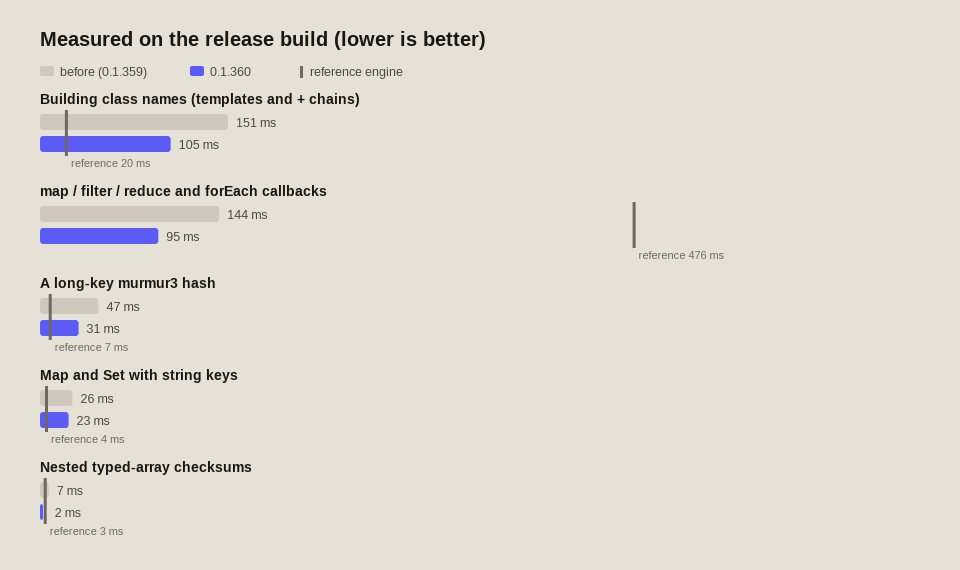
Floati now writes all of its machine code itself. The five compilers that turn hot JavaScript into machine code build Updraft IR, Floati's own compiler core, which Floati lowers to ARM64 and x86-64 code with no outside code generator in the browser any more: compiles take about half the time, the code is smaller and faster, and the browser program is 2.45 MB smaller. A large news site that showed as a blank strip in 0.1.359 renders in full again: a function's own variables were confused with a global of the same name declared inside one of its inner functions, so a framework's library read as undefined. Functions whose inner functions capture their variables, and functions that use ?? or ?., now compile instead of staying in the interpreter. Gust, the instant compiler, makes half the code it did, and its x86-64 version now runs correctly on Windows. Strings are faster and lighter (building class names 151 -> 105 ms with 3.7 times fewer allocations, a long-key hash 47 -> 31 ms), a script declaring 16,000 global functions starts in 22 ms instead of 935, callbacks over arrays run 5 times faster than in the reference engine, and a paused Map or Set iterator no longer skips an entry.

2.45 MB smallerThe browser program
64 -> 13,214 pixelsThe news site's page height
18.5 -> 9.05 MBGust code for 1,500 warm functions
주요 내용4

Why Floati now writes all of its own machine code

Every compiler in Floati now builds Updraft IR, which Floati lowers itself to ARM64 and x86-64 machine code
Before, after and the reference engine for each measurement

Updraft is the machine-code compiler Floati builds for itself. Its first tiers shipped earlier this month: Gust, which turns a function into machine code in under a microsecond per operation, and Thermal, which keeps a hot loop's numbers in the processor's registers. Until this release the other five compilers (hot loops, callbacks and recursion, batch drivers, whole functions, and typed-array vector kernels) still handed their work to a general-purpose code generator written for other projects. Now all five build Updraft IR, and Floati lowers it itself: registers chosen by linear scan, repeated values merged, loop-invariant code hoisted out of loops, checks fused into the branches that read them, and 128-bit vectors on both CPUs. Why build our own: the outside generator spent about 100 times longer per operation than a page can afford on code that runs only a few times, it knew nothing about JavaScript values or Floati's page objects, it kept code memory we could not free, and it was the last large part of the engine Floati did not own. The business decision was to own the whole engine, as Floati owns its layout, network and media code, but to remove the outside generator only once ours matched or beat it on every axis we measure. It did: an integer loop 29 -> 23 ms on ARM64, callbacks over arrays 120 -> 101 ms, entry code 238 -> 216 bytes per function in half the compile time, 1.2 times faster code on x86-64, and vector sums on Windows 175 -> 4.5 ms (the old generator could not build them there at all). Every compiled program is checked against what the IR means: 100,000 random programs with 8 inputs each, plus every test map in 13 tier configurations.

The browser program2.45 MB smallerCallbacks over arrays144 -> 95 ms (reference engine 476)

A blank news site renders again, and closures compile

A news site with a front page built by a JavaScript framework showed as a 64-pixel strip in 0.1.359, with 30 copies of one error: a property read on undefined. The cause was in how a function gets its fast plan: a var declared inside one of its inner functions was counted as the outer function's own variable, so the outer function's reads of a global with the same name, the framework's library here, read that empty variable instead. Inner functions are now left out of the scan, and the fix came with a larger change: a function whose inner functions capture its variables used to stay in the interpreter, and now gets a plan. The captured variables live in one scope made when the function is called, the way a function context works, and everything else stays in registers. Functions that use ?? and ?. compile as well. On a recorded load of the same site, functions refused a plan fell from 343 to 232.

The news site's page height64 -> 13,214 pixelsFunctions refused a plan on that site343 -> 232

Gust's code halved

Gust copied every slow path at every place it could happen: each reference count drop, each stack check and each call into the runtime carried its own save, call and restore sequence. Now each kind of slow path is one routine per function, and a site makes a short jump into it, so Gust's code for 1,500 warm functions fell from 18.5 to 9.05 MB, which also means less to compile and more of it fits in the processor's cache. Gust's x86-64 version for Intel and Windows machines now uses the Windows calling convention there, and its shared routines belong to one thread each: a routine shared across threads could read another thread's view of a replaced method, a wrong answer the new test caught 241 times in 600 runs before the fix. x86-64 Gust stays behind a switch while its code is made smaller still.

Gust code for 1,500 warm functions18.5 -> 9.05 MB

Strings, start-up and iterators

A string literal in a hot function was boxed into a new string on every call: 'a' + i + 'b' made three strings where one is the answer. It is now the literal's own value, so building class names makes 3.7 times fewer allocations. Reading s.length no longer copies the string, Map and Set hash their string keys 8 bytes at a time with a seed chosen per run, and Thermal now compiles hash loops that read strings. A script declaring many global functions checked each new name against all the earlier ones, so setting up 16,000 took almost a second; it is a single pass now. And a Map or Set iterator paused while its collection was compacted many times resumed at the wrong place and skipped an entry; it now keeps an ordinal and resumes exactly.

Building class names151 -> 105 ms, 3.7 times fewer allocations16,000 global functions set up935 -> 22 msRelease checks against the reference browser8 of 8 the same

바뀐 점

변경 9개
  1. JavaScript와 JITEvery native compiler in Floati builds Updraft IR, lowered by Floati itself on ARM64 and x86-64; the outside code generator is gone and the browser program is 2.45 MB smaller.
  2. JavaScript와 JITFaster code on both CPUs: an integer loop 29 -> 23 ms, callbacks over arrays 144 -> 95 ms (the reference engine 476), vector sums on Windows 175 -> 4.5 ms.
  3. 렌더링A large news site that showed as a blank strip renders in full: a variable declared in an inner function no longer hides a global from the outer one.
  4. 렌더링Functions whose inner functions capture their variables, and functions using ?? and ?., compile instead of staying in the interpreter.
  5. 탭과 인터페이스Gust makes half the code (18.5 -> 9.05 MB on 1,500 functions), and x86-64 Gust runs correctly on Windows.
  6. JavaScript와 JITStrings: one value per literal (3.7 times fewer allocations building class names), length without a copy, faster string keys in Map and Set, and hash loops over strings in Thermal.
  7. 렌더링A script declaring 16,000 global functions starts in 22 ms instead of 935.
  8. 렌더링A paused Map or Set iterator keeps its place through any number of compactions.
  9. JavaScript와 JITEach iterator kind has its own prototype behind Iterator.prototype, and matchAll returns an iterator, as the standard says.

내 브라우저에서 확인

각 확인 항목은 지금 읽고 있는 브라우저에서 바로 실행됩니다. 아무것도 전송되지 않습니다.

검사내 브라우저Floati
a closure keeps a live binding to its function's local in a hot function확인 중예
?? and ?. give the standard answers in a hot function확인 중예
a paused Map iterator keeps its place through heavy churn확인 중예
length of a string with astral characters in a hot loop확인 중예
a long-key murmur3 hash gives 32-bit answers in a hot function확인 중예
strings built in a hot function from text and numbers확인 중예
a nested Uint8 checksum gives the same total확인 중예
each iterator kind has its own prototype behind Iterator.prototype확인 중예
통과 8 / 8
v0.1.360 이후 전부를 한곳에서

버전

v0.1.0 - 0.1.9 · 10 7월 2026418v0.1.427 · 25 11월 2026

11월2026 · 버전 40개

42725 11월Layouts that remember their work최신 · v0.1.427 · 렌더링9 42625 11월Compiled with what real pages runv0.1.426 · JavaScript와 JIT 42525 11월Built with whole-program optimizationv0.1.425 · 렌더링 42425 11월More layout reused after a script changes the pagev0.1.424 · 렌더링 42324 11월The optimizing compiler works off the main threadv0.1.423 · 렌더링 42222 11월Text-reading loops and element-tree builders run fasterv0.1.422 · JavaScript와 JIT14 42122 11월Calls from loops run inside the loop's own machine codev0.1.421 · JavaScript와 JIT9 42021 11월Pages you come back to run their scripts soonerv0.1.420 · 렌더링17 41918 11월A faster interpreter runs the page's codev0.1.419 · JavaScript와 JIT12 41815 11월Scripts run faster on busy pagesv0.1.418 · JavaScript와 JIT34 41711 11월Pages wait less for their own scripts and stylesv0.1.417 · JavaScript와 JIT13 41611 11월WebGPU loops run 2 to 3 times faster on Macsv0.1.416 · JavaScript와 JIT 41510 11월WebGPU loops count right on Macsv0.1.415 · JavaScript와 JIT 41410 11월WebGPU runs in its own graphics processv0.1.414 · 렌더링 41310 11월A graphics card reset no longer takes the browser downv0.1.413 · 렌더링 4129 11월Video moves to the graphics cardv0.1.412 · 미디어 4119 11월No canvas stall on Windows, patterns and every blend mode on the graphics cardv0.1.411 · 렌더링 4109 11월Canvas drawing moves to the graphics cardv0.1.410 · 렌더링27 4098 11월Every tile on the GPUv0.1.409 · 렌더링26 4088 11월3D at 120 frames a secondv0.1.408 · 렌더링23 4077 11월WebGL 2v0.1.407 · 렌더링36 4066 11월A stuck tab stops at oncev0.1.406 · 렌더링16 4055 11월Small WebGL drawings get smooth edgesv0.1.405 · 렌더링 4045 11월WebGL pages finally movev0.1.404 · 렌더링25 4035 11월WebGPU is herev0.1.403 · 렌더링35 4024 11월A canvas that moves itself to the GPUv0.1.402 · 렌더링 4014 11월99% of real pages decided by the GPUv0.1.401 · 렌더링9 4004 11월Smooth turns, the same bytes on every chip, and fields that keep their textv0.1.400 · 렌더링15 3994 11월Animations on the GPU compositor, and text that stays in its boxv0.1.399 · 렌더링22 3984 11월Gradient patterns that tile, animations that keep up, and a much faster canvasv0.1.398 · 렌더링14 3973 11월Transitions that ease, and a GPU that draws 94% of real pages itselfv0.1.397 · 렌더링 3963 11월Animations on the GPU compositor, and spinners that spin as arcsv0.1.396 · 렌더링 3953 11월Carousels that fade, badges that stay put, and floats that stay insidev0.1.395 · 렌더링12 3943 11월Background images over their colour, interlaced pictures, and borders in every colourv0.1.394 · 렌더링 3932 11월Style sheets in page order, and symbols that fall back like macOSv0.1.393 · 렌더링 3922 11월Icon fonts loaded by script, and colour emoji on Windowsv0.1.392 · 탭과 인터페이스 3911 11월Emoji in colour, sized as in the reference browserv0.1.391 · JavaScript와 JIT 3901 11월A classified ads site's front page: blank before, whole nowv0.1.390 · JavaScript와 JIT12 3891 11월A computer maker's home page: navigation labels back, buttons apartv0.1.389 · 렌더링 3881 11월A space agency's home page, a news section and a language site's header now match the referencev0.1.388 · 렌더링18

10월2026 · 버전 58개

57개 더 보기
9월2026버전 124개 8월2026버전 140개

7월2026 · 버전 56개

6531 7월We started grading the engine on real websites, and five things broke immediatelyv0.1.65 · 렌더링 6431 7월An ad and tracker blocker built into the engine, not bolted onto itv0.1.64 · 개인정보 보호와 Shields 6331 7월Four real sites stopped breaking, and the engine learned to explain itselfv0.1.63 · 렌더링 6230 7월Scripts get much faster, and two of the speed-ups turned out to be switched offv0.1.62 · JavaScript와 JIT13 6130 7월Twenty rendering fixes found by scoring every test page against the reference browserv0.1.61 · 렌더링20 6030 7월Text that measures like the reference browser, an accessibility tree, web security, and animationsv0.1.60 · 렌더링11 5825 7월Rounded outlines, disclosure widgets, and a border reset fixv0.1.58 · 렌더링 5725 7월Form fieldsets render their legend properlyv0.1.57 · 렌더링 5624 7월Data tables and dropdowns render rightv0.1.56 · 렌더링 5524 7월Rounder corners, fixed card grids, numbered lists, decorated underlinesv0.1.55 · 렌더링 5424 7월Real 3D transforms, and the modern web renders faithfullyv0.1.54 · 렌더링 5323 7월Layout is essentially complete, and modern visual styling arrivesv0.1.53 · 렌더링 5223 7월Floati now reads HTML and CSS selectors exactly like the reference browserv0.1.52 · 렌더링 5123 7월Rendering a real page with Floati's own engine no longer hangsv0.1.51 · 미디어 5023 7월You can see when Floati is drawing the page itselfv0.1.50 · JavaScript와 JIT 4923 7월Sites you click start responding, and the web lays out like the reference browserv0.1.49 · 렌더링15 4822 7월Text breathes like the reference browser, and the old web settles into placev0.1.48 · 렌더링9 4722 7월Cards, columns and grids stop landing on top of each otherv0.1.47 · 렌더링 4622 7월Pages sit where they should on the screenv0.1.46 · 렌더링 4522 7월The websites that used to come out broken now come out rightv0.1.45 · 렌더링10 4421 7월A large encyclopedia works properly, and icons stop coming out as blobsv0.1.44 · 렌더링 4321 7월The heavy pages get another three to six times fasterv0.1.43 · 렌더링 4221 7월Real pages render three to twelve times fasterv0.1.42 · 렌더링 4121 7월Pages lay out faster, and even more JavaScript becomes machine codev0.1.41 · JavaScript와 JIT 4021 7월JavaScript now runs in machine codev0.1.40 · JavaScript와 JIT 3921 7월Second windows work, and loops with real helpers get compiledv0.1.39 · 탭과 인터페이스 3820 7월Loops that call a helper get compiledv0.1.38 · JavaScript와 JIT 3720 7월Text-scanning loops get much fasterv0.1.37 · JavaScript와 JIT 3620 7월Faster field reads, and loops over binary datav0.1.36 · 웹 API와 DOM 3520 7월Loops over objects get compiledv0.1.35 · JavaScript와 JIT 3420 7월The everyday array loop gets compiledv0.1.34 · JavaScript와 JIT 3319 7월Math in loops gets compiledv0.1.33 · JavaScript와 JIT 3219 7월Bit-twiddling loops get compiledv0.1.32 · 렌더링 3119 7월Faster loops over listsv0.1.31 · JavaScript와 JIT 3019 7월Hot loops get compiledv0.1.30 · JavaScript와 JIT 2919 7월Faster JavaScriptv0.1.29 · JavaScript와 JIT 2819 7월More of the modern web lays out rightv0.1.28 · 렌더링 2719 7월Pages that lay out the way they shouldv0.1.27 · 렌더링 2618 7월Highlight what you read, and find it againv0.1.26 · 기억과 읽기 2518 7월Columns line up, and Floati reads more closelyv0.1.25 · 렌더링 2418 7월Formulas at the right sizev0.1.24 · 렌더링 2318 7월Math formulas, and pages that refused to loadv0.1.23 · 렌더링 2218 7월Navigation bars get their spacing backv0.1.22 · 렌더링 2118 7월Print sheets stay on paper, navs stop gluingv0.1.21 · 렌더링 2017 7월The whole font familyv0.1.20 · 렌더링 1917 7월Typography and icons, pixel for pixelv0.1.19 · 렌더링 1817 7월Real fonts, real picturesv0.1.18 · 렌더링 1717 7월Engine pages become real tabsv0.1.17 · 탭과 인터페이스 1617 7월Six times faster, and jQuery worksv0.1.16 · 웹 API와 DOM 1516 7월Real sites render rightv0.1.15 · 렌더링 1415 7월Video plays on our own enginev0.1.14 · 미디어 1315 7월Tabs that know each otherv0.1.13 · 탭과 인터페이스 1214 7월The engine starts taking overv0.1.12 · 렌더링 1112 7월Pick your engine per sitev0.1.11 · 렌더링 1012 7월Your browsing, remembered locallyv0.1.10 · 기억과 읽기 0-910 7월First public releasesv0.1.0 - 0.1.9 · 기억과 읽기