De release-opmerkingen zijn in het Engels geschreven.
Scripts can read and change SVG the way they do in the reference browser, and a hidden hang is gone
Charts, maps and icon libraries talk to SVG through its object model: lengths with units, transform lists, view boxes, gradients. Floati had almost none of it. All 281 of the SVG members the reference browser has are now here, generated from the reference browser's own answers and checked on 1,604 cases every build. The engine's own checks also caught a rare hang: a common text-scanning loop could run forever once the code got hot. That is fixed, along with how regular expressions track their position, and a slowdown that switched off some of the engine's fastest paths on every page after the first. getComputedStyle now also lists all 475 CSS properties, like the reference browser.
Charts drawn by script appear

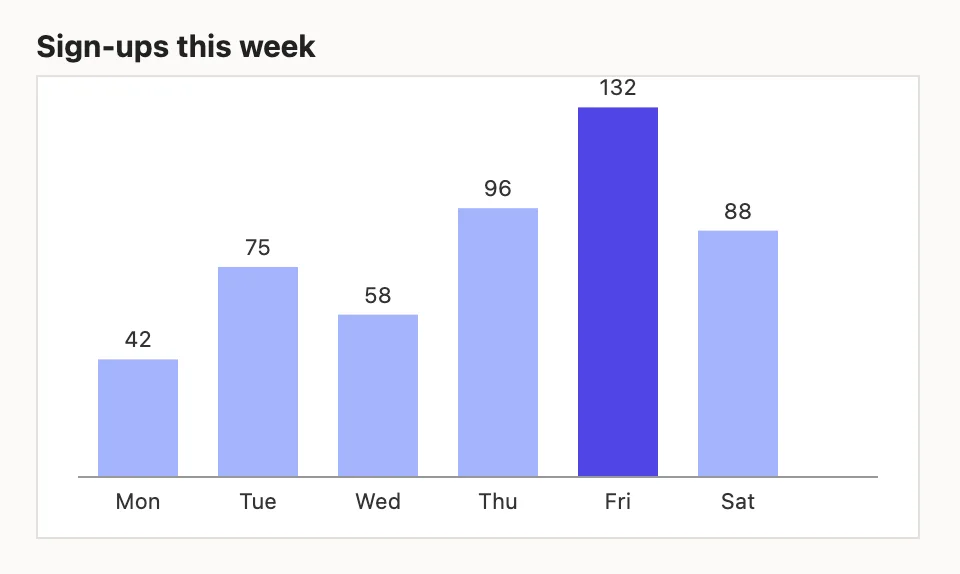
This chart is ordinary chart code: it sizes each bar through the SVG object model and places each label with a transform list, the way D3 and most chart kits do. On Floati those objects did not exist, so the script stopped at the first bar and the chart stayed empty. It now draws like the reference browser, labels included: SVG text also follows its transforms now, which chart axes rely on.
a bar chart built with the SVG object model
SVG you can script
D3, chart libraries and icon kits read and change SVG through objects: a rectangle's width as a length with a unit, a transform as a list you can edit, a gradient's units as a number. Floati had almost none of these, so those scripts saw nothing. Rather than write each one by hand, we asked the reference browser itself: a generator walks every SVG element the reference browser knows and records what each member is, which attribute it mirrors and how it starts. Every build then checks all of them on 1,604 cases: each one starts as the reference browser's does, and writing a value back leaves it unchanged.
A hang our own checks found
A very common way to scan text, looping until a regular expression finds no more matches, could run forever after the loop had run a few dozen times. The engine's fast path for that loop updated the expression's position directly, so when the fast path handed back to the slower one, the same step ran twice and the loop never found its end. Stateful expressions now stay on the exact path, and a new check runs these loops on every speed tier and compares them with the interpreter. Fixing it also brought replace, match, matchAll and split in line with the reference browser on how they move an expression's position.
Wat er veranderd is
10 wijzigingen- WeergaveThe SVG object model arrives: SVGLength (with units, percentages and font-relative sizes), SVGNumber, SVGAngle, SVGRect, SVGPoint, SVGMatrix, SVGTransform and editable transform lists, SVGPreserveAspectRatio, the number, length, point and string lists, and every SVGAnimated wrapper. All 281 animated members of every SVG element now exist and mirror their attributes both ways, plus the SVG element's factories (createSVGMatrix, createSVGPoint and the rest). 145 of 146 checks match the reference browser; the 146th is a reference-browser bug, where consolidating a transform list leaves the attribute out of date.
- WeergaveWhich member mirrors which attribute, its type, its keywords and its starting value come from the reference browser's own answers, recorded by a generator, so the table cannot drift by hand. Every build checks 1,604 generated cases against it.
- Web-API’s en DOMThe 16 filter-effect element types that were missing (feConvolveMatrix, feTurbulence, the lighting and component-transfer elements and more) have their own interfaces, and symbol elements are graphics elements, as in the reference browser.
- WeergaveSVG text follows its transforms: a label inside a group moved with transform, or with a transform of its own, is drawn where it belongs and at the transformed size. Chart axes position every label this way, so axis labels sat stacked at the top left. Rotated text is placed correctly but still drawn upright.
- Web-API’s en DOMAttribute names keep their case on SVG elements: getAttribute('viewBox') used to return nothing, and setAttribute('viewBox') stored a lowercase name, because every element folded names to lowercase. Only HTML elements do that now, as the DOM standard says.
- JavaScript en JITFixed: a loop that scans text with a global or sticky regular expression could run forever once it became hot, or silently skip matches. The fast path moved the expression's position directly, and a hand-back to the slower path repeated the step. A new check runs these loops on every speed tier, in a real page, and requires the interpreter's answer.
- WeergaveRegular expressions keep their position exactly as in the reference browser across replace, replaceAll, match, matchAll, search and split: global ones end at 0, sticky ones match where they stand and move on, matchAll starts where the expression stands and refuses a non-global one, and a sticky separator splits like any other. 25 of 25 checks match.
- JavaScript en JITFixed a slowdown on every page after the first: closing a page made its own clean-up look like a script rewriting the built-in Array, RegExp and String methods, which switched their fastest paths off for the rest of the session.
- JavaScript en JITgetComputedStyle lists every property, as the reference browser does: its length, numbered entries and Array.from give all 475 CSS properties in the reference browser's order, then the element's custom properties.
- WeergaveOur checks got stricter: the test runner now reports every failing test instead of stopping at the first, which had hidden two outdated tests behind an unrelated failure.
Probeer in je browser
Elke test draait live in de browser waarmee je leest. Er wordt niets verstuurd.





