Alle versies v0.1.37924 Okt 2026Weergave, Web-API’s en DOM, Privacy en Shields, Toegankelijkheid, Geheugen en lezen Feed

De release-opmerkingen zijn in het Engels geschreven.

Pages laid out the way their authors wrote them, and less memory again

A page-drawing release with more memory saved. Comparing Floati's picture of a page with the reference browser's, pixel by pixel, on a set of well-known sites showed where Floati laid pages out wrongly, and fourteen of those mistakes are fixed: which style rule wins when two disagree, how a line break, a grid, a flexible row and a font size written as a sum behave, where a line of text sits, and more. A design framework's documentation page went from 26 percent of its pixels different to 5, a news front page from 35 to 20. On memory, the same 33 randomly picked popular sites now use 4,301 MB in Floati against 10,377 MB in the reference browser on the same Mac (59 percent less; 0.1.378 used 4,524), the average site settles at 130 MB, and Floati uses less than the reference browser on 29 of the 33. Pictures nobody can see, because they are fully transparent or hidden, now give back their memory, and pictures on sharp screens are kept at exactly the pixels they are drawn at. Measured and tested on a Mac; the Windows build passes the same engine tests.

26 -> 5 percentA design framework's documentation page, pixels different from the reference
reference browser 10,377 MB -> Floati 4,301 MB33 random sites, total memory
Hoogtepunten2

Pages look the way they were written
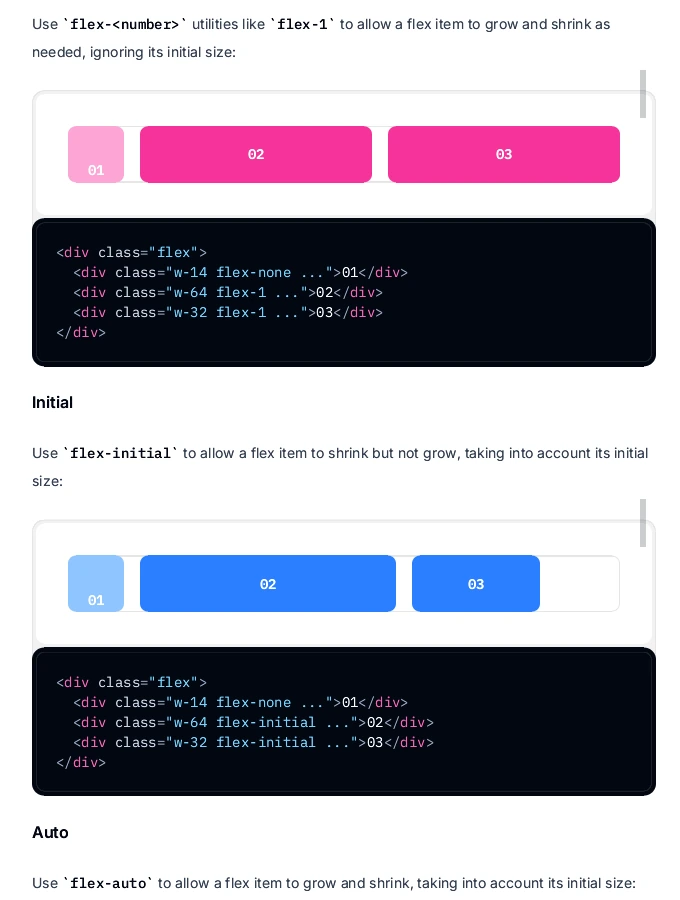
VoorNa
Voor: A design framework's documentation page: Floati 0.1.378, Floati 0.1.379 and the reference browser. The gaps under each example now match, so every heading below sits where the page puts it.
Voor
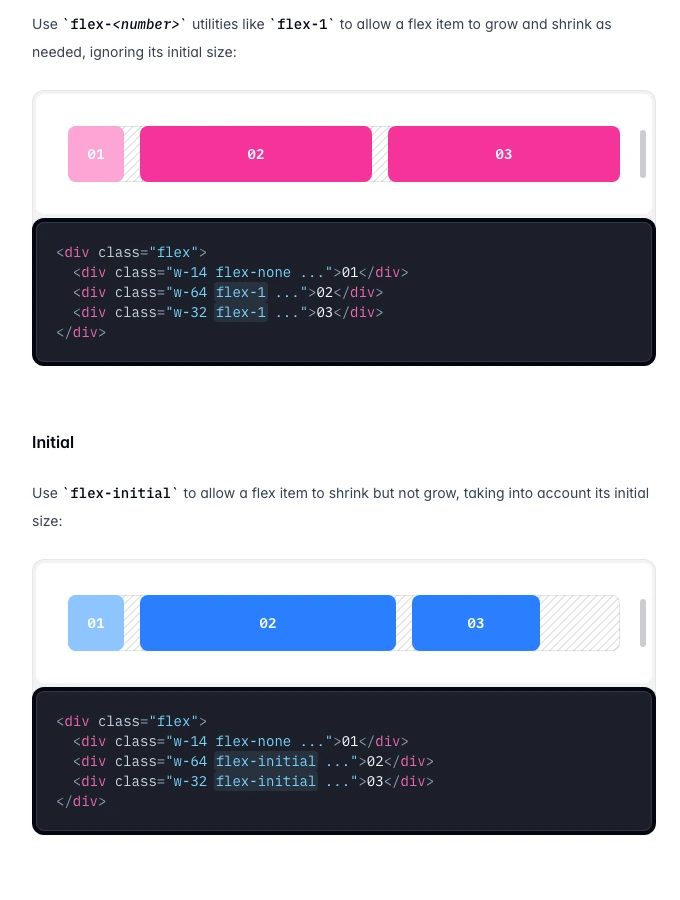
Na: A design framework's documentation page: Floati 0.1.378, Floati 0.1.379 and the reference browser. The gaps under each example now match, so every heading below sits where the page puts it.
Na · v0.1.379
Dezelfde pagina in de referentiebrowser
Referentiebrowser

To find layout mistakes we draw well-known pages in Floati and in the reference browser and compare them pixel by pixel, then shrink each difference down to a few lines of page code and check that rule against the reference. Fourteen fixes came out of it. When a site's style sheet marks a rule as important it now beats a style written on the element itself, as the standard says; it used to lose, so menus and buttons sat in the wrong place. Rules written with the newer selector forms (is, where, not, has) now weigh exactly as much as they should, so the right one wins. A line break at the end of a line no longer starts an empty extra line. A font size written as a sum (a calc) is worked out once, so everything inside inherits the size and not the formula. A line height written in em or percent is fixed where it is written, so text inside a bigger heading does not grow its own gaps. Grids now share the height of a tall item among the rows it spans the way the reference does and understand rows named by the page, flexible rows stretch their items to the exact height the page set, an overlay over a picture covers the whole picture, labels meant only for screen readers no longer push the header down, and a button with a two-line label lines up with its neighbours. Every fix has a test that fails without it.

A design framework's documentation page: Floati 0.1.378, Floati 0.1.379 and the reference browser. The gaps under each example now match, so every heading below sits where the page puts it.

A design framework's documentation page, pixels different from the reference26 -> 5 percentA news front page35 -> 20 percent13 well-known sites, total difference181 -> about 140

Less memory on the same random sites

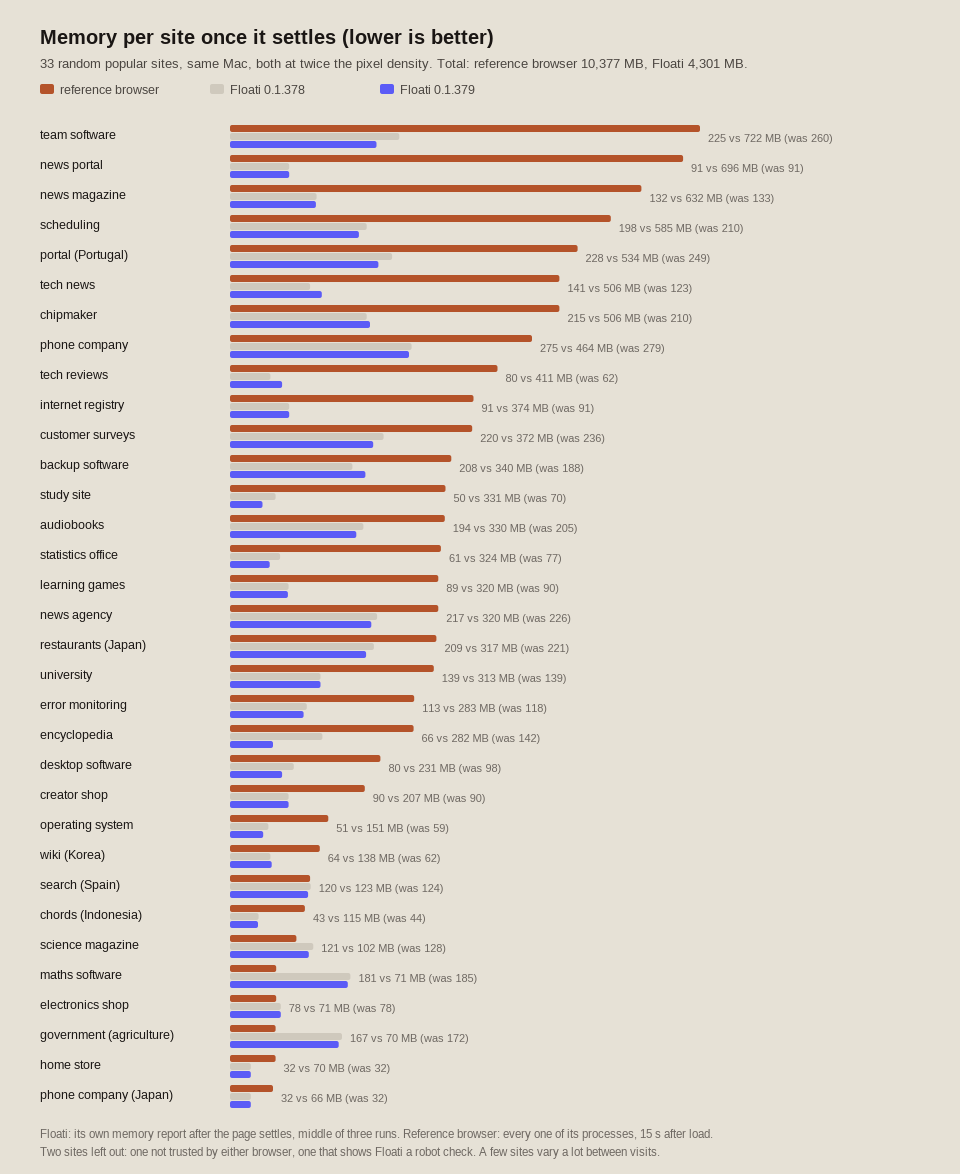
Memory per site after it settles: the reference browser, Floati 0.1.378 and Floati 0.1.379, same Mac, same screen density

The same 33 sites as in the last two releases, picked at random from a public list of the most visited websites, opened in Floati on the same Mac at twice the pixel density, three times each (the middle result is shown). Floati used 4,301 MB in total, against 10,377 MB for the reference browser and 4,524 MB for 0.1.378, and less than the reference browser on 29 of the 33. Three changes did most of it. A picture that is fully transparent or hidden (the resting slides of a fading slideshow, for example) is not drawn, so it now gives its memory back like a picture far down the page, and takes it again the moment it shows. On a sharp screen a picture is kept at exactly the pixels it is drawn at, where Floati used to keep a quarter more in case the box grew, and background pictures are kept at the size they are painted, not their full file size. And each picture keeps only one form: the compressed file or the drawn pixels, whichever it needs, never both. An encyclopedia went from 142 to 66 MB, a study site from 70 to 50, a team software site from 260 to 225. Four sites still use more than the reference browser: a maths software site, a government site, a science magazine and a shop, mostly because of large pictures and the compiled code of scripts that never run.

33 random sites, total memoryreference browser 10,377 MB -> Floati 4,301 MBFloati 0.1.378 -> 0.1.3794,524 -> 4,301 MBAverage site, settled130 MBSites where Floati uses less29 of 33

Wat er veranderd is

22 wijzigingen
  1. WeergaveAn !important rule in a style sheet now beats a style written directly on the element, the order the standard sets (normal rules, then the element's own style, then important rules). A page that forces a margin with !important now gets it.
  2. WeergaveA scrolling panel inside a column of fixed height keeps the height the column gives it and scrolls its own content, instead of growing to fit everything and spilling over the panel below.
  3. Web-API’s en DOMSelector weights follow the newest standard: :where() adds nothing, while :is(), :not() and :has() weigh as much as their strongest part. A CSS framework's 'weakest' typography rules no longer beat stronger ones, so its documentation headings get the right spacing (pixel difference from the reference 26 -> 17 percent).
  4. WeergaveA line break (<br>) ends the line it sits on: one at the end of a line no longer opens an extra empty line, and one at the start breaks before what follows. Code blocks that end every line with a break were drawn twice as tall.
  5. WeergaveA font size written as a formula (calc(), such as 'one em minus 20 percent') is worked out once where it is written, so nested elements inherit the result instead of shrinking the text again at every level. A docs site's live code editor drew its code as faint dashes 4 pixels tall; it is 13.6 pixels now, as in the reference.
  6. WeergaveA line height written in em, percent or rem is turned into pixels where it is declared and passed down as pixels, so a large heading inside a smaller block no longer gets a line nearly twice too tall. Plain numbers still pass down as numbers, as the standard says.
  7. WeergaveA flexible row with a set height stretches its items to exactly that height; taller content now overflows instead of making the row taller (a news site's 32 pixel logo row had become 36).
  8. WeergaveAn inline block whose text sits inside nested boxes lines up on that text's baseline, so navigation bars and story lists built that way are no longer taller than they should be (one list was 107 pixels too tall).
  9. WeergaveA full-cover overlay inside a box whose height comes from its content now sizes against that box's final height; such overlays came out 0 pixels tall.
  10. WeergaveFlex items sized with fit-content, max-content or min-content keep that size instead of being stretched across the card.
  11. WeergaveA stretched flex column counts as having a known height for what is inside it, so footers pushed to the bottom with margin-top: auto now sit at the bottom of their card.
  12. ToegankelijkheidLabels hidden for screen readers (positioned off-screen) take no room in the line they sit in; they made a news site's masthead 31 pixels taller.
  13. WeergaveGrid items that span several rows share their extra height the way the standard describes, filling rows that can still grow first; four common shapes now match the reference exactly.
  14. WeergaveGrids understand named row lines (grid-row: headline), and row templates that name their lines size their rows correctly; the names used to be read as extra rows.
  15. Geheugen en lezenPictures that are invisible (inside something fully transparent or hidden) give their memory back and take it again only when they show. A fade carousel's waiting slides are exactly this.
  16. Geheugen en lezenEach picture now keeps only the smaller of its two forms it needs: a picture on screen keeps its pixels, a hidden or far one only its file. Photo PNGs could never be given back before. A restaurant guide went from 252 to 211 MB.
  17. Geheugen en lezenOn sharp (2x) screens a picture keeps exactly the pixels its box shows, with no extra quarter kept 'for zooming' (zooming decodes it again at the new size anyway), and is shrunk once it is 1.2 times too wide instead of 1.5. A chipmaker's site went from 230 to 199 MB.
  18. Geheugen en lezenBackground pictures are shrunk to the size their drawn copy needs, whether they are covered, contained or tiled, and grow back when the box gets bigger. A phone company kept a 3200 pixel strip behind a box 2 pixels tall.
  19. WeergaveGroundwork for compiling functions only when they first run: those functions now share their script's text instead of each keeping a copy.
  20. Geheugen en lezenMeasured before building: combining half-empty memory pages would give back only 1 to 2 MB on the heaviest sites, so that idea was set aside in favour of the image work above.
  21. Geheugen en lezen33 random popular sites: 4,301 MB in Floati (0.1.378: 4,524) against 10,377 MB in the reference browser; the average site settles at 130 MB.
  22. Privacy en ShieldsKnown: module scripts from another site are not yet checked like other requests; four sites still use more memory than the reference browser.

Alles sinds v0.1.379 op één plek

Versies

v0.1.0 - 0.1.9 · 10 Jul 2026418v0.1.427 · 25 Nov 2026

november2026 · 40 versies

42725 NovLayouts that remember their workNieuwste · v0.1.427 · Weergave9 42625 NovCompiled with what real pages runv0.1.426 · JavaScript en JIT 42525 NovBuilt with whole-program optimizationv0.1.425 · Weergave 42425 NovMore layout reused after a script changes the pagev0.1.424 · Weergave 42324 NovThe optimizing compiler works off the main threadv0.1.423 · Weergave 42222 NovText-reading loops and element-tree builders run fasterv0.1.422 · JavaScript en JIT14 42122 NovCalls from loops run inside the loop's own machine codev0.1.421 · JavaScript en JIT9 42021 NovPages you come back to run their scripts soonerv0.1.420 · Weergave17 41918 NovA faster interpreter runs the page's codev0.1.419 · JavaScript en JIT12 41815 NovScripts run faster on busy pagesv0.1.418 · JavaScript en JIT34 41711 NovPages wait less for their own scripts and stylesv0.1.417 · JavaScript en JIT13 41611 NovWebGPU loops run 2 to 3 times faster on Macsv0.1.416 · JavaScript en JIT 41510 NovWebGPU loops count right on Macsv0.1.415 · JavaScript en JIT 41410 NovWebGPU runs in its own graphics processv0.1.414 · Weergave 41310 NovA graphics card reset no longer takes the browser downv0.1.413 · Weergave 4129 NovVideo moves to the graphics cardv0.1.412 · Media 4119 NovNo canvas stall on Windows, patterns and every blend mode on the graphics cardv0.1.411 · Weergave 4109 NovCanvas drawing moves to the graphics cardv0.1.410 · Weergave27 4098 NovEvery tile on the GPUv0.1.409 · Weergave26 4088 Nov3D at 120 frames a secondv0.1.408 · Weergave23 4077 NovWebGL 2v0.1.407 · Weergave36 4066 NovA stuck tab stops at oncev0.1.406 · Weergave16 4055 NovSmall WebGL drawings get smooth edgesv0.1.405 · Weergave 4045 NovWebGL pages finally movev0.1.404 · Weergave25 4035 NovWebGPU is herev0.1.403 · Weergave35 4024 NovA canvas that moves itself to the GPUv0.1.402 · Weergave 4014 Nov99% of real pages decided by the GPUv0.1.401 · Weergave9 4004 NovSmooth turns, the same bytes on every chip, and fields that keep their textv0.1.400 · Weergave15 3994 NovAnimations on the GPU compositor, and text that stays in its boxv0.1.399 · Weergave22 3984 NovGradient patterns that tile, animations that keep up, and a much faster canvasv0.1.398 · Weergave14 3973 NovTransitions that ease, and a GPU that draws 94% of real pages itselfv0.1.397 · Weergave 3963 NovAnimations on the GPU compositor, and spinners that spin as arcsv0.1.396 · Weergave 3953 NovCarousels that fade, badges that stay put, and floats that stay insidev0.1.395 · Weergave12 3943 NovBackground images over their colour, interlaced pictures, and borders in every colourv0.1.394 · Weergave 3932 NovStyle sheets in page order, and symbols that fall back like macOSv0.1.393 · Weergave 3922 NovIcon fonts loaded by script, and colour emoji on Windowsv0.1.392 · Tabbladen en interface 3911 NovEmoji in colour, sized as in the reference browserv0.1.391 · JavaScript en JIT 3901 NovA classified ads site's front page: blank before, whole nowv0.1.390 · JavaScript en JIT12 3891 NovA computer maker's home page: navigation labels back, buttons apartv0.1.389 · Weergave 3881 NovA space agency's home page, a news section and a language site's header now match the referencev0.1.388 · Weergave18

oktober2026 · 58 versies

Nog 57 tonen
september2026124 versies augustus2026140 versies

juli2026 · 56 versies

6531 JulWe started grading the engine on real websites, and five things broke immediatelyv0.1.65 · Weergave 6431 JulAn ad and tracker blocker built into the engine, not bolted onto itv0.1.64 · Privacy en Shields 6331 JulFour real sites stopped breaking, and the engine learned to explain itselfv0.1.63 · Weergave 6230 JulScripts get much faster, and two of the speed-ups turned out to be switched offv0.1.62 · JavaScript en JIT13 6130 JulTwenty rendering fixes found by scoring every test page against the reference browserv0.1.61 · Weergave20 6030 JulText that measures like the reference browser, an accessibility tree, web security, and animationsv0.1.60 · Weergave11 5825 JulRounded outlines, disclosure widgets, and a border reset fixv0.1.58 · Weergave 5725 JulForm fieldsets render their legend properlyv0.1.57 · Weergave 5624 JulData tables and dropdowns render rightv0.1.56 · Weergave 5524 JulRounder corners, fixed card grids, numbered lists, decorated underlinesv0.1.55 · Weergave 5424 JulReal 3D transforms, and the modern web renders faithfullyv0.1.54 · Weergave 5323 JulLayout is essentially complete, and modern visual styling arrivesv0.1.53 · Weergave 5223 JulFloati now reads HTML and CSS selectors exactly like the reference browserv0.1.52 · Weergave 5123 JulRendering a real page with Floati's own engine no longer hangsv0.1.51 · Media 5023 JulYou can see when Floati is drawing the page itselfv0.1.50 · JavaScript en JIT 4923 JulSites you click start responding, and the web lays out like the reference browserv0.1.49 · Weergave15 4822 JulText breathes like the reference browser, and the old web settles into placev0.1.48 · Weergave9 4722 JulCards, columns and grids stop landing on top of each otherv0.1.47 · Weergave 4622 JulPages sit where they should on the screenv0.1.46 · Weergave 4522 JulThe websites that used to come out broken now come out rightv0.1.45 · Weergave10 4421 JulA large encyclopedia works properly, and icons stop coming out as blobsv0.1.44 · Weergave 4321 JulThe heavy pages get another three to six times fasterv0.1.43 · Weergave 4221 JulReal pages render three to twelve times fasterv0.1.42 · Weergave 4121 JulPages lay out faster, and even more JavaScript becomes machine codev0.1.41 · JavaScript en JIT 4021 JulJavaScript now runs in machine codev0.1.40 · JavaScript en JIT 3921 JulSecond windows work, and loops with real helpers get compiledv0.1.39 · Tabbladen en interface 3820 JulLoops that call a helper get compiledv0.1.38 · JavaScript en JIT 3720 JulText-scanning loops get much fasterv0.1.37 · JavaScript en JIT 3620 JulFaster field reads, and loops over binary datav0.1.36 · Web-API’s en DOM 3520 JulLoops over objects get compiledv0.1.35 · JavaScript en JIT 3420 JulThe everyday array loop gets compiledv0.1.34 · JavaScript en JIT 3319 JulMath in loops gets compiledv0.1.33 · JavaScript en JIT 3219 JulBit-twiddling loops get compiledv0.1.32 · Weergave 3119 JulFaster loops over listsv0.1.31 · JavaScript en JIT 3019 JulHot loops get compiledv0.1.30 · JavaScript en JIT 2919 JulFaster JavaScriptv0.1.29 · JavaScript en JIT 2819 JulMore of the modern web lays out rightv0.1.28 · Weergave 2719 JulPages that lay out the way they shouldv0.1.27 · Weergave 2618 JulHighlight what you read, and find it againv0.1.26 · Geheugen en lezen 2518 JulColumns line up, and Floati reads more closelyv0.1.25 · Weergave 2418 JulFormulas at the right sizev0.1.24 · Weergave 2318 JulMath formulas, and pages that refused to loadv0.1.23 · Weergave 2218 JulNavigation bars get their spacing backv0.1.22 · Weergave 2118 JulPrint sheets stay on paper, navs stop gluingv0.1.21 · Weergave 2017 JulThe whole font familyv0.1.20 · Weergave 1917 JulTypography and icons, pixel for pixelv0.1.19 · Weergave 1817 JulReal fonts, real picturesv0.1.18 · Weergave 1717 JulEngine pages become real tabsv0.1.17 · Tabbladen en interface 1617 JulSix times faster, and jQuery worksv0.1.16 · Web-API’s en DOM 1516 JulReal sites render rightv0.1.15 · Weergave 1415 JulVideo plays on our own enginev0.1.14 · Media 1315 JulTabs that know each otherv0.1.13 · Tabbladen en interface 1214 JulThe engine starts taking overv0.1.12 · Weergave 1112 JulPick your engine per sitev0.1.11 · Weergave 1012 JulYour browsing, remembered locallyv0.1.10 · Geheugen en lezen 0-910 JulFirst public releasesv0.1.0 - 0.1.9 · Geheugen en lezen