Versions nyinaa v0.1.35816 Oct 2026Krataafa nhyehyɛeɛ, JavaScript ne JIT, Nkaeɛ ne akenkan Feed

Wɔakyerɛw release ho nsɛm no wɔ Borɔfo kasa mu.

Thermal, Floati's own optimizing compiler, is on: hot loops keep their numbers and strings in registers

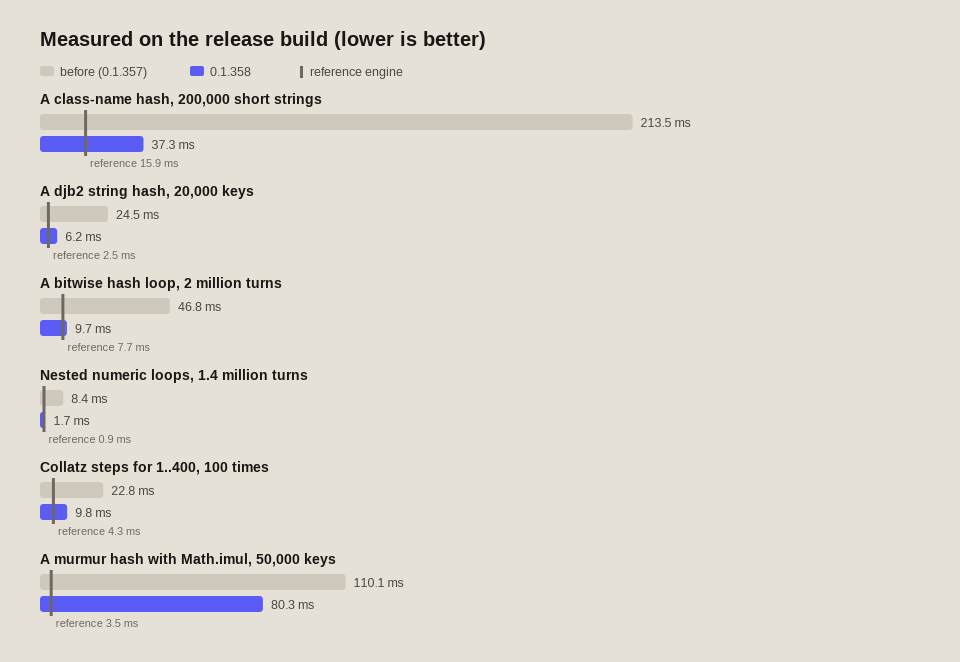
This release switches on Thermal, the optimizing tier of Updraft, the compiler Floati writes for itself. When a function with a loop gets hot, Thermal compiles it straight to ARM64 machine code with its numbers, whole numbers, true/false values and plain-text strings held in the processor's registers instead of in memory, and reads a string's characters where they already are. Loops that hash strings, mix bits or count run 2.4 to 5.8 times faster than in 0.1.357, and a class-name hash of the kind news sites run is now within about twice the reference engine. Functions with a short loop called many times now compile as a whole instead of entering the loop tier on every call, functions that use the bitwise NOT (~) compile at all, and very large functions no longer pay a big optimizing compile that did not make them faster. Eleven real pages measure the same as before, and every page in Floati's test set draws pixel for pixel as it did.

214 -> 37 ms (reference engine 16)A class-name hash, 200,000 short strings
unchangedAnswers with Thermal leaving at every 3rd op
0.997 (no page slower)Eleven real pages, Thermal on vs off
Nsɛm titiriw3

Thermal: values in registers, not in memory

How Thermal runs a loop: values in registers, the string read in place, and a failed guess writing the shared frame for the interpreter
Before, after and the reference engine for six measurements

Gust, Updraft's first tier, compiles a function in well under a microsecond per operation, but keeps every value boxed in memory: each turn of a loop loads its variables, checks what kind of value each one holds, and stores them back. Thermal is the second tier. It reads the shape of a hot function, works out how long each value lives, gives the busiest ones a processor register for the whole loop, and writes ARM64 code directly, still in about half a microsecond per operation where the general-purpose code generator Floati still uses needs 80 to 400. Numbers stay as numbers, whole numbers stay as integers so bitwise operators and counters need no conversions, and a string the function was given is read in place: s.charCodeAt(i) becomes one byte read, checked once when the function starts rather than on every turn, which is safe because Thermal code never runs other scripts that could change String.prototype in between.

A class-name hash, 200,000 short strings214 -> 37 ms (reference engine 16)A djb2 string hash, 20,000 keys24.5 -> 6.2 ms

When a guess is wrong, nothing is lost

Thermal compiles for what a function has done so far: that a sum stays a whole number, that a position is inside the string. When one of those guesses fails, a sum past 2^53 or a position past the end, it writes the function's values into the frame the interpreter uses and the interpreter finishes the call from that exact operation; there is nothing to translate, because Floati's interpreter, Gust and Thermal all keep a call's values in the same frame. A function that keeps leaving, or that is called with values Thermal does not take (a string with accents, an object), is handed back to Gust and Cranelift as before. Every test map was also run with Thermal forced to leave at every third operation, and gave the same answers.

Answers with Thermal leaving at every 3rd opunchanged

Why Floati turned it on now

Updraft has one rule: a tier replaces what it replaces only once it is better on every measured axis. Before switching Thermal on, every page in Floati's test set was drawn with it and without it and compared pixel for pixel, and eleven recorded real pages were timed both ways. The comparison found three mistakes that tests had missed, among them a string returned from a compiled loop coming back as true or false, which broke a table on a documentation site; each is fixed and has a test that fails without the fix. With them fixed, all pages draw identically and the eleven pages time the same (0.997 of before), so Thermal is on for Apple Silicon. Intel and Windows machines still use Cranelift until Updraft can write x86-64 code.

Eleven real pages, Thermal on vs off0.997 (no page slower)

Deɛ asesa

nsesaeɛ 6
  1. JavaScript ne JITThermal, Floati's own optimizing compiler, is on for Apple Silicon: hot loops keep numbers, whole numbers and plain-text strings in registers (2.4 to 5.8 times faster on hashes and counting loops).
  2. Krataafa nhyehyɛeɛA string a hot function is given is read in place: s.charCodeAt(i) is one byte read, s.length one load.
  3. JavaScript ne JITWhen a compiled guess fails, the interpreter finishes the call from that exact operation, with nothing to translate.
  4. JavaScript ne JITA function with a short loop called many times compiles as a whole instead of entering the loop tier on every call: a murmur hash over short keys 110 -> 80 ms.
  5. Krataafa nhyehyɛeɛFunctions that use the bitwise NOT (~) now compile.
  6. Nkaeɛ ne akenkanVery large functions stay on Gust instead of paying an optimizing compile that did not make them faster (8 MB less at the peak). A page that hashes with functions newly compiled in this release still peaks higher than in 0.1.357 (128 vs 119 MB), the cost of compiling them; Thermal taking them whole is next.

Sɔ hwɛ wɔ wo browser mu

Nhwehwɛmu biara di dwuma wɔ browser a woreyɛ ho akenkan no mu. Wɔmmfa hwee nkɔ baabiara.

HwɛWo browserFloati
A class-name hash over concatenated strings is exactƐrehwɛAane
A hot hash sees charCodeAt replaced on String.prototypeƐrehwɛAane
A hot hash over non-ASCII text counts UTF-16 unitsƐrehwɛAane
A hot function returns its string parameter as a stringƐrehwɛAane
An empty string is false in a hot loopƐrehwɛAane
~ in a hot function on numbers, strings, objects and BigIntƐrehwɛAane
Integer sums past 2^31 and 2^53 in a hot loop stay exactƐrehwɛAane
>>> results past 2^31 read as numbers in a hot loopƐrehwɛAane
Atwam 8 / 8
Biribiara fi v0.1.358 wɔ baabi korɔ

Versions

v0.1.0 - 0.1.9 · 10 Jul 2026418v0.1.427 · 25 Nov 2026

November2026 · versions 40

42725 NovLayouts that remember their workFoforɔ paa · v0.1.427 · Krataafa nhyehyɛeɛ9 42625 NovCompiled with what real pages runv0.1.426 · JavaScript ne JIT 42525 NovBuilt with whole-program optimizationv0.1.425 · Krataafa nhyehyɛeɛ 42425 NovMore layout reused after a script changes the pagev0.1.424 · Krataafa nhyehyɛeɛ 42324 NovThe optimizing compiler works off the main threadv0.1.423 · Krataafa nhyehyɛeɛ 42222 NovText-reading loops and element-tree builders run fasterv0.1.422 · JavaScript ne JIT14 42122 NovCalls from loops run inside the loop's own machine codev0.1.421 · JavaScript ne JIT9 42021 NovPages you come back to run their scripts soonerv0.1.420 · Krataafa nhyehyɛeɛ17 41918 NovA faster interpreter runs the page's codev0.1.419 · JavaScript ne JIT12 41815 NovScripts run faster on busy pagesv0.1.418 · JavaScript ne JIT34 41711 NovPages wait less for their own scripts and stylesv0.1.417 · JavaScript ne JIT13 41611 NovWebGPU loops run 2 to 3 times faster on Macsv0.1.416 · JavaScript ne JIT 41510 NovWebGPU loops count right on Macsv0.1.415 · JavaScript ne JIT 41410 NovWebGPU runs in its own graphics processv0.1.414 · Krataafa nhyehyɛeɛ 41310 NovA graphics card reset no longer takes the browser downv0.1.413 · Krataafa nhyehyɛeɛ 4129 NovVideo moves to the graphics cardv0.1.412 · Media 4119 NovNo canvas stall on Windows, patterns and every blend mode on the graphics cardv0.1.411 · Krataafa nhyehyɛeɛ 4109 NovCanvas drawing moves to the graphics cardv0.1.410 · Krataafa nhyehyɛeɛ27 4098 NovEvery tile on the GPUv0.1.409 · Krataafa nhyehyɛeɛ26 4088 Nov3D at 120 frames a secondv0.1.408 · Krataafa nhyehyɛeɛ23 4077 NovWebGL 2v0.1.407 · Krataafa nhyehyɛeɛ36 4066 NovA stuck tab stops at oncev0.1.406 · Krataafa nhyehyɛeɛ16 4055 NovSmall WebGL drawings get smooth edgesv0.1.405 · Krataafa nhyehyɛeɛ 4045 NovWebGL pages finally movev0.1.404 · Krataafa nhyehyɛeɛ25 4035 NovWebGPU is herev0.1.403 · Krataafa nhyehyɛeɛ35 4024 NovA canvas that moves itself to the GPUv0.1.402 · Krataafa nhyehyɛeɛ 4014 Nov99% of real pages decided by the GPUv0.1.401 · Krataafa nhyehyɛeɛ9 4004 NovSmooth turns, the same bytes on every chip, and fields that keep their textv0.1.400 · Krataafa nhyehyɛeɛ15 3994 NovAnimations on the GPU compositor, and text that stays in its boxv0.1.399 · Krataafa nhyehyɛeɛ22 3984 NovGradient patterns that tile, animations that keep up, and a much faster canvasv0.1.398 · Krataafa nhyehyɛeɛ14 3973 NovTransitions that ease, and a GPU that draws 94% of real pages itselfv0.1.397 · Krataafa nhyehyɛeɛ 3963 NovAnimations on the GPU compositor, and spinners that spin as arcsv0.1.396 · Krataafa nhyehyɛeɛ 3953 NovCarousels that fade, badges that stay put, and floats that stay insidev0.1.395 · Krataafa nhyehyɛeɛ12 3943 NovBackground images over their colour, interlaced pictures, and borders in every colourv0.1.394 · Krataafa nhyehyɛeɛ 3932 NovStyle sheets in page order, and symbols that fall back like macOSv0.1.393 · Krataafa nhyehyɛeɛ 3922 NovIcon fonts loaded by script, and colour emoji on Windowsv0.1.392 · Tabs ne interface 3911 NovEmoji in colour, sized as in the reference browserv0.1.391 · JavaScript ne JIT 3901 NovA classified ads site's front page: blank before, whole nowv0.1.390 · JavaScript ne JIT12 3891 NovA computer maker's home page: navigation labels back, buttons apartv0.1.389 · Krataafa nhyehyɛeɛ 3881 NovA space agency's home page, a news section and a language site's header now match the referencev0.1.388 · Krataafa nhyehyɛeɛ18

October2026 · versions 58

Kyerɛ 57 bio
September2026versions 124 August2026versions 140 July2026versions 56