Alle weergawes v0.1.35816 Okt 2026Vertoning, JavaScript en JIT, Geheue en lees Voer

Die weergawenotas is in Engels geskryf.

Thermal, Floati's own optimizing compiler, is on: hot loops keep their numbers and strings in registers

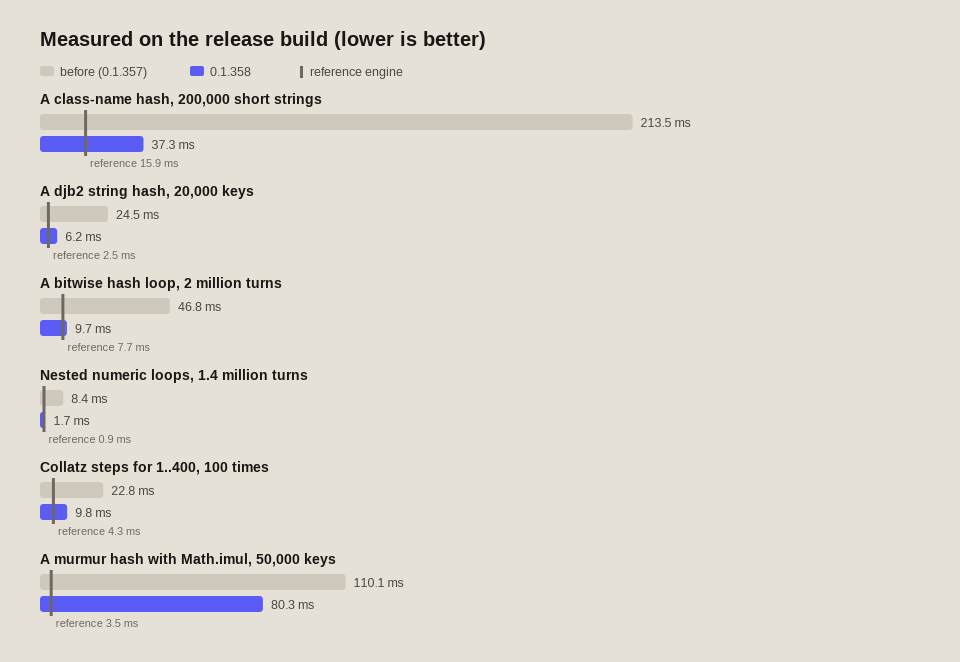
This release switches on Thermal, the optimizing tier of Updraft, the compiler Floati writes for itself. When a function with a loop gets hot, Thermal compiles it straight to ARM64 machine code with its numbers, whole numbers, true/false values and plain-text strings held in the processor's registers instead of in memory, and reads a string's characters where they already are. Loops that hash strings, mix bits or count run 2.4 to 5.8 times faster than in 0.1.357, and a class-name hash of the kind news sites run is now within about twice the reference engine. Functions with a short loop called many times now compile as a whole instead of entering the loop tier on every call, functions that use the bitwise NOT (~) compile at all, and very large functions no longer pay a big optimizing compile that did not make them faster. Eleven real pages measure the same as before, and every page in Floati's test set draws pixel for pixel as it did.

214 -> 37 ms (reference engine 16)A class-name hash, 200,000 short strings
unchangedAnswers with Thermal leaving at every 3rd op
0.997 (no page slower)Eleven real pages, Thermal on vs off
Hoogtepunte3

Thermal: values in registers, not in memory

How Thermal runs a loop: values in registers, the string read in place, and a failed guess writing the shared frame for the interpreter
Before, after and the reference engine for six measurements

Gust, Updraft's first tier, compiles a function in well under a microsecond per operation, but keeps every value boxed in memory: each turn of a loop loads its variables, checks what kind of value each one holds, and stores them back. Thermal is the second tier. It reads the shape of a hot function, works out how long each value lives, gives the busiest ones a processor register for the whole loop, and writes ARM64 code directly, still in about half a microsecond per operation where the general-purpose code generator Floati still uses needs 80 to 400. Numbers stay as numbers, whole numbers stay as integers so bitwise operators and counters need no conversions, and a string the function was given is read in place: s.charCodeAt(i) becomes one byte read, checked once when the function starts rather than on every turn, which is safe because Thermal code never runs other scripts that could change String.prototype in between.

A class-name hash, 200,000 short strings214 -> 37 ms (reference engine 16)A djb2 string hash, 20,000 keys24.5 -> 6.2 ms

When a guess is wrong, nothing is lost

Thermal compiles for what a function has done so far: that a sum stays a whole number, that a position is inside the string. When one of those guesses fails, a sum past 2^53 or a position past the end, it writes the function's values into the frame the interpreter uses and the interpreter finishes the call from that exact operation; there is nothing to translate, because Floati's interpreter, Gust and Thermal all keep a call's values in the same frame. A function that keeps leaving, or that is called with values Thermal does not take (a string with accents, an object), is handed back to Gust and Cranelift as before. Every test map was also run with Thermal forced to leave at every third operation, and gave the same answers.

Answers with Thermal leaving at every 3rd opunchanged

Why Floati turned it on now

Updraft has one rule: a tier replaces what it replaces only once it is better on every measured axis. Before switching Thermal on, every page in Floati's test set was drawn with it and without it and compared pixel for pixel, and eleven recorded real pages were timed both ways. The comparison found three mistakes that tests had missed, among them a string returned from a compiled loop coming back as true or false, which broke a table on a documentation site; each is fixed and has a test that fails without the fix. With them fixed, all pages draw identically and the eleven pages time the same (0.997 of before), so Thermal is on for Apple Silicon. Intel and Windows machines still use Cranelift until Updraft can write x86-64 code.

Eleven real pages, Thermal on vs off0.997 (no page slower)

Wat verander het

6 veranderinge
  1. JavaScript en JITThermal, Floati's own optimizing compiler, is on for Apple Silicon: hot loops keep numbers, whole numbers and plain-text strings in registers (2.4 to 5.8 times faster on hashes and counting loops).
  2. VertoningA string a hot function is given is read in place: s.charCodeAt(i) is one byte read, s.length one load.
  3. JavaScript en JITWhen a compiled guess fails, the interpreter finishes the call from that exact operation, with nothing to translate.
  4. JavaScript en JITA function with a short loop called many times compiles as a whole instead of entering the loop tier on every call: a murmur hash over short keys 110 -> 80 ms.
  5. VertoningFunctions that use the bitwise NOT (~) now compile.
  6. Geheue en leesVery large functions stay on Gust instead of paying an optimizing compile that did not make them faster (8 MB less at the peak). A page that hashes with functions newly compiled in this release still peaks higher than in 0.1.357 (128 vs 119 MB), the cost of compiling them; Thermal taking them whole is next.

Probeer in jou blaaier

Elke toets loop regstreeks in die blaaier waarmee jy lees. Niks word iewers heen gestuur nie.

KontroleerJou blaaierFloati
A class-name hash over concatenated strings is exactBesig om na te gaanJa
A hot hash sees charCodeAt replaced on String.prototypeBesig om na te gaanJa
A hot hash over non-ASCII text counts UTF-16 unitsBesig om na te gaanJa
A hot function returns its string parameter as a stringBesig om na te gaanJa
An empty string is false in a hot loopBesig om na te gaanJa
~ in a hot function on numbers, strings, objects and BigIntBesig om na te gaanJa
Integer sums past 2^31 and 2^53 in a hot loop stay exactBesig om na te gaanJa
>>> results past 2^31 read as numbers in a hot loopBesig om na te gaanJa
Geslaag 8 / 8
Alles sedert v0.1.358 op een plek

Weergawes

v0.1.0 - 0.1.9 · 10 Jul 2026418v0.1.427 · 25 Nov 2026

Oktober2026 · 33 weergawes

37121 OktDrop files onto pages, dictate without your voice leaving the Mac, and controllers that rumblev0.1.371 · Web-API’s en DOM · probeer dit 37021 OktOpen your files, share to your phone, have pages read aloud, install sites as apps, play with a controller, and accented text drawn rightv0.1.370 · Privaatheid en Shields · probeer dit11 36920 OktPasskeys with Touch ID and Windows Hello, sites that work offline, notifications you allow, and devices asked for first, all kept on your devicev0.1.369 · Privaatheid en Shields · probeer dit9 36820 OktA site's own security rules are kept the whole time the page runs, Trusted Types, a map of every unsafe write in DevTools, and animations from scriptv0.1.368 · Privaatheid en Shields · probeer dit 36720 OktEvents, form controls, performance timing, URL patterns, live streams and the newest JavaScript: the Web APIs score rises from 59 to 62v0.1.367 · Web-API’s en DOM · probeer dit10 36619 OktEvents, custom form controls, fonts and navigation work the way the web standards say: the Web APIs score rises from 53 to 59v0.1.366 · Web-API’s en DOM · probeer dit9 36519 OktThe code-size budget fits your processor, and code that has gone cold makes room for code that is hot nowv0.1.365 · JavaScript en JIT · probeer dit 36419 OktCompiled code that fits the processor's caches: big pages up to 1.8 times faster, and fast compiled code on Windows and Intel machinesv0.1.364 · JavaScript en JIT · probeer dit 36319 OktThermal runs on one code generator, building strings is up to 8 times faster, and two slow paths that grew with the square of their input are linearv0.1.363 · JavaScript en JIT · probeer dit12 36219 OktA page scheduler that stalled now runs, try / finally and spreads compile, and deleting thousands of properties is 180 times fasterv0.1.362 · Vertoning · probeer dit 36118 OktThermal runs on Windows and Intel machines, a register fix for compiled code on Windows, try / catch compiles, and reading a growing string is 200 times fasterv0.1.361 · JavaScript en JIT · probeer dit 36018 OktEvery byte of machine code is Floati's own, a news site that showed blank renders, Gust's code is half the size, and closures and ?? compilev0.1.360 · JavaScript en JIT · probeer dit9 35916 OktThermal reads object members and folds Math, string building compiles, and methods, Array subclasses and globals behave as the standard saysv0.1.359 · JavaScript en JIT · probeer dit 35816 OktThermal, Floati's own optimizing compiler, is on: hot loops keep their numbers and strings in registersv0.1.358 · JavaScript en JIT · probeer dit 35715 OktLoops that test a number run as machine code, more of your functions compile, and reading page nodes is three times fasterv0.1.357 · JavaScript en JIT · probeer dit14 35614 OktRecursion makes a fraction of the calls, loops keep objects in registers, and element writes stop searchingv0.1.356 · JavaScript en JIT · probeer dit 35514 OktA hot loop changes compiler without stopping, property writes skip the detour, and pure recursion remembers its answersv0.1.355 · JavaScript en JIT · probeer dit 35413 OktFloati compiles JavaScript with its own compiler, Updraft: about a hundred times faster to compile, and compiled code no longer piles upv0.1.354 · JavaScript en JIT · probeer dit 35311 OktStyle matching tries a third of the rules, queries prepare their selector once, sibling walks stay fastv0.1.353 · Vertoning · probeer dit 35211 OktCode that loads on demand starts at once, images decode beside their downloads, writes run compiledv0.1.352 · Vertoning · probeer dit10 35111 OktStyles read once, layouts redone only where they changed, built-ins in compiled loopsv0.1.351 · JavaScript en JIT · probeer dit12 35010 OktHelpers that compile, strings that stay small, and events that fire fastv0.1.350 · JavaScript en JIT · probeer dit14 34910 OktScripts that grow in step with their work, layouts laid out once, and colours mixed like the referencev0.1.349 · Vertoning · probeer dit13 3489 OktScripts that only compile when it pays, cards that line up, and bold that stays boldv0.1.348 · Vertoning · probeer dit14 3478 OktCards inside links, small print at its real size, and errors you can followv0.1.347 · Vertoning · probeer dit17 3467 OktA real performance timeline, site icons from the engine with a lookalike check, and forms that lay out rightv0.1.346 · Vertoning · probeer dit14 3457 OktReal WebGL, a real 2D canvas, and canvas text that matches the reference browserv0.1.345 · Vertoning · probeer dit10 3436 OktSign-ins that stay signed in, a real IndexedDB, and a storage button that shows what sites keepv0.1.343 · Privaatheid en Shields · probeer dit25 3425 OktTheme switchers, chart labels sized by CSS, and SVG text you can measurev0.1.342 · Web-API’s en DOM · probeer dit 3415 OktCanvas text measured and drawn like the reference browser, and SVG shapes you can measurev0.1.341 · Vertoning · probeer dit 3405 OktScripts can read and change SVG the way they do in the reference browser, and a hidden hang is gonev0.1.340 · Vertoning · probeer dit10 3395 OktEvery computed style, real stylesheet objects and full 3D geometry, each checked against the reference browserv0.1.339 · Web-API’s en DOM · probeer dit12 3385 OktPages load faster, render truer and gain a dozen modern web features, each one checked against the reference browserv0.1.338 · Web-API’s en DOM · probeer dit19