كل الإصدارات v0.1.35816 أكتوبر 2026العرض, JavaScript و JIT, الذاكرة والقراءة الخلاصة

ملاحظات الإصدار مكتوبة بالإنجليزية.

Thermal, Floati's own optimizing compiler, is on: hot loops keep their numbers and strings in registers

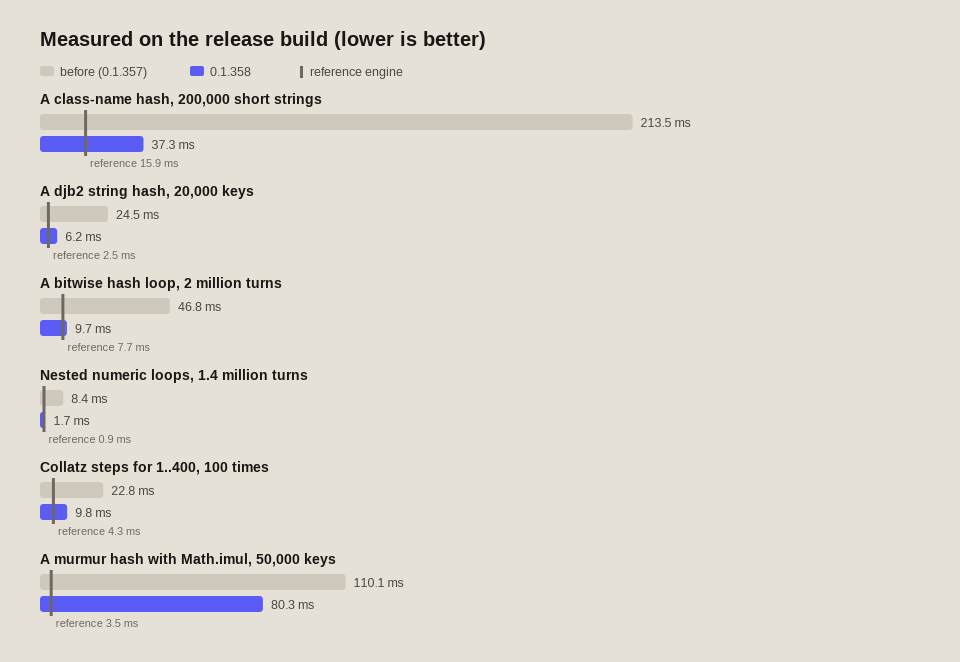
This release switches on Thermal, the optimizing tier of Updraft, the compiler Floati writes for itself. When a function with a loop gets hot, Thermal compiles it straight to ARM64 machine code with its numbers, whole numbers, true/false values and plain-text strings held in the processor's registers instead of in memory, and reads a string's characters where they already are. Loops that hash strings, mix bits or count run 2.4 to 5.8 times faster than in 0.1.357, and a class-name hash of the kind news sites run is now within about twice the reference engine. Functions with a short loop called many times now compile as a whole instead of entering the loop tier on every call, functions that use the bitwise NOT (~) compile at all, and very large functions no longer pay a big optimizing compile that did not make them faster. Eleven real pages measure the same as before, and every page in Floati's test set draws pixel for pixel as it did.

214 -> 37 ms (reference engine 16)A class-name hash, 200,000 short strings
unchangedAnswers with Thermal leaving at every 3rd op
0.997 (no page slower)Eleven real pages, Thermal on vs off
أبرز ما فيه3

Thermal: values in registers, not in memory

How Thermal runs a loop: values in registers, the string read in place, and a failed guess writing the shared frame for the interpreter
Before, after and the reference engine for six measurements

Gust, Updraft's first tier, compiles a function in well under a microsecond per operation, but keeps every value boxed in memory: each turn of a loop loads its variables, checks what kind of value each one holds, and stores them back. Thermal is the second tier. It reads the shape of a hot function, works out how long each value lives, gives the busiest ones a processor register for the whole loop, and writes ARM64 code directly, still in about half a microsecond per operation where the general-purpose code generator Floati still uses needs 80 to 400. Numbers stay as numbers, whole numbers stay as integers so bitwise operators and counters need no conversions, and a string the function was given is read in place: s.charCodeAt(i) becomes one byte read, checked once when the function starts rather than on every turn, which is safe because Thermal code never runs other scripts that could change String.prototype in between.

A class-name hash, 200,000 short strings214 -> 37 ms (reference engine 16)A djb2 string hash, 20,000 keys24.5 -> 6.2 ms

When a guess is wrong, nothing is lost

Thermal compiles for what a function has done so far: that a sum stays a whole number, that a position is inside the string. When one of those guesses fails, a sum past 2^53 or a position past the end, it writes the function's values into the frame the interpreter uses and the interpreter finishes the call from that exact operation; there is nothing to translate, because Floati's interpreter, Gust and Thermal all keep a call's values in the same frame. A function that keeps leaving, or that is called with values Thermal does not take (a string with accents, an object), is handed back to Gust and Cranelift as before. Every test map was also run with Thermal forced to leave at every third operation, and gave the same answers.

Answers with Thermal leaving at every 3rd opunchanged

Why Floati turned it on now

Updraft has one rule: a tier replaces what it replaces only once it is better on every measured axis. Before switching Thermal on, every page in Floati's test set was drawn with it and without it and compared pixel for pixel, and eleven recorded real pages were timed both ways. The comparison found three mistakes that tests had missed, among them a string returned from a compiled loop coming back as true or false, which broke a table on a documentation site; each is fixed and has a test that fails without the fix. With them fixed, all pages draw identically and the eleven pages time the same (0.997 of before), so Thermal is on for Apple Silicon. Intel and Windows machines still use Cranelift until Updraft can write x86-64 code.

Eleven real pages, Thermal on vs off0.997 (no page slower)

ما الذي تغيّر

6 تغييرات
  1. JavaScript و JITThermal, Floati's own optimizing compiler, is on for Apple Silicon: hot loops keep numbers, whole numbers and plain-text strings in registers (2.4 to 5.8 times faster on hashes and counting loops).
  2. العرضA string a hot function is given is read in place: s.charCodeAt(i) is one byte read, s.length one load.
  3. JavaScript و JITWhen a compiled guess fails, the interpreter finishes the call from that exact operation, with nothing to translate.
  4. JavaScript و JITA function with a short loop called many times compiles as a whole instead of entering the loop tier on every call: a murmur hash over short keys 110 -> 80 ms.
  5. العرضFunctions that use the bitwise NOT (~) now compile.
  6. الذاكرة والقراءةVery large functions stay on Gust instead of paying an optimizing compile that did not make them faster (8 MB less at the peak). A page that hashes with functions newly compiled in this release still peaks higher than in 0.1.357 (128 vs 119 MB), the cost of compiling them; Thermal taking them whole is next.

جرّبه في متصفحك

كل اختبار يعمل مباشرة في المتصفح الذي تقرأ به. لا يُرسل أي شيء إلى أي مكان.

تحققمتصفحكFloati
A class-name hash over concatenated strings is exactجارٍ الفحصنعم
A hot hash sees charCodeAt replaced on String.prototypeجارٍ الفحصنعم
A hot hash over non-ASCII text counts UTF-16 unitsجارٍ الفحصنعم
A hot function returns its string parameter as a stringجارٍ الفحصنعم
An empty string is false in a hot loopجارٍ الفحصنعم
~ in a hot function on numbers, strings, objects and BigIntجارٍ الفحصنعم
Integer sums past 2^31 and 2^53 in a hot loop stay exactجارٍ الفحصنعم
>>> results past 2^31 read as numbers in a hot loopجارٍ الفحصنعم
ناجحة 8 / 8
كل شيء منذ v0.1.358 في مكان واحد

الإصدارات

v0.1.0 - 0.1.9 · 10 يوليو 2026418v0.1.427 · 25 نوفمبر 2026

نوفمبر2026 · 40 إصدارًا

42725 نوفمبرLayouts that remember their workالأحدث · v0.1.427 · العرض9 42625 نوفمبرCompiled with what real pages runv0.1.426 · JavaScript و JIT 42525 نوفمبرBuilt with whole-program optimizationv0.1.425 · العرض 42425 نوفمبرMore layout reused after a script changes the pagev0.1.424 · العرض 42324 نوفمبرThe optimizing compiler works off the main threadv0.1.423 · العرض 42222 نوفمبرText-reading loops and element-tree builders run fasterv0.1.422 · JavaScript و JIT14 42122 نوفمبرCalls from loops run inside the loop's own machine codev0.1.421 · JavaScript و JIT9 42021 نوفمبرPages you come back to run their scripts soonerv0.1.420 · العرض17 41918 نوفمبرA faster interpreter runs the page's codev0.1.419 · JavaScript و JIT12 41815 نوفمبرScripts run faster on busy pagesv0.1.418 · JavaScript و JIT34 41711 نوفمبرPages wait less for their own scripts and stylesv0.1.417 · JavaScript و JIT13 41611 نوفمبرWebGPU loops run 2 to 3 times faster on Macsv0.1.416 · JavaScript و JIT 41510 نوفمبرWebGPU loops count right on Macsv0.1.415 · JavaScript و JIT 41410 نوفمبرWebGPU runs in its own graphics processv0.1.414 · العرض 41310 نوفمبرA graphics card reset no longer takes the browser downv0.1.413 · العرض 4129 نوفمبرVideo moves to the graphics cardv0.1.412 · الوسائط 4119 نوفمبرNo canvas stall on Windows, patterns and every blend mode on the graphics cardv0.1.411 · العرض 4109 نوفمبرCanvas drawing moves to the graphics cardv0.1.410 · العرض27 4098 نوفمبرEvery tile on the GPUv0.1.409 · العرض26 4088 نوفمبر3D at 120 frames a secondv0.1.408 · العرض23 4077 نوفمبرWebGL 2v0.1.407 · العرض36 4066 نوفمبرA stuck tab stops at oncev0.1.406 · العرض16 4055 نوفمبرSmall WebGL drawings get smooth edgesv0.1.405 · العرض 4045 نوفمبرWebGL pages finally movev0.1.404 · العرض25 4035 نوفمبرWebGPU is herev0.1.403 · العرض35 4024 نوفمبرA canvas that moves itself to the GPUv0.1.402 · العرض 4014 نوفمبر99% of real pages decided by the GPUv0.1.401 · العرض9 4004 نوفمبرSmooth turns, the same bytes on every chip, and fields that keep their textv0.1.400 · العرض15 3994 نوفمبرAnimations on the GPU compositor, and text that stays in its boxv0.1.399 · العرض22 3984 نوفمبرGradient patterns that tile, animations that keep up, and a much faster canvasv0.1.398 · العرض14 3973 نوفمبرTransitions that ease, and a GPU that draws 94% of real pages itselfv0.1.397 · العرض 3963 نوفمبرAnimations on the GPU compositor, and spinners that spin as arcsv0.1.396 · العرض 3953 نوفمبرCarousels that fade, badges that stay put, and floats that stay insidev0.1.395 · العرض12 3943 نوفمبرBackground images over their colour, interlaced pictures, and borders in every colourv0.1.394 · العرض 3932 نوفمبرStyle sheets in page order, and symbols that fall back like macOSv0.1.393 · العرض 3922 نوفمبرIcon fonts loaded by script, and colour emoji on Windowsv0.1.392 · الألسنة والواجهة 3911 نوفمبرEmoji in colour, sized as in the reference browserv0.1.391 · JavaScript و JIT 3901 نوفمبرA classified ads site's front page: blank before, whole nowv0.1.390 · JavaScript و JIT12 3891 نوفمبرA computer maker's home page: navigation labels back, buttons apartv0.1.389 · العرض 3881 نوفمبرA space agency's home page, a news section and a language site's header now match the referencev0.1.388 · العرض18

أكتوبر2026 · 58 إصدارًا

اعرض 57 أخرى
سبتمبر2026124 إصدارًا أغسطس2026140 إصدارًا يوليو202656 إصدارًا