كل الإصدارات v0.1.36219 أكتوبر 2026العرض, JavaScript و JIT الخلاصة

ملاحظات الإصدار مكتوبة بالإنجليزية.

A page scheduler that stalled now runs, try / finally and spreads compile, and deleting thousands of properties is 180 times faster

A break or continue that left a try block skipped its finally block. That broke more than tidy-up code: a widely used UI library's scheduler clears its "busy" flag in a finally that it leaves with break, so in Floati the flag stayed set after the first batch of work and every later batch waited forever. Pages built with that library looked right but never ran their later work (effects, an embedded code editor). break and continue now run every finally they leave, innermost first, as the standard says, and those pages do all their startup work, as in the reference browser. try / finally, object and array spread, destructuring from a Set, a Map or a generator, unary plus and regular-expression literals now run on the plan interpreter instead of the slowest tier, and so do for (let x of ..) loops over anything that is not an array. Deleting 64,000 properties one by one went from 5,993 to 33 ms, a function with try / finally called 2 million times from 430 to 243 ms, and on x86-64 Thermal keeps values in registers across calls in rarely run code (a float loop 315 -> 160 ms). Object spread now runs getters before converting a later computed key, and spreading null into an array throws a TypeError, as the standard says.

9 of 9 the sameRelease checks against the reference browser
5,993 -> 33 ms (reference engine 19)Delete 64,000 properties
أبرز ما فيه2

break, continue and finally

A scheduler that leaves a labelled block with break: before, its finally never ran; now it does

A finally block runs however its try block ends: normally, by return, by a throw, or by break and continue. Floati handled the first three, but a break or continue out of a try jumped straight to its target and skipped the finally. That mattered on real pages. A widely used UI library runs queued work inside a labelled block, sets a "busy" flag, and clears it in a finally it leaves with break. In Floati the flag was never cleared, so after the first batch the scheduler believed it was still working and never started another: effects never ran, and an embedded code editor never parsed its text. The pages still looked complete, which is why the page checks did not catch it. Now a break or continue that crosses finally blocks runs each one, innermost first, with its own state restored, then lands where it was going. Each finally body resumes its own completion, so a try / finally inside a finally no longer takes an outer return or throw at its end, and a return routed into a finally closes the try's handlers first. The two pages built with that library now spend more time in JavaScript, because they do the work the reference browser does. The code they now run is compiled: a for (let x of ..) loop over a Set, a Map, a generator or a string used to be refused a plan because of the jump that ends it when the iterator is done, and now it is planned.

Release checks against the reference browser9 of 9 the same

More of every page compiles, and deletes are linear
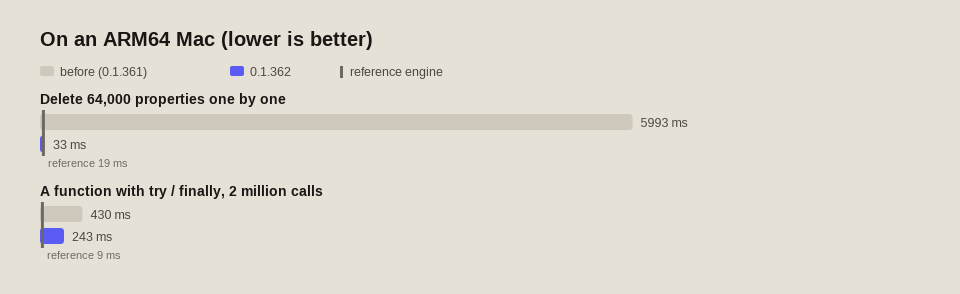
Before, after and the reference engine on an ARM64 Mac

The plan interpreter runs most hot functions. Several common constructs kept a function out of it, in the bytecode interpreter: try / finally, object and array spread ({ ...a, ...b }, [...set]), destructuring from anything iterable, unary plus on objects, and regular-expression literals (the most common refusal on a news site's load). Each is now a plan operation, checked against the interpreter in every tier on new test maps. Deleting a property from a large object shifted every property after it, so deleting n properties took time proportional to n squared. Deletes now leave a marker that is cleaned up in bulk, so the remaining properties keep their order and deleting 64,000 takes 33 ms instead of 5,993. On x86-64, Updraft IR's register allocator now keeps values in registers that a call may change, across calls in rarely run blocks, saving them only around those calls; a float loop with a rare slow path went from 315 to 160 ms.

Delete 64,000 properties5,993 -> 33 ms (reference engine 19)try / finally, 2 million calls430 -> 243 ms (reference engine 9)

ما الذي تغيّر

7 تغييرات
  1. العرضbreak and continue out of a try run its finally block; a UI library's scheduler no longer stalls after its first batch.
  2. العرضEach finally body resumes its own completion, and a throw in a finally after a return is no longer caught by its own try.
  3. JavaScript و JITtry / finally, spread, destructuring from iterables, unary plus and regex literals run on the plan interpreter.
  4. JavaScript و JITfor (let x of ..) over a Set, a Map, a generator or a string is compiled instead of interpreted.
  5. العرضDeleting many properties from one object is linear: 64,000 deletes 5,993 -> 33 ms.
  6. JavaScript و JITx86-64: values stay in registers across calls in rarely run code (a float loop 315 -> 160 ms).
  7. العرضObject spread runs getters before a later computed key is converted, and [...null] throws a TypeError.

جرّبه في متصفحك

كل اختبار يعمل مباشرة في المتصفح الذي تقرأ به. لا يُرسل أي شيء إلى أي مكان.

تحققمتصفحكFloati
a break out of a labelled block runs its finally (a page scheduler no longer stalls)جارٍ الفحصنعم
break and continue out of try run the finally blockجارٍ الفحصنعم
a finally that returns overrides a throw, in a hot functionجارٍ الفحصنعم
object spread runs getters before a later computed key is convertedجارٍ الفحصنعم
spreading null into an array throws a TypeErrorجارٍ الفحصنعم
destructuring and spread from Set, Map and generators in a hot functionجارٍ الفحصنعم
a regex literal is a new object each evaluationجارٍ الفحصنعم
deleting thousands of properties keeps the remaining orderجارٍ الفحصنعم
unary plus converts objects through valueOf and Symbol.toPrimitiveجارٍ الفحصنعم
ناجحة 9 / 9
كل شيء منذ v0.1.362 في مكان واحد

الإصدارات

v0.1.0 - 0.1.9 · 10 يوليو 2026418v0.1.427 · 25 نوفمبر 2026

نوفمبر2026 · 3 إصدارات

أكتوبر2026 · 7 إصدارات

سبتمبر2026 · 14 إصدارًا

32026 سبتمبرPages no longer freeze while a script waits on the networkv0.1.320 · JavaScript و JIT 31725 سبتمبرCloser to the reference browser, and no more address bar tricksv0.1.317 · واجهات الويب و DOM 30924 سبتمبرPages arrive like they do in the reference browser, in a fraction of the memoryv0.1.309 · الشبكات13 30322 سبتمبرHTTP/3 is on, and it is ours: the fastest web protocol, built from scratchv0.1.303 · الشبكات 30222 سبتمبرThe site you open stays your business, and the browser checks every certificate itselfv0.1.302 · الخصوصية و Shields 30019 سبتمبرReads the newest web compression, reuses secure connections, and remembers where sites livev0.1.300 · الذاكرة والقراءة 29919 سبتمبرPages start loading sooner: smarter connections and a faster path onto slow networksv0.1.299 · الشبكات 29516 سبتمبرClass-based JavaScript runs dramatically faster: calling a method through a list of objects is now many times quickerv0.1.295 · JavaScript و JIT 29416 سبتمبرInteger, bitwise and pixel-processing JavaScript runs a lot faster, and the browser still proves every shortcut before it trusts itv0.1.294 · JavaScript و JIT 29316 سبتمبرClass-based and object-heavy JavaScript runs dramatically faster, with speed the browser proves before it trustsv0.1.293 · JavaScript و JIT 29216 سبتمبرRecursive JavaScript runs dramatically faster, so the heaviest in-page computation feels quickv0.1.292 · JavaScript و JIT 27811 سبتمبرA tracker can no longer follow you from one site to the nextv0.1.278 · العرض 27610 سبتمبرSecurity you can check: an honest ledger, a referrer firewall, and mixed content shut downv0.1.276 · الخصوصية و Shields 2122 سبتمبرPages you render with Floati's own engine appear right away nowv0.1.212 · العرض

أغسطس2026 · 14 إصدارًا

19421 أغسطسFaster on pages that change as you use them - plus a tab-hover fixv0.1.194 · الألسنة والواجهة 19321 أغسطسSelect text, find on the page, and zoom - plus faster renderingv0.1.193 · الألسنة والواجهة 19220 أغسطسCrisp, high-resolution rendering on retina screensv0.1.192 · العرض 18018 أغسطسSee how much of a whole page's download actually showed up on screenv0.1.180 · الخصوصية و Shields 17618 أغسطسWitness Mode: cryptographic, offline proof of what a site showed you (a world-first)v0.1.176 · الخصوصية و Shields 17418 أغسطسCounterfactual Browsing: see exactly what a script did to your page (a world-first)v0.1.174 · الخصوصية و Shields 17016 أغسطسRender Receipts: seal a page into proof the reference browser structurally cannot offerv0.1.170 · واجهات الويب و DOM 12813 أغسطسHSTS: sites that demand https are never reached over plaintext, not even oncev0.1.128 · الشبكات 12713 أغسطسEncrypted DNS (DoH) inside the engine, so your network cannot see which sites you look upv0.1.127 · الشبكات 12613 أغسطسReal HTTP/2 multiplexing: many streams share one connectionv0.1.126 · الشبكات 1067 أغسطسA real, deterministic AnalyserNode FFTv0.1.106 · العرض 1057 أغسطسHTTP/2: the modern web transport, from scratchv0.1.105 · الوسائط 966 أغسطسStateful audio DSP: filters, delay and waveshapingv0.1.96 · الوسائط 661 أغسطسThe worst score on the board turned out to be a cookie bannerv0.1.66 · العرض9

يوليو2026 · 4 إصدارات





