सभी वर्ज़न v0.1.35614 अक्ट 2026JavaScript और JIT, मेमोरी और पढ़ना, टैब और इंटरफ़ेस फ़ीड

रिलीज़ नोट्स अंग्रेज़ी में लिखे गए हैं।

Recursion makes a fraction of the calls, loops keep objects in registers, and element writes stop searching

This release makes three kinds of everyday JavaScript faster. Recursive functions now answer their simplest cases where they are called and run every other level inside their parent, so walking a tree makes a fraction of the calls, and recursion whose last step returns a property now compiles at all. Long loops that walk a list, keep the best object seen so far, copy objects, compare them or ask typeof now run in Floati's fastest loop tier, 20 to 40 times faster than before. Setting a property on page elements no longer searches every element prototype each time, so building elements is almost three times faster, and a getter a page puts on an element prototype now answers reads as it does in the reference browser. One crash is fixed: freeing a long linked list made inside a function no longer overflows the stack.

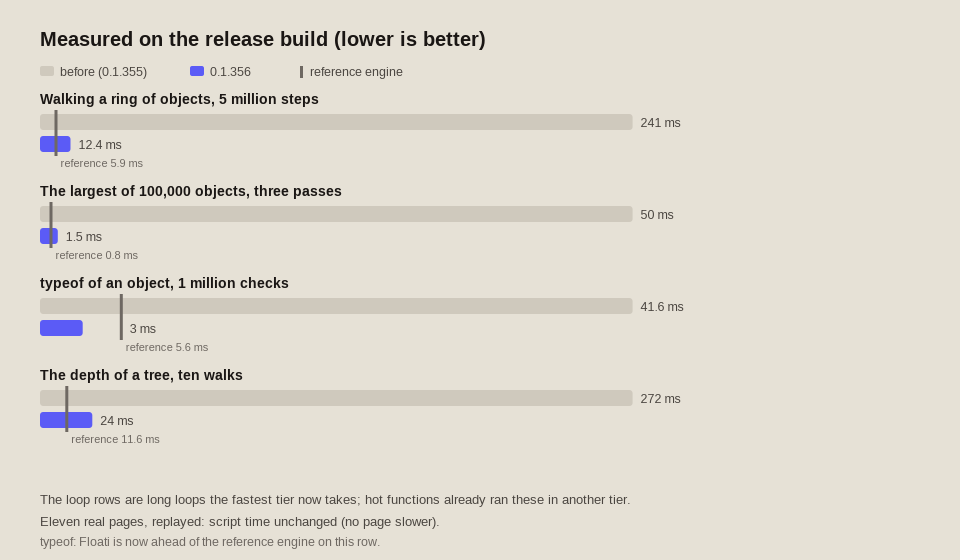
272 -> 24 msThe depth of a tree, ten walks
241 -> 12.4 ms (reference engine 5.9)Walking a ring of objects, 5 million steps
10 -> 3.5 msBuilding 3,000 elements, twenty times
मुख्य बातें3

Recursion makes a fraction of the calls

A tree sum before and after: 31 calls become 5

A recursive function usually starts with its simplest case: if the tree is empty, return 0; if n is below 2, return n. Floati's recursion tier now runs that test where the call is made, so a call that would only answer the simple case is never made, and it copies one level of the function into its parent, so every other level of a tree runs without a call at all (a technique from research on divide-and-conquer programs). Each copy still counts toward the call-depth limit and the work budget exactly as a call would, so a runaway recursion stops where it did. Once a recursive function has run, its property reads are compiled again with the object layouts they saw built in. Recursion whose last step returns a property, like the depth of a tree that returns a leaf's value, used to fall back to slower code because one path returned a number and the other a value of any type; now the two paths meet as a number, and anything else hands the work back to the interpreter.

The depth of a tree, ten walks272 -> 24 msA count whose base case returns a property80 -> 4.7 ms

Loops keep objects in registers

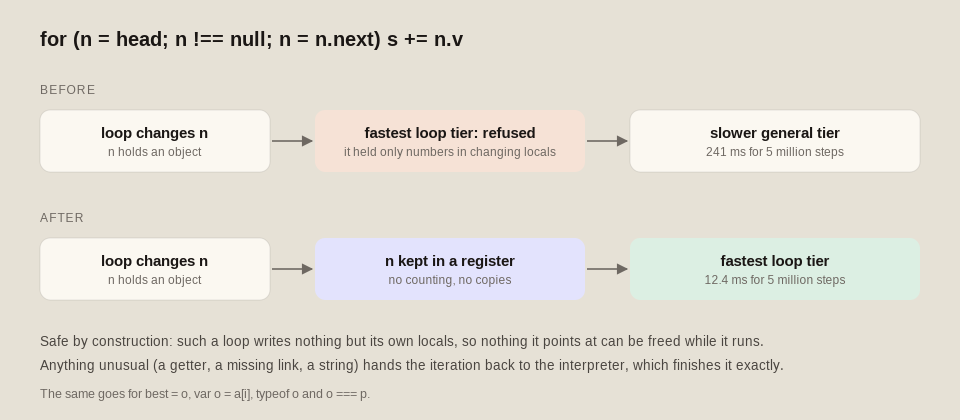
A list walk before and after: refused by the fastest loop tier, then run there with the object in a register
Before, after and the reference engine for four measurements

Floati's fastest loop tier kept numbers in registers, and objects only when the loop never changed which object a variable held. A loop like for (n = head; n !== null; n = n.next), or one that remembers the largest object seen so far, was refused and ran in a slower tier. Now such a variable holds the object directly, with no counting or copying, because these loops write nothing but their own variables: nothing they point at can be freed while they run. They can read properties, compare with null and with each other, copy, ask typeof and test truthiness; anything unusual, a getter, a missing link or a string compared by identity, hands that iteration back to the interpreter, which finishes it exactly. These are long loops the fastest tier now takes; a function that is already hot ran them in another tier and is unchanged.

Walking a ring of objects, 5 million steps241 -> 12.4 ms (reference engine 5.9)typeof of an object, 1 million checks41.6 -> 3 ms (reference engine 5.6)

Element writes stop searching

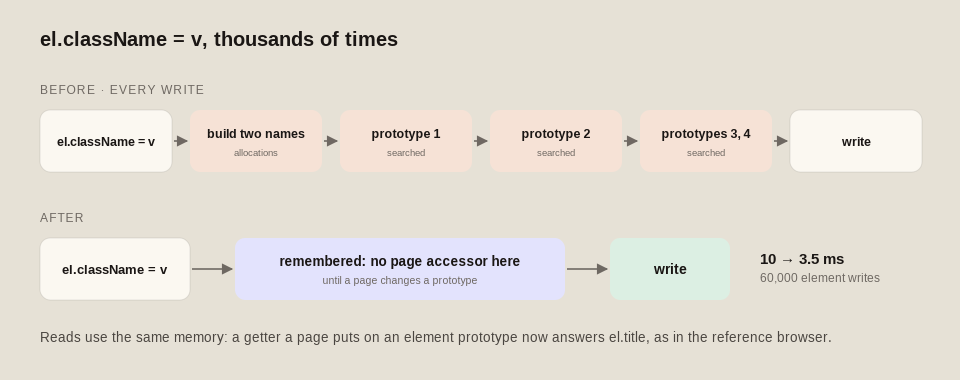
An element property write before and after: from a search of four prototypes to a remembered answer

Every el.className = v or el.textContent = v checked whether a page script had defined that property as an accessor on one of the element's prototypes: it built two names and searched four prototypes, every time, to learn that nothing was there. On a page that builds elements this was most of its script time. Floati now remembers the answer per element type until a page changes a prototype, which makes element-building three times faster. Reads use the same memory, which fixed a gap: a getter a page defines on an element prototype, as some monitoring and compatibility scripts do, now answers reads of that property as it does in the reference browser; before, Floati answered from its own value.

Building 3,000 elements, twenty times10 -> 3.5 msA getter on an element prototypenow answers reads

क्या बदला

8 बदलाव
  1. JavaScript और JITRecursive functions answer their simple case where they are called and run alternate levels inside their parent: a tree walk makes a fraction of the calls.
  2. JavaScript और JITRecursion whose last step returns a property (a tree's depth, a count) now compiles: a tree depth 272 -> 24 ms.
  3. JavaScript और JITOnce a recursive function has run, its property reads are compiled again with the layouts they saw built in.
  4. JavaScript और JITLong loops that walk a list, keep the best object so far, copy or compare objects, or ask typeof run in the fastest loop tier: a 5 million step walk 241 -> 12.4 ms.
  5. मेमोरी और पढ़नाSetting properties on page elements remembers that no page accessor intercepts them: building elements is three times faster.
  6. JavaScript और JITA getter a page defines on an element prototype now answers reads of that property, as in the reference browser.
  7. मेमोरी और पढ़नाFixed: freeing a long linked list built inside a function no longer overflows the stack and closes the page.
  8. टैब और इंटरफ़ेसFloati's pages and update notes now open at browser.floati.life.

अपने ब्राउज़र में आज़माएँ

हर जाँच उसी ब्राउज़र में लाइव चलती है जिसमें आप पढ़ रहे हैं। कहीं कुछ नहीं भेजा जाता।

जाँचेंआपका ब्राउज़रFloati
A recursive base case that returns a property still adds upजाँच हो रही हैहाँ
An unrolled recursion keeps its arguments in orderजाँच हो रही हैहाँ
A setter added to an element prototype after many writes runsजाँच हो रही हैहाँ
A long walk around a ring of objects keeps its placeजाँच हो रही हैहाँ
The largest object found in a loop is that very objectजाँच हो रही हैहाँ
Equal strings compare equal in a hot loopजाँच हो रही हैहाँ
Typeof in a hot loop tells functions, arrays and null apartजाँच हो रही हैहाँ
A long list built in a function is freed when it returnsजाँच हो रही हैहाँ
पास 8 / 8
v0.1.356 के बाद से सब कुछ एक जगह

वर्ज़न

v0.1.0 - 0.1.9 · 10 जुल 2026418v0.1.427 · 25 नव 2026

नवमबर2026 · 3 वर्ज़न

अक्टूबर2026 · 7 वर्ज़न

सितमबर2026 · 14 वर्ज़न

32026 सितPages no longer freeze while a script waits on the networkv0.1.320 · JavaScript और JIT 31725 सितCloser to the reference browser, and no more address bar tricksv0.1.317 · वेब API और DOM 30924 सितPages arrive like they do in the reference browser, in a fraction of the memoryv0.1.309 · नेटवर्किंग13 30322 सितHTTP/3 is on, and it is ours: the fastest web protocol, built from scratchv0.1.303 · नेटवर्किंग 30222 सितThe site you open stays your business, and the browser checks every certificate itselfv0.1.302 · प्राइवेसी और Shields 30019 सितReads the newest web compression, reuses secure connections, and remembers where sites livev0.1.300 · मेमोरी और पढ़ना 29919 सितPages start loading sooner: smarter connections and a faster path onto slow networksv0.1.299 · नेटवर्किंग 29516 सितClass-based JavaScript runs dramatically faster: calling a method through a list of objects is now many times quickerv0.1.295 · JavaScript और JIT 29416 सितInteger, bitwise and pixel-processing JavaScript runs a lot faster, and the browser still proves every shortcut before it trusts itv0.1.294 · JavaScript और JIT 29316 सितClass-based and object-heavy JavaScript runs dramatically faster, with speed the browser proves before it trustsv0.1.293 · JavaScript और JIT 29216 सितRecursive JavaScript runs dramatically faster, so the heaviest in-page computation feels quickv0.1.292 · JavaScript और JIT 27811 सितA tracker can no longer follow you from one site to the nextv0.1.278 · रेंडरिंग 27610 सितSecurity you can check: an honest ledger, a referrer firewall, and mixed content shut downv0.1.276 · प्राइवेसी और Shields 2122 सितPages you render with Floati's own engine appear right away nowv0.1.212 · रेंडरिंग

अगस्त2026 · 14 वर्ज़न

19421 अगFaster on pages that change as you use them - plus a tab-hover fixv0.1.194 · टैब और इंटरफ़ेस 19321 अगSelect text, find on the page, and zoom - plus faster renderingv0.1.193 · टैब और इंटरफ़ेस 19220 अगCrisp, high-resolution rendering on retina screensv0.1.192 · रेंडरिंग 18018 अगSee how much of a whole page's download actually showed up on screenv0.1.180 · प्राइवेसी और Shields 17618 अगWitness Mode: cryptographic, offline proof of what a site showed you (a world-first)v0.1.176 · प्राइवेसी और Shields 17418 अगCounterfactual Browsing: see exactly what a script did to your page (a world-first)v0.1.174 · प्राइवेसी और Shields 17016 अगRender Receipts: seal a page into proof the reference browser structurally cannot offerv0.1.170 · वेब API और DOM 12813 अगHSTS: sites that demand https are never reached over plaintext, not even oncev0.1.128 · नेटवर्किंग 12713 अगEncrypted DNS (DoH) inside the engine, so your network cannot see which sites you look upv0.1.127 · नेटवर्किंग 12613 अगReal HTTP/2 multiplexing: many streams share one connectionv0.1.126 · नेटवर्किंग 1067 अगA real, deterministic AnalyserNode FFTv0.1.106 · रेंडरिंग 1057 अगHTTP/2: the modern web transport, from scratchv0.1.105 · मीडिया 966 अगStateful audio DSP: filters, delay and waveshapingv0.1.96 · मीडिया 661 अगThe worst score on the board turned out to be a cookie bannerv0.1.66 · रेंडरिंग9

जुलाई2026 · 4 वर्ज़न