Tutte le versioni v0.1.37924 Ott 2026Rendering, API web e DOM, Privacy e Shields, Accessibilità, Memoria e lettura Feed

Le note di rilascio sono scritte in inglese.

Pages laid out the way their authors wrote them, and less memory again

A page-drawing release with more memory saved. Comparing Floati's picture of a page with the reference browser's, pixel by pixel, on a set of well-known sites showed where Floati laid pages out wrongly, and fourteen of those mistakes are fixed: which style rule wins when two disagree, how a line break, a grid, a flexible row and a font size written as a sum behave, where a line of text sits, and more. A design framework's documentation page went from 26 percent of its pixels different to 5, a news front page from 35 to 20. On memory, the same 33 randomly picked popular sites now use 4,301 MB in Floati against 10,377 MB in the reference browser on the same Mac (59 percent less; 0.1.378 used 4,524), the average site settles at 130 MB, and Floati uses less than the reference browser on 29 of the 33. Pictures nobody can see, because they are fully transparent or hidden, now give back their memory, and pictures on sharp screens are kept at exactly the pixels they are drawn at. Measured and tested on a Mac; the Windows build passes the same engine tests.

26 -> 5 percentA design framework's documentation page, pixels different from the reference
reference browser 10,377 MB -> Floati 4,301 MB33 random sites, total memory
In evidenza2

Pages look the way they were written
PrimaDopo
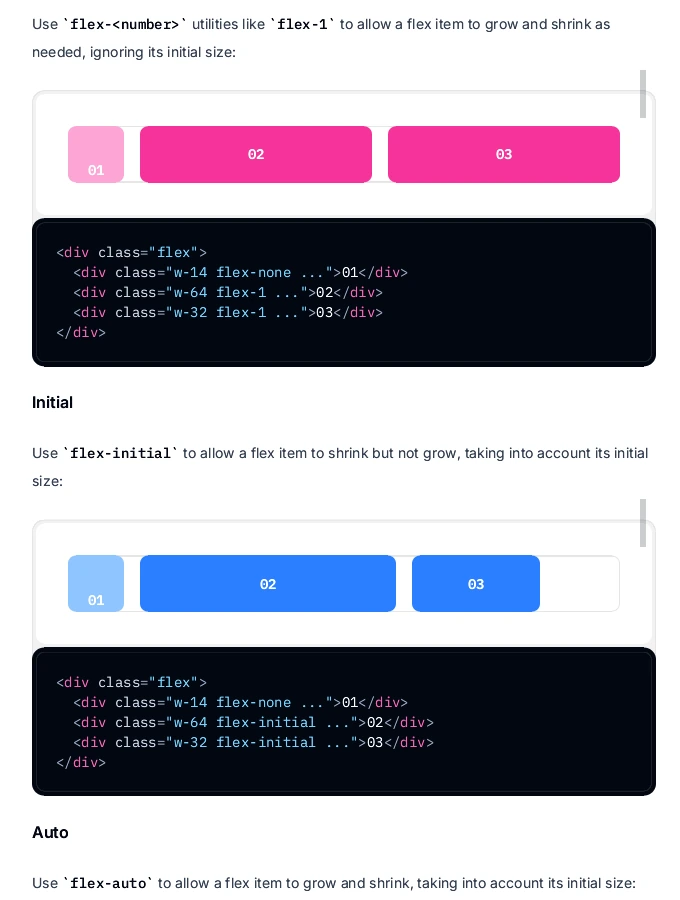
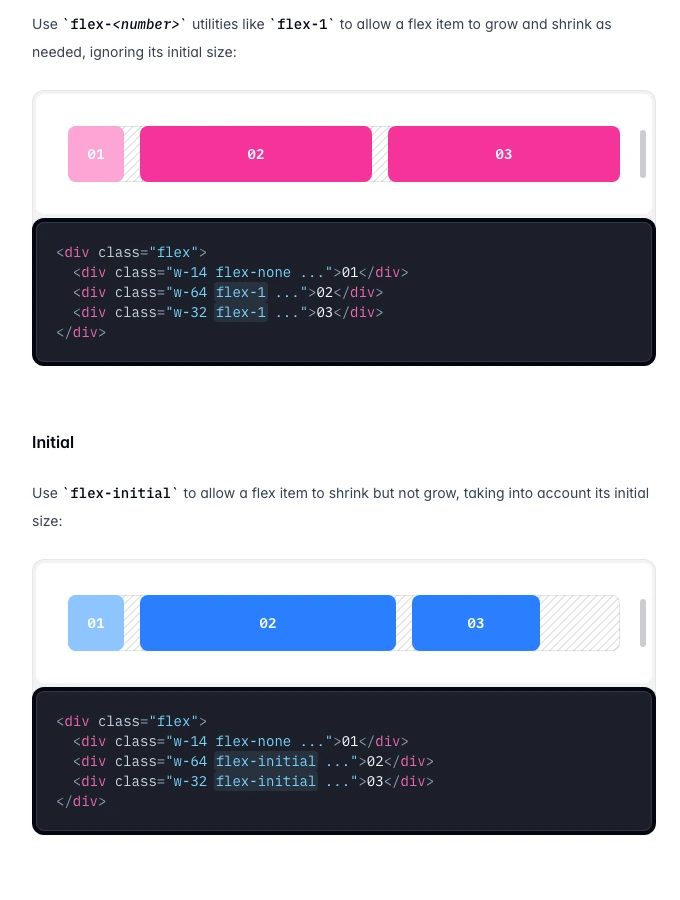
Prima: A design framework's documentation page: Floati 0.1.378, Floati 0.1.379 and the reference browser. The gaps under each example now match, so every heading below sits where the page puts it.
Prima
Dopo: A design framework's documentation page: Floati 0.1.378, Floati 0.1.379 and the reference browser. The gaps under each example now match, so every heading below sits where the page puts it.
Dopo · v0.1.379
La stessa pagina nel browser di riferimento
Browser di riferimento

To find layout mistakes we draw well-known pages in Floati and in the reference browser and compare them pixel by pixel, then shrink each difference down to a few lines of page code and check that rule against the reference. Fourteen fixes came out of it. When a site's style sheet marks a rule as important it now beats a style written on the element itself, as the standard says; it used to lose, so menus and buttons sat in the wrong place. Rules written with the newer selector forms (is, where, not, has) now weigh exactly as much as they should, so the right one wins. A line break at the end of a line no longer starts an empty extra line. A font size written as a sum (a calc) is worked out once, so everything inside inherits the size and not the formula. A line height written in em or percent is fixed where it is written, so text inside a bigger heading does not grow its own gaps. Grids now share the height of a tall item among the rows it spans the way the reference does and understand rows named by the page, flexible rows stretch their items to the exact height the page set, an overlay over a picture covers the whole picture, labels meant only for screen readers no longer push the header down, and a button with a two-line label lines up with its neighbours. Every fix has a test that fails without it.

A design framework's documentation page: Floati 0.1.378, Floati 0.1.379 and the reference browser. The gaps under each example now match, so every heading below sits where the page puts it.

A design framework's documentation page, pixels different from the reference26 -> 5 percentA news front page35 -> 20 percent13 well-known sites, total difference181 -> about 140

Less memory on the same random sites

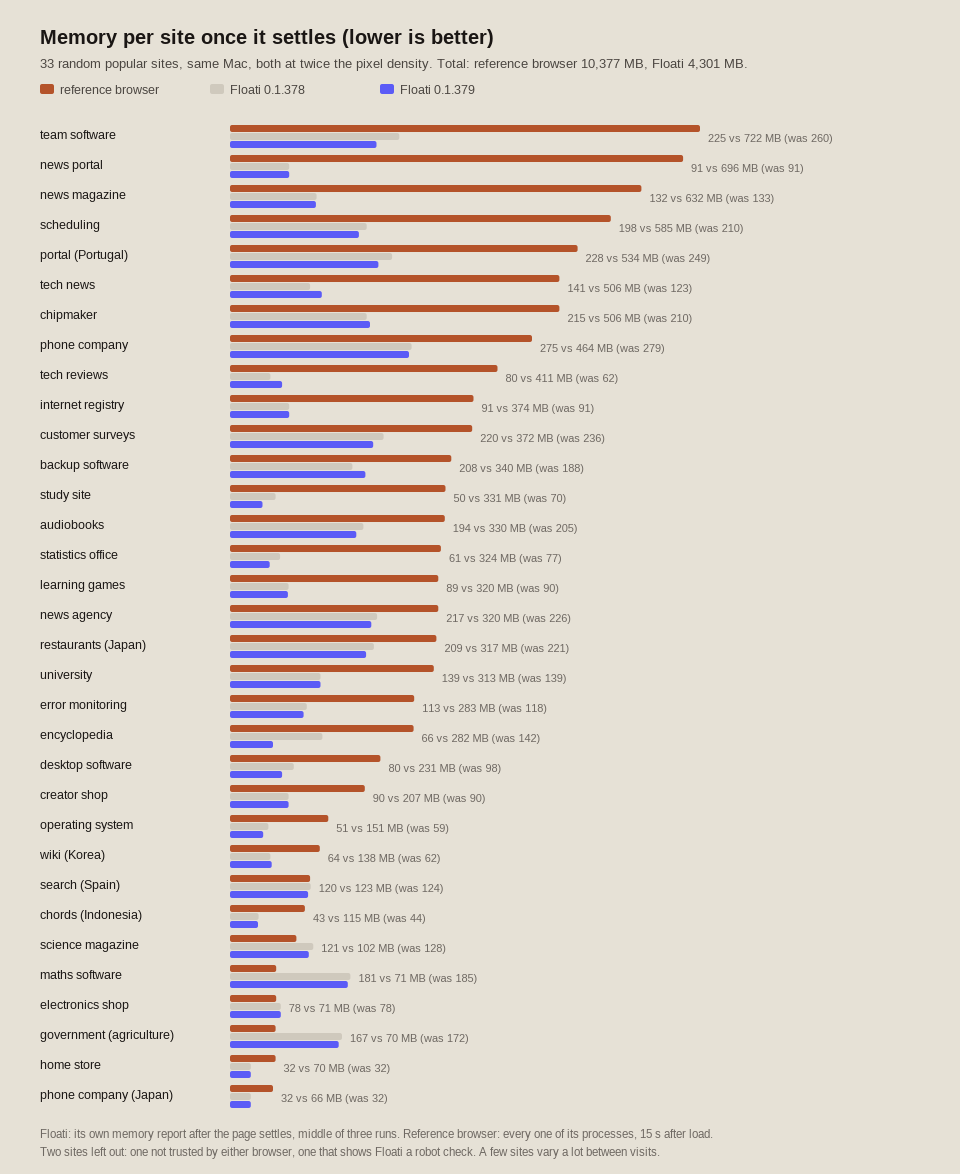
Memory per site after it settles: the reference browser, Floati 0.1.378 and Floati 0.1.379, same Mac, same screen density

The same 33 sites as in the last two releases, picked at random from a public list of the most visited websites, opened in Floati on the same Mac at twice the pixel density, three times each (the middle result is shown). Floati used 4,301 MB in total, against 10,377 MB for the reference browser and 4,524 MB for 0.1.378, and less than the reference browser on 29 of the 33. Three changes did most of it. A picture that is fully transparent or hidden (the resting slides of a fading slideshow, for example) is not drawn, so it now gives its memory back like a picture far down the page, and takes it again the moment it shows. On a sharp screen a picture is kept at exactly the pixels it is drawn at, where Floati used to keep a quarter more in case the box grew, and background pictures are kept at the size they are painted, not their full file size. And each picture keeps only one form: the compressed file or the drawn pixels, whichever it needs, never both. An encyclopedia went from 142 to 66 MB, a study site from 70 to 50, a team software site from 260 to 225. Four sites still use more than the reference browser: a maths software site, a government site, a science magazine and a shop, mostly because of large pictures and the compiled code of scripts that never run.

33 random sites, total memoryreference browser 10,377 MB -> Floati 4,301 MBFloati 0.1.378 -> 0.1.3794,524 -> 4,301 MBAverage site, settled130 MBSites where Floati uses less29 of 33

Cosa è cambiato

22 modifiche
  1. RenderingAn !important rule in a style sheet now beats a style written directly on the element, the order the standard sets (normal rules, then the element's own style, then important rules). A page that forces a margin with !important now gets it.
  2. RenderingA scrolling panel inside a column of fixed height keeps the height the column gives it and scrolls its own content, instead of growing to fit everything and spilling over the panel below.
  3. API web e DOMSelector weights follow the newest standard: :where() adds nothing, while :is(), :not() and :has() weigh as much as their strongest part. A CSS framework's 'weakest' typography rules no longer beat stronger ones, so its documentation headings get the right spacing (pixel difference from the reference 26 -> 17 percent).
  4. RenderingA line break (<br>) ends the line it sits on: one at the end of a line no longer opens an extra empty line, and one at the start breaks before what follows. Code blocks that end every line with a break were drawn twice as tall.
  5. RenderingA font size written as a formula (calc(), such as 'one em minus 20 percent') is worked out once where it is written, so nested elements inherit the result instead of shrinking the text again at every level. A docs site's live code editor drew its code as faint dashes 4 pixels tall; it is 13.6 pixels now, as in the reference.
  6. RenderingA line height written in em, percent or rem is turned into pixels where it is declared and passed down as pixels, so a large heading inside a smaller block no longer gets a line nearly twice too tall. Plain numbers still pass down as numbers, as the standard says.
  7. RenderingA flexible row with a set height stretches its items to exactly that height; taller content now overflows instead of making the row taller (a news site's 32 pixel logo row had become 36).
  8. RenderingAn inline block whose text sits inside nested boxes lines up on that text's baseline, so navigation bars and story lists built that way are no longer taller than they should be (one list was 107 pixels too tall).
  9. RenderingA full-cover overlay inside a box whose height comes from its content now sizes against that box's final height; such overlays came out 0 pixels tall.
  10. RenderingFlex items sized with fit-content, max-content or min-content keep that size instead of being stretched across the card.
  11. RenderingA stretched flex column counts as having a known height for what is inside it, so footers pushed to the bottom with margin-top: auto now sit at the bottom of their card.
  12. AccessibilitàLabels hidden for screen readers (positioned off-screen) take no room in the line they sit in; they made a news site's masthead 31 pixels taller.
  13. RenderingGrid items that span several rows share their extra height the way the standard describes, filling rows that can still grow first; four common shapes now match the reference exactly.
  14. RenderingGrids understand named row lines (grid-row: headline), and row templates that name their lines size their rows correctly; the names used to be read as extra rows.
  15. Memoria e letturaPictures that are invisible (inside something fully transparent or hidden) give their memory back and take it again only when they show. A fade carousel's waiting slides are exactly this.
  16. Memoria e letturaEach picture now keeps only the smaller of its two forms it needs: a picture on screen keeps its pixels, a hidden or far one only its file. Photo PNGs could never be given back before. A restaurant guide went from 252 to 211 MB.
  17. Memoria e letturaOn sharp (2x) screens a picture keeps exactly the pixels its box shows, with no extra quarter kept 'for zooming' (zooming decodes it again at the new size anyway), and is shrunk once it is 1.2 times too wide instead of 1.5. A chipmaker's site went from 230 to 199 MB.
  18. Memoria e letturaBackground pictures are shrunk to the size their drawn copy needs, whether they are covered, contained or tiled, and grow back when the box gets bigger. A phone company kept a 3200 pixel strip behind a box 2 pixels tall.
  19. RenderingGroundwork for compiling functions only when they first run: those functions now share their script's text instead of each keeping a copy.
  20. Memoria e letturaMeasured before building: combining half-empty memory pages would give back only 1 to 2 MB on the heaviest sites, so that idea was set aside in favour of the image work above.
  21. Memoria e lettura33 random popular sites: 4,301 MB in Floati (0.1.378: 4,524) against 10,377 MB in the reference browser; the average site settles at 130 MB.
  22. Privacy e ShieldsKnown: module scripts from another site are not yet checked like other requests; four sites still use more memory than the reference browser.

Tutto dalla v0.1.379 in un unico posto

Versioni

v0.1.0 - 0.1.9 · 10 Lug 2026418v0.1.427 · 25 Nov 2026

Novembre2026 · 6 versioni

Ottobre2026 · 19 versioni

38631 OttReal sites render closer to the reference browserv0.1.386 · Rendering14 38429 OttSafety review, a rare crash fixed, functions compiled soonerv0.1.384 · Memoria e lettura46 38025 OttScrolling boxes scroll, pages look right, and scripts from other sites need permissionv0.1.380 · Rendering16 37924 OttPages laid out the way their authors wrote them, and less memory againv0.1.379 · Rendering22 37823 OttOther sites' data stays private, and less memory againv0.1.378 · Memoria e lettura 37522 OttClosed pages let go, sites stay apart, and fonts stop costing memoryv0.1.375 · Memoria e lettura9 37321 OttEvery page on our own engine, two pages side by side, videos that keep playing, and your own clockv0.1.373 · Schede e interfaccia17 37221 OttYour data stays put, your choices stick, and dictation that really listensv0.1.372 · Rendering 37121 OttDrop files onto pages, dictate without your voice leaving the Mac, and controllers that rumblev0.1.371 · API web e DOM · provalo 37021 OttOpen your files, share to your phone, have pages read aloud, install sites as apps, play with a controller, and accented text drawn rightv0.1.370 · Privacy e Shields · provalo11 36920 OttPasskeys with Touch ID and Windows Hello, sites that work offline, notifications you allow, and devices asked for first, all kept on your devicev0.1.369 · Privacy e Shields · provalo9 36820 OttA site's own security rules are kept the whole time the page runs, Trusted Types, a map of every unsafe write in DevTools, and animations from scriptv0.1.368 · Privacy e Shields · provalo 36619 OttEvents, custom form controls, fonts and navigation work the way the web standards say: the Web APIs score rises from 53 to 59v0.1.366 · API web e DOM · provalo9 3467 OttA real performance timeline, site icons from the engine with a lookalike check, and forms that lay out rightv0.1.346 · Rendering · provalo14 3457 OttReal WebGL, a real 2D canvas, and canvas text that matches the reference browserv0.1.345 · Rendering · provalo10 3436 OttSign-ins that stay signed in, a real IndexedDB, and a storage button that shows what sites keepv0.1.343 · Privacy e Shields · provalo25 3385 OttPages load faster, render truer and gain a dozen modern web features, each one checked against the reference browserv0.1.338 · API web e DOM · provalo19 3362 OttSite controls that do what they say: permissions that really ask, and Shields per sitev0.1.336 · Privacy e Shields13 3321 OttPinned tabs on the left or the right, and an honest measure of the web platformv0.1.332 · Schede e interfaccia9

Settembre2026 · 26 versioni

31926 SetA PDF viewer that does what Acrobat Pro charges forv0.1.319 · Schede e interfaccia16 31725 SetCloser to the reference browser, and no more address bar tricksv0.1.317 · API web e DOM 30924 SetPages arrive like they do in the reference browser, in a fraction of the memoryv0.1.309 · Rete13 30423 SetSound and video, decoded by our own codev0.1.304 · Media 30322 SetHTTP/3 is on, and it is ours: the fastest web protocol, built from scratchv0.1.303 · Rete 30222 SetThe site you open stays your business, and the browser checks every certificate itselfv0.1.302 · Privacy e Shields 30122 SetSites can no longer follow you between other sites, and the next page starts soonerv0.1.301 · Privacy e Shields 29116 SetA private wayback machine for pages you seal, cited answers that open where you read them, and a privacy report that is ready the instant a page loadsv0.1.291 · Memoria e lettura 29015 SetFloati spots trackers no list has caught, answers your questions from your own reading, and gets even closer to the pixelv0.1.290 · Privacy e Shields 28915 SetA wave of rendering fixes: images, text wrapping, margins and flexible layouts closer to the pixelv0.1.289 · Rendering 28815 SetThe pages where you type a password stay out of your memory, and text renders truer to the pagev0.1.288 · Memoria e lettura 28711 SetA downloads manager that looks out for you, and scan-free QR that reads any code on a pagev0.1.287 · Schede e interfaccia 28211 SetOne tracker can't follow you between the sites it sits on, and insecure content shown and healedv0.1.282 · Privacy e Shields 28011 SetAn honest block count, and font fingerprinting defeatedv0.1.280 · Privacy e Shields 27911 SetSee your protection at a glance, tap for the detailv0.1.279 · Rendering 27811 SetA tracker can no longer follow you from one site to the nextv0.1.278 · Rendering 27710 SetSee the security, do not just trust itv0.1.277 · Rendering 27610 SetSecurity you can check: an honest ledger, a referrer firewall, and mixed content shut downv0.1.276 · Privacy e Shields 27510 SetTiming Shield and a cleaner device surfacev0.1.275 · Rendering 27410 SetFingerprint Shield: see and prove what a page tried to learn about youv0.1.274 · Memoria e lettura 2549 SetDialogs and popovers: modern overlays that layer correctlyv0.1.254 · Rendering 2468 SetMemory: your browser remembers what you read, and can prove itv0.1.246 · Memoria e lettura 2183 SetA calmer launch and a tidier browserv0.1.218 · Schede e interfaccia 2173 SetYour passwords, the Floati wayv0.1.217 · Schede e interfaccia 2143 SetUpdates that put you back exactly where you left off, and tab groups that finally behavev0.1.214 · Schede e interfaccia 2061 SetExplain this page: the browser now understands what a site does, and can prove itv0.1.206 · Privacy e Shields

Agosto2026 · 23 versioni

20328 AgoPages you open with the Floati engine now render on your graphics cardv0.1.203 · Rendering 18418 AgoArticles with a sidebar box now flow around it, the way they shouldv0.1.184 · Privacy e Shields 18318 AgoOne report: what did this page actually do to me?v0.1.183 · Privacy e Shields 18218 AgoNow it also spots the audio version of that tracking trickv0.1.182 · Privacy e Shields 18118 AgoSee when a page tries to fingerprint you (and know it failed)v0.1.181 · Privacy e Shields 18018 AgoSee how much of a whole page's download actually showed up on screenv0.1.180 · Privacy e Shields 17718 AgoBytes-to-Pixels Ledger: which of a page's downloaded bytes actually painted anythingv0.1.177 · Privacy e Shields 17618 AgoWitness Mode: cryptographic, offline proof of what a site showed you (a world-first)v0.1.176 · Privacy e Shields 17418 AgoCounterfactual Browsing: see exactly what a script did to your page (a world-first)v0.1.174 · Privacy e Shields 17318 AgoPixel Provenance: a click can only reach what you actually see (a world-first)v0.1.173 · Privacy e Shields 17218 AgoSplit-motion video decodes: the VP8 inter path is complete, real WebM streams bit-exactv0.1.172 · Media 17016 AgoRender Receipts: seal a page into proof the reference browser structurally cannot offerv0.1.170 · API web e DOM 14314 AgoUnmodified Puppeteer drives the engine end to endv0.1.143 · JavaScript e JIT 12813 AgoHSTS: sites that demand https are never reached over plaintext, not even oncev0.1.128 · Rete 12713 AgoEncrypted DNS (DoH) inside the engine, so your network cannot see which sites you look upv0.1.127 · Rete 12013 AgoDevTools: a WebSocket transport, so external tools can attachv0.1.120 · DevTools 1057 AgoHTTP/2: the modern web transport, from scratchv0.1.105 · Media 1017 AgoAES-GCM: the authenticated encryption the real web actually usesv0.1.101 · Privacy e Shields 1006 AgoThe browser can be driven, not just watched: a DevTools Protocol that mutates the real pagev0.1.100 · DevTools 956 AgoReal, deterministic Web Audio (it used to be a silent stub)v0.1.95 · Media 926 AgoReal encryption in the browser, and the fix that made it usablev0.1.92 · Rendering 916 AgoMethod calls run at machine speed - and a real crash fixed on the wayv0.1.91 · JavaScript e JIT 704 AgoOne press, and you are on the new versionv0.1.70 · Schede e interfaccia

Luglio2026 · 7 versioni