すべてのバージョン v0.1.35514 10月 2026レンダリング, JavaScript と JIT, メモリーと読書 フィード

リリースノートは英語で書かれています。

A hot loop changes compiler without stopping, property writes skip the detour, and pure recursion remembers its answers

This release builds on Updraft, the compiler Floati wrote for itself. A long loop can now move between the interpreter, Gust and the optimizing compiler in the middle of a run, on one shared frame, so hot code reaches fast code sooner; and because a Gust compile costs about a microsecond per operation, Floati now compiles warm code much earlier, which makes eleven real pages about 1% faster. Compiled code writes object properties itself instead of calling a general helper, one array with a named property no longer slows down every other array on the page, and functions that only compute from their arguments remember the answers they have already worked out.

123 -> 77 msWarm-up runs with 20,000-step loops
25 -> 9.5 nsA function that writes a property, per call
7 -> under 1 ms (reference engine 3 ms)fib(30)
ハイライト3

A loop changes compiler without stopping

A hot loop moves from the interpreter to Gust to the optimizing compiler, on one frame

Floati runs new code in its interpreter, compiles warm code with Gust, and moves code that stays hot to its optimizing compiler. Until now a function could only change compiler between calls: a long loop that started in the interpreter, or in Gust, stayed there until it finished. Because all three tiers keep a function's state in the same frame, a loop can now switch at the top of an iteration with nothing to translate: a loop in a function that is still warming up enters Gust there, and once it has run long enough to pay for the bigger compile, Gust hands the same frame to the optimizing compiler at a loop edge. Floati also prices the first compile at what a Gust compile really costs, about a microsecond per operation instead of the hundred the old code generator needed, so warm code is compiled far sooner.

Warm-up runs with 20,000-step loops123 -> 77 msScript time on eleven real pages1.0% lower, no page slower

Property writes without the detour

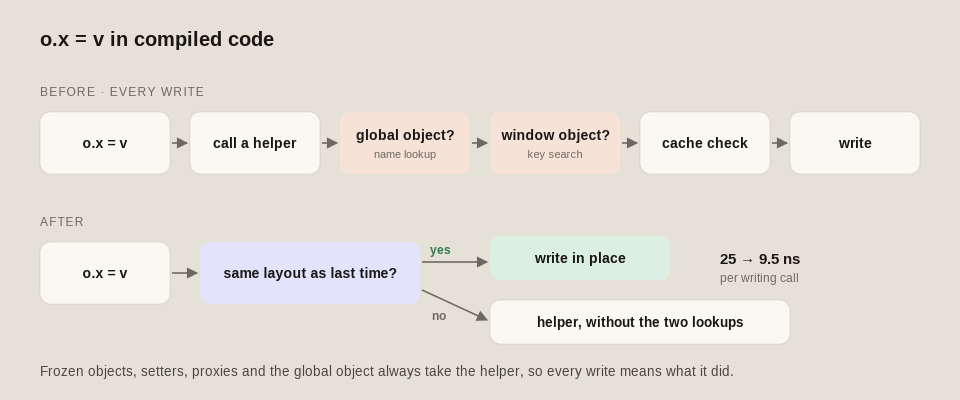
A property write before (six steps) and after (a layout check and a write)

Every o.x = v in compiled code used to call a general helper, and that helper first looked up the global object by name and searched the object for a window marker before it even reached its cache. Compiled code now checks that the object has the layout this write saw last time and writes the value in place. Anything unusual (a frozen or sealed object, a read-only property, a setter, a proxy, the global object) still takes the helper, so every write means exactly what it did, and the helper itself now skips the two lookups. A second slowdown is gone too: as soon as one array anywhere on a page got a named property, as some libraries do, push, pop and the other array methods lost their fast path on every array for the rest of the session. Now only that array is treated differently.

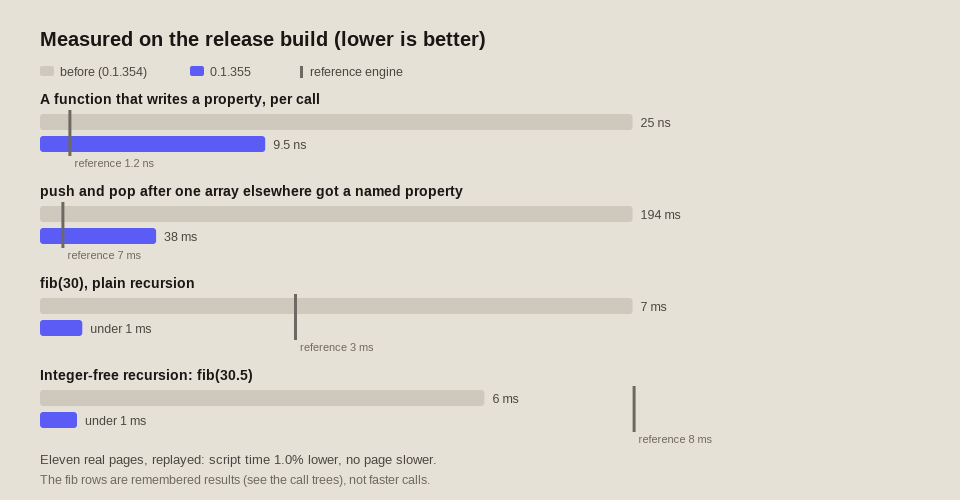
A function that writes a property, per call25 -> 9.5 nspush and pop after one array elsewhere got a named property194 -> 38 ms

Pure recursion remembers its answers

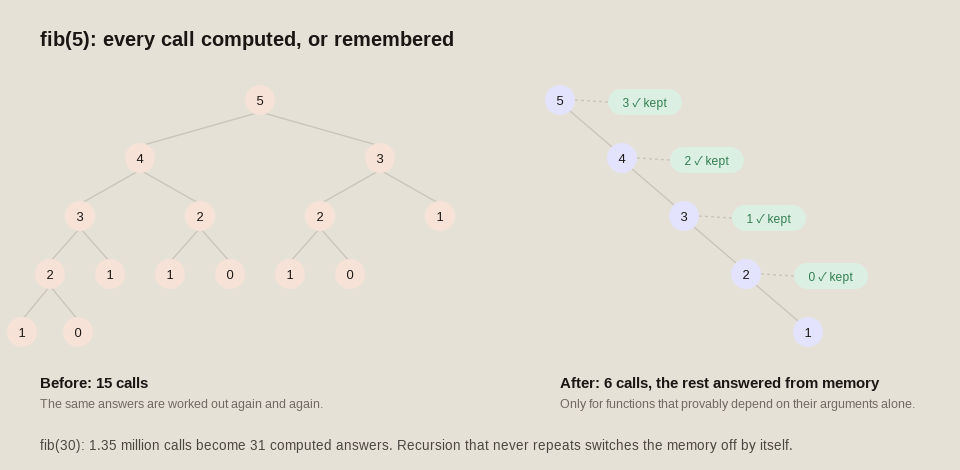
fib(5) without memory: 15 calls; with remembered answers: 6
Before, after and the reference engine for four measurements

Some recursive functions compute their result from their arguments and nothing else: no writes, no objects, no random numbers. Floati's recursion tier can prove that, and for such a function it now remembers each result for the arguments it was computed for, within one run. Asking again for an answer it already has costs a lookup instead of a whole subtree of calls, so a naive fib(30) does 31 computations instead of 1.35 million. The answers are exactly the ones recomputing would give, and the call stack goes as deep as before, so a runaway recursion still stops where it did. The memory resets on every new call into the function, so a value it captures can change between runs, and a recursion that never repeats a call switches the memory off by itself after a few thousand calls. This is a different kind of speed from faster calls: recursion that does not repeat work, such as walking a tree, runs as before.

fib(30)7 -> under 1 ms (reference engine 3 ms)Recursion that never repeats a callunchanged

変更点

6 件の変更
  1. JavaScript と JITA long loop in a function that is still warming up continues in compiled code from the top of the loop, and a hot loop moves on to the optimizing compiler at a loop edge instead of waiting for the next call.
  2. JavaScript と JITThe first compile is priced at what it really costs (about a microsecond per operation), so warm code is compiled much sooner: script time on eleven real pages is 1.0% lower, with no page slower.
  3. JavaScript と JITCompiled code writes an object property in place when the object has the layout the write saw before: a function that writes a property costs 9.5 instead of 25 nanoseconds.
  4. レンダリングWrites that still need the general path skip two lookups they never needed.
  5. JavaScript と JITGiving one array a named property no longer slows push, pop and other array methods on every other array: 194 -> 38 ms in a test loop.
  6. メモリーと読書Recursive functions that compute only from their arguments remember their answers within a run; a recursion that never repeats a call turns this off by itself.

ブラウザで試す

どのチェックも、今お読みのブラウザでその場で実行されます。何も送信されません。

チェックあなたのブラウザFloati
A loop handed between compilers mid-run keeps its state確認中はい
A remembered recursive result follows a changed captured value確認中はい
A remembered result tells -0 from 0確認中はい
Math.random is never remembered確認中はい
A frozen object refuses a compiled write in strict code確認中はい
A setter defined after warm-up runs on a compiled write確認中はい
An array that overrides push keeps its own after compile確認中はい
合格 7 / 7
v0.1.355 以降のすべてを 1 か所に

バージョン

v0.1.0 - 0.1.9 · 10 7月 2026418v0.1.427 · 25 11月 2026

11月2026 · 40 件のバージョン

42725 11月Layouts that remember their work最新 · v0.1.427 · レンダリング9 42625 11月Compiled with what real pages runv0.1.426 · JavaScript と JIT 42525 11月Built with whole-program optimizationv0.1.425 · レンダリング 42425 11月More layout reused after a script changes the pagev0.1.424 · レンダリング 42324 11月The optimizing compiler works off the main threadv0.1.423 · レンダリング 42222 11月Text-reading loops and element-tree builders run fasterv0.1.422 · JavaScript と JIT14 42122 11月Calls from loops run inside the loop's own machine codev0.1.421 · JavaScript と JIT9 42021 11月Pages you come back to run their scripts soonerv0.1.420 · レンダリング17 41918 11月A faster interpreter runs the page's codev0.1.419 · JavaScript と JIT12 41815 11月Scripts run faster on busy pagesv0.1.418 · JavaScript と JIT34 41711 11月Pages wait less for their own scripts and stylesv0.1.417 · JavaScript と JIT13 41611 11月WebGPU loops run 2 to 3 times faster on Macsv0.1.416 · JavaScript と JIT 41510 11月WebGPU loops count right on Macsv0.1.415 · JavaScript と JIT 41410 11月WebGPU runs in its own graphics processv0.1.414 · レンダリング 41310 11月A graphics card reset no longer takes the browser downv0.1.413 · レンダリング 4129 11月Video moves to the graphics cardv0.1.412 · メディア 4119 11月No canvas stall on Windows, patterns and every blend mode on the graphics cardv0.1.411 · レンダリング 4109 11月Canvas drawing moves to the graphics cardv0.1.410 · レンダリング27 4098 11月Every tile on the GPUv0.1.409 · レンダリング26 4088 11月3D at 120 frames a secondv0.1.408 · レンダリング23 4077 11月WebGL 2v0.1.407 · レンダリング36 4066 11月A stuck tab stops at oncev0.1.406 · レンダリング16 4055 11月Small WebGL drawings get smooth edgesv0.1.405 · レンダリング 4045 11月WebGL pages finally movev0.1.404 · レンダリング25 4035 11月WebGPU is herev0.1.403 · レンダリング35 4024 11月A canvas that moves itself to the GPUv0.1.402 · レンダリング 4014 11月99% of real pages decided by the GPUv0.1.401 · レンダリング9 4004 11月Smooth turns, the same bytes on every chip, and fields that keep their textv0.1.400 · レンダリング15 3994 11月Animations on the GPU compositor, and text that stays in its boxv0.1.399 · レンダリング22 3984 11月Gradient patterns that tile, animations that keep up, and a much faster canvasv0.1.398 · レンダリング14 3973 11月Transitions that ease, and a GPU that draws 94% of real pages itselfv0.1.397 · レンダリング 3963 11月Animations on the GPU compositor, and spinners that spin as arcsv0.1.396 · レンダリング 3953 11月Carousels that fade, badges that stay put, and floats that stay insidev0.1.395 · レンダリング12 3943 11月Background images over their colour, interlaced pictures, and borders in every colourv0.1.394 · レンダリング 3932 11月Style sheets in page order, and symbols that fall back like macOSv0.1.393 · レンダリング 3922 11月Icon fonts loaded by script, and colour emoji on Windowsv0.1.392 · タブと画面 3911 11月Emoji in colour, sized as in the reference browserv0.1.391 · JavaScript と JIT 3901 11月A classified ads site's front page: blank before, whole nowv0.1.390 · JavaScript と JIT12 3891 11月A computer maker's home page: navigation labels back, buttons apartv0.1.389 · レンダリング 3881 11月A space agency's home page, a news section and a language site's header now match the referencev0.1.388 · レンダリング18

10月2026 · 58 件のバージョン

さらに 57 件表示
9月2026124 件のバージョン 8月2026140 件のバージョン 7月202656 件のバージョン