Alle versies v0.1.36219 Okt 2026Weergave, JavaScript en JIT Feed

De release-opmerkingen zijn in het Engels geschreven.

A page scheduler that stalled now runs, try / finally and spreads compile, and deleting thousands of properties is 180 times faster

A break or continue that left a try block skipped its finally block. That broke more than tidy-up code: a widely used UI library's scheduler clears its "busy" flag in a finally that it leaves with break, so in Floati the flag stayed set after the first batch of work and every later batch waited forever. Pages built with that library looked right but never ran their later work (effects, an embedded code editor). break and continue now run every finally they leave, innermost first, as the standard says, and those pages do all their startup work, as in the reference browser. try / finally, object and array spread, destructuring from a Set, a Map or a generator, unary plus and regular-expression literals now run on the plan interpreter instead of the slowest tier, and so do for (let x of ..) loops over anything that is not an array. Deleting 64,000 properties one by one went from 5,993 to 33 ms, a function with try / finally called 2 million times from 430 to 243 ms, and on x86-64 Thermal keeps values in registers across calls in rarely run code (a float loop 315 -> 160 ms). Object spread now runs getters before converting a later computed key, and spreading null into an array throws a TypeError, as the standard says.

9 of 9 the sameRelease checks against the reference browser
5,993 -> 33 ms (reference engine 19)Delete 64,000 properties
Hoogtepunten2

break, continue and finally

A scheduler that leaves a labelled block with break: before, its finally never ran; now it does

A finally block runs however its try block ends: normally, by return, by a throw, or by break and continue. Floati handled the first three, but a break or continue out of a try jumped straight to its target and skipped the finally. That mattered on real pages. A widely used UI library runs queued work inside a labelled block, sets a "busy" flag, and clears it in a finally it leaves with break. In Floati the flag was never cleared, so after the first batch the scheduler believed it was still working and never started another: effects never ran, and an embedded code editor never parsed its text. The pages still looked complete, which is why the page checks did not catch it. Now a break or continue that crosses finally blocks runs each one, innermost first, with its own state restored, then lands where it was going. Each finally body resumes its own completion, so a try / finally inside a finally no longer takes an outer return or throw at its end, and a return routed into a finally closes the try's handlers first. The two pages built with that library now spend more time in JavaScript, because they do the work the reference browser does. The code they now run is compiled: a for (let x of ..) loop over a Set, a Map, a generator or a string used to be refused a plan because of the jump that ends it when the iterator is done, and now it is planned.

Release checks against the reference browser9 of 9 the same

More of every page compiles, and deletes are linear
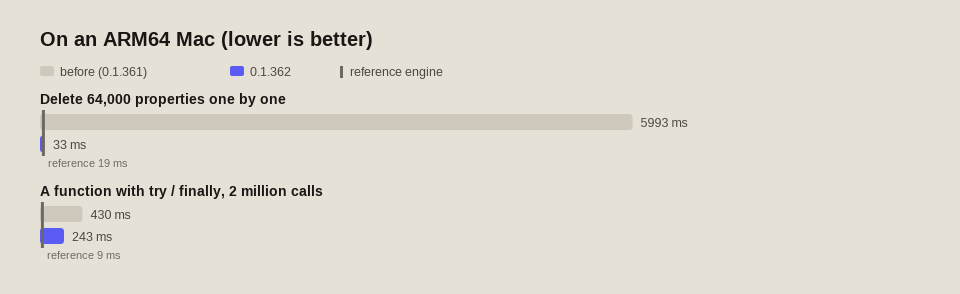
Before, after and the reference engine on an ARM64 Mac

The plan interpreter runs most hot functions. Several common constructs kept a function out of it, in the bytecode interpreter: try / finally, object and array spread ({ ...a, ...b }, [...set]), destructuring from anything iterable, unary plus on objects, and regular-expression literals (the most common refusal on a news site's load). Each is now a plan operation, checked against the interpreter in every tier on new test maps. Deleting a property from a large object shifted every property after it, so deleting n properties took time proportional to n squared. Deletes now leave a marker that is cleaned up in bulk, so the remaining properties keep their order and deleting 64,000 takes 33 ms instead of 5,993. On x86-64, Updraft IR's register allocator now keeps values in registers that a call may change, across calls in rarely run blocks, saving them only around those calls; a float loop with a rare slow path went from 315 to 160 ms.

Delete 64,000 properties5,993 -> 33 ms (reference engine 19)try / finally, 2 million calls430 -> 243 ms (reference engine 9)

Wat er veranderd is

7 wijzigingen
  1. Weergavebreak and continue out of a try run its finally block; a UI library's scheduler no longer stalls after its first batch.
  2. WeergaveEach finally body resumes its own completion, and a throw in a finally after a return is no longer caught by its own try.
  3. JavaScript en JITtry / finally, spread, destructuring from iterables, unary plus and regex literals run on the plan interpreter.
  4. JavaScript en JITfor (let x of ..) over a Set, a Map, a generator or a string is compiled instead of interpreted.
  5. WeergaveDeleting many properties from one object is linear: 64,000 deletes 5,993 -> 33 ms.
  6. JavaScript en JITx86-64: values stay in registers across calls in rarely run code (a float loop 315 -> 160 ms).
  7. WeergaveObject spread runs getters before a later computed key is converted, and [...null] throws a TypeError.

Probeer in je browser

Elke test draait live in de browser waarmee je leest. Er wordt niets verstuurd.

ControleerJouw browserFloati
a break out of a labelled block runs its finally (a page scheduler no longer stalls)Bezig met controlerenJa
break and continue out of try run the finally blockBezig met controlerenJa
a finally that returns overrides a throw, in a hot functionBezig met controlerenJa
object spread runs getters before a later computed key is convertedBezig met controlerenJa
spreading null into an array throws a TypeErrorBezig met controlerenJa
destructuring and spread from Set, Map and generators in a hot functionBezig met controlerenJa
a regex literal is a new object each evaluationBezig met controlerenJa
deleting thousands of properties keeps the remaining orderBezig met controlerenJa
unary plus converts objects through valueOf and Symbol.toPrimitiveBezig met controlerenJa
Geslaagd 9 / 9
Alles sinds v0.1.362 op één plek

Versies

v0.1.0 - 0.1.9 · 10 Jul 2026418v0.1.427 · 25 Nov 2026

november2026 · 6 versies

oktober2026 · 19 versies

38631 OktReal sites render closer to the reference browserv0.1.386 · Weergave14 38429 OktSafety review, a rare crash fixed, functions compiled soonerv0.1.384 · Geheugen en lezen46 38025 OktScrolling boxes scroll, pages look right, and scripts from other sites need permissionv0.1.380 · Weergave16 37924 OktPages laid out the way their authors wrote them, and less memory againv0.1.379 · Weergave22 37823 OktOther sites' data stays private, and less memory againv0.1.378 · Geheugen en lezen 37522 OktClosed pages let go, sites stay apart, and fonts stop costing memoryv0.1.375 · Geheugen en lezen9 37321 OktEvery page on our own engine, two pages side by side, videos that keep playing, and your own clockv0.1.373 · Tabbladen en interface17 37221 OktYour data stays put, your choices stick, and dictation that really listensv0.1.372 · Weergave 37121 OktDrop files onto pages, dictate without your voice leaving the Mac, and controllers that rumblev0.1.371 · Web-API’s en DOM · probeer het 37021 OktOpen your files, share to your phone, have pages read aloud, install sites as apps, play with a controller, and accented text drawn rightv0.1.370 · Privacy en Shields · probeer het11 36920 OktPasskeys with Touch ID and Windows Hello, sites that work offline, notifications you allow, and devices asked for first, all kept on your devicev0.1.369 · Privacy en Shields · probeer het9 36820 OktA site's own security rules are kept the whole time the page runs, Trusted Types, a map of every unsafe write in DevTools, and animations from scriptv0.1.368 · Privacy en Shields · probeer het 36619 OktEvents, custom form controls, fonts and navigation work the way the web standards say: the Web APIs score rises from 53 to 59v0.1.366 · Web-API’s en DOM · probeer het9 3467 OktA real performance timeline, site icons from the engine with a lookalike check, and forms that lay out rightv0.1.346 · Weergave · probeer het14 3457 OktReal WebGL, a real 2D canvas, and canvas text that matches the reference browserv0.1.345 · Weergave · probeer het10 3436 OktSign-ins that stay signed in, a real IndexedDB, and a storage button that shows what sites keepv0.1.343 · Privacy en Shields · probeer het25 3385 OktPages load faster, render truer and gain a dozen modern web features, each one checked against the reference browserv0.1.338 · Web-API’s en DOM · probeer het19 3362 OktSite controls that do what they say: permissions that really ask, and Shields per sitev0.1.336 · Privacy en Shields13 3321 OktPinned tabs on the left or the right, and an honest measure of the web platformv0.1.332 · Tabbladen en interface9

september2026 · 26 versies

31926 SepA PDF viewer that does what Acrobat Pro charges forv0.1.319 · Tabbladen en interface16 31725 SepCloser to the reference browser, and no more address bar tricksv0.1.317 · Web-API’s en DOM 30924 SepPages arrive like they do in the reference browser, in a fraction of the memoryv0.1.309 · Netwerk13 30423 SepSound and video, decoded by our own codev0.1.304 · Media 30322 SepHTTP/3 is on, and it is ours: the fastest web protocol, built from scratchv0.1.303 · Netwerk 30222 SepThe site you open stays your business, and the browser checks every certificate itselfv0.1.302 · Privacy en Shields 30122 SepSites can no longer follow you between other sites, and the next page starts soonerv0.1.301 · Privacy en Shields 29116 SepA private wayback machine for pages you seal, cited answers that open where you read them, and a privacy report that is ready the instant a page loadsv0.1.291 · Geheugen en lezen 29015 SepFloati spots trackers no list has caught, answers your questions from your own reading, and gets even closer to the pixelv0.1.290 · Privacy en Shields 28915 SepA wave of rendering fixes: images, text wrapping, margins and flexible layouts closer to the pixelv0.1.289 · Weergave 28815 SepThe pages where you type a password stay out of your memory, and text renders truer to the pagev0.1.288 · Geheugen en lezen 28711 SepA downloads manager that looks out for you, and scan-free QR that reads any code on a pagev0.1.287 · Tabbladen en interface 28211 SepOne tracker can't follow you between the sites it sits on, and insecure content shown and healedv0.1.282 · Privacy en Shields 28011 SepAn honest block count, and font fingerprinting defeatedv0.1.280 · Privacy en Shields 27911 SepSee your protection at a glance, tap for the detailv0.1.279 · Weergave 27811 SepA tracker can no longer follow you from one site to the nextv0.1.278 · Weergave 27710 SepSee the security, do not just trust itv0.1.277 · Weergave 27610 SepSecurity you can check: an honest ledger, a referrer firewall, and mixed content shut downv0.1.276 · Privacy en Shields 27510 SepTiming Shield and a cleaner device surfacev0.1.275 · Weergave 27410 SepFingerprint Shield: see and prove what a page tried to learn about youv0.1.274 · Geheugen en lezen 2549 SepDialogs and popovers: modern overlays that layer correctlyv0.1.254 · Weergave 2468 SepMemory: your browser remembers what you read, and can prove itv0.1.246 · Geheugen en lezen 2183 SepA calmer launch and a tidier browserv0.1.218 · Tabbladen en interface 2173 SepYour passwords, the Floati wayv0.1.217 · Tabbladen en interface 2143 SepUpdates that put you back exactly where you left off, and tab groups that finally behavev0.1.214 · Tabbladen en interface 2061 SepExplain this page: the browser now understands what a site does, and can prove itv0.1.206 · Privacy en Shields

augustus2026 · 23 versies

20328 AugPages you open with the Floati engine now render on your graphics cardv0.1.203 · Weergave 18418 AugArticles with a sidebar box now flow around it, the way they shouldv0.1.184 · Privacy en Shields 18318 AugOne report: what did this page actually do to me?v0.1.183 · Privacy en Shields 18218 AugNow it also spots the audio version of that tracking trickv0.1.182 · Privacy en Shields 18118 AugSee when a page tries to fingerprint you (and know it failed)v0.1.181 · Privacy en Shields 18018 AugSee how much of a whole page's download actually showed up on screenv0.1.180 · Privacy en Shields 17718 AugBytes-to-Pixels Ledger: which of a page's downloaded bytes actually painted anythingv0.1.177 · Privacy en Shields 17618 AugWitness Mode: cryptographic, offline proof of what a site showed you (a world-first)v0.1.176 · Privacy en Shields 17418 AugCounterfactual Browsing: see exactly what a script did to your page (a world-first)v0.1.174 · Privacy en Shields 17318 AugPixel Provenance: a click can only reach what you actually see (a world-first)v0.1.173 · Privacy en Shields 17218 AugSplit-motion video decodes: the VP8 inter path is complete, real WebM streams bit-exactv0.1.172 · Media 17016 AugRender Receipts: seal a page into proof the reference browser structurally cannot offerv0.1.170 · Web-API’s en DOM 14314 AugUnmodified Puppeteer drives the engine end to endv0.1.143 · JavaScript en JIT 12813 AugHSTS: sites that demand https are never reached over plaintext, not even oncev0.1.128 · Netwerk 12713 AugEncrypted DNS (DoH) inside the engine, so your network cannot see which sites you look upv0.1.127 · Netwerk 12013 AugDevTools: a WebSocket transport, so external tools can attachv0.1.120 · DevTools 1057 AugHTTP/2: the modern web transport, from scratchv0.1.105 · Media 1017 AugAES-GCM: the authenticated encryption the real web actually usesv0.1.101 · Privacy en Shields 1006 AugThe browser can be driven, not just watched: a DevTools Protocol that mutates the real pagev0.1.100 · DevTools 956 AugReal, deterministic Web Audio (it used to be a silent stub)v0.1.95 · Media 926 AugReal encryption in the browser, and the fix that made it usablev0.1.92 · Weergave 916 AugMethod calls run at machine speed - and a real crash fixed on the wayv0.1.91 · JavaScript en JIT 704 AugOne press, and you are on the new versionv0.1.70 · Tabbladen en interface

juli2026 · 7 versies