Alle versies v0.1.36920 Okt 2026Weergave, Web-API’s en DOM, Netwerk, Privacy en Shields, Geheugen en lezen Feed

De release-opmerkingen zijn in het Engels geschreven.

Passkeys with Touch ID and Windows Hello, sites that work offline, notifications you allow, and devices asked for first, all kept on your device

The biggest privacy and safety release so far. Sites can sign you in with a passkey instead of a password: Floati makes the key, keeps it in its vault on this device behind Touch ID or Windows Hello, and gives the site only a public key, never anything about your device. Sites can keep working offline: a site's service worker answers its pages and files from its own offline copy, even after a restart with no network. A site can show you notifications once you allow it, but it cannot reach you once its page is closed, because Floati keeps no push service; the site card now lists what a site keeps running in the background, with a button to remove it. Location, motion sensors, MIDI, the screen staying awake and every other device a page asks for go through one prompt that asks only after you click, and the site card lists everything a page reached for. Pages also gain the scheduling, locking, highlighting, file and cryptography tools they expect, every page starts about 10 ms faster, and a leak that left memory behind after every page closed is fixed. Measured against the reference browser, the Web APIs surface goes from 63.8 to 73.5 percent.

8 of 9 (one better: no error where the reference has no service to reach)Passkey checks matching the reference
11 of 13 (two better by design)Service worker and notification checks matching the reference
29 of 30 (one pending: XSLT and EditContext)Scheduling, locks, observer and highlight checks matching the reference
Hoogtepunten8

Passkeys, kept on this device

VoorNa
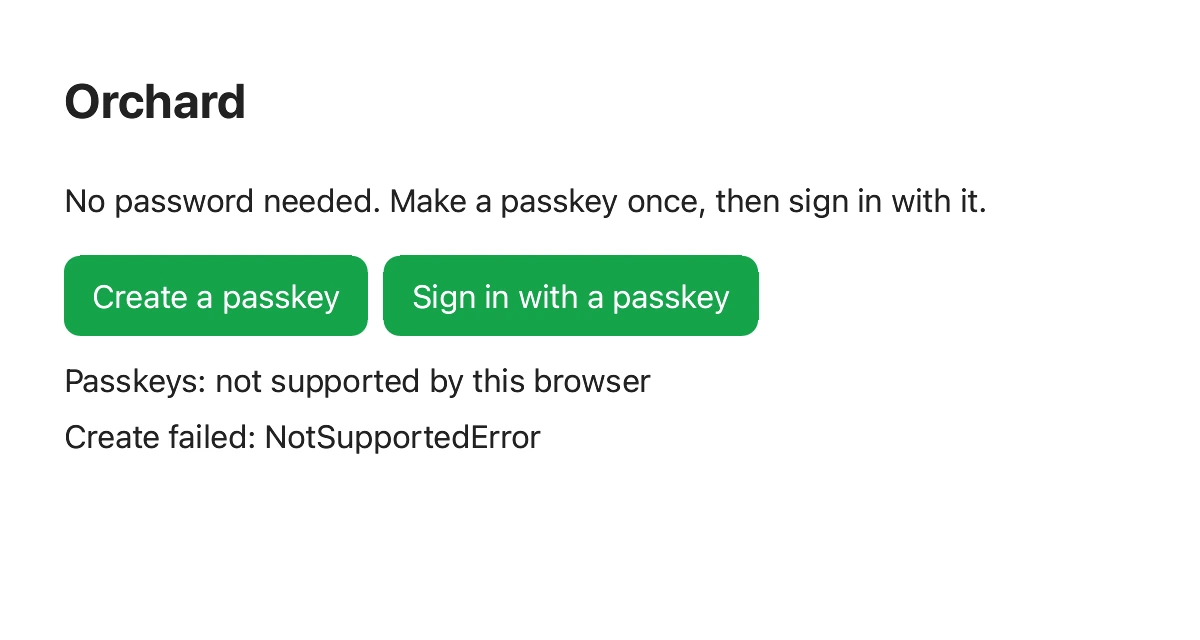
Voor: a site making a passkey and signing in with it, the signature checked by the site
Voor
Na: a site making a passkey and signing in with it, the signature checked by the site
Na · v0.1.369

A passkey replaces a password with a key pair: the site keeps the public half, your device keeps the private half and signs a fresh challenge each time you sign in, so there is nothing for a site to leak and nothing a fake site can phish (a passkey works only on the site that made it). Floati now makes and uses passkeys through the standard every site uses (navigator.credentials, PublicKeyCredential and the JSON helpers). Nothing happens until you confirm in Floati's own sheet, which names the site and the account; then Touch ID on a Mac or Windows Hello on a PC checks that it is you. The private key lives in Floati's vault, encrypted on this device, and is never synced or exported. The site learns as little as the standard allows: attestation is always "none" and the authenticator's model id is blank, so a site cannot tell which device or browser made the key. In the picture, a site makes a passkey, signs in with it and checks the signature itself.

a site making a passkey and signing in with it, the signature checked by the site

Passkey checks matching the reference8 of 9 (one better: no error where the reference has no service to reach)

Sites that work offline

VoorNa
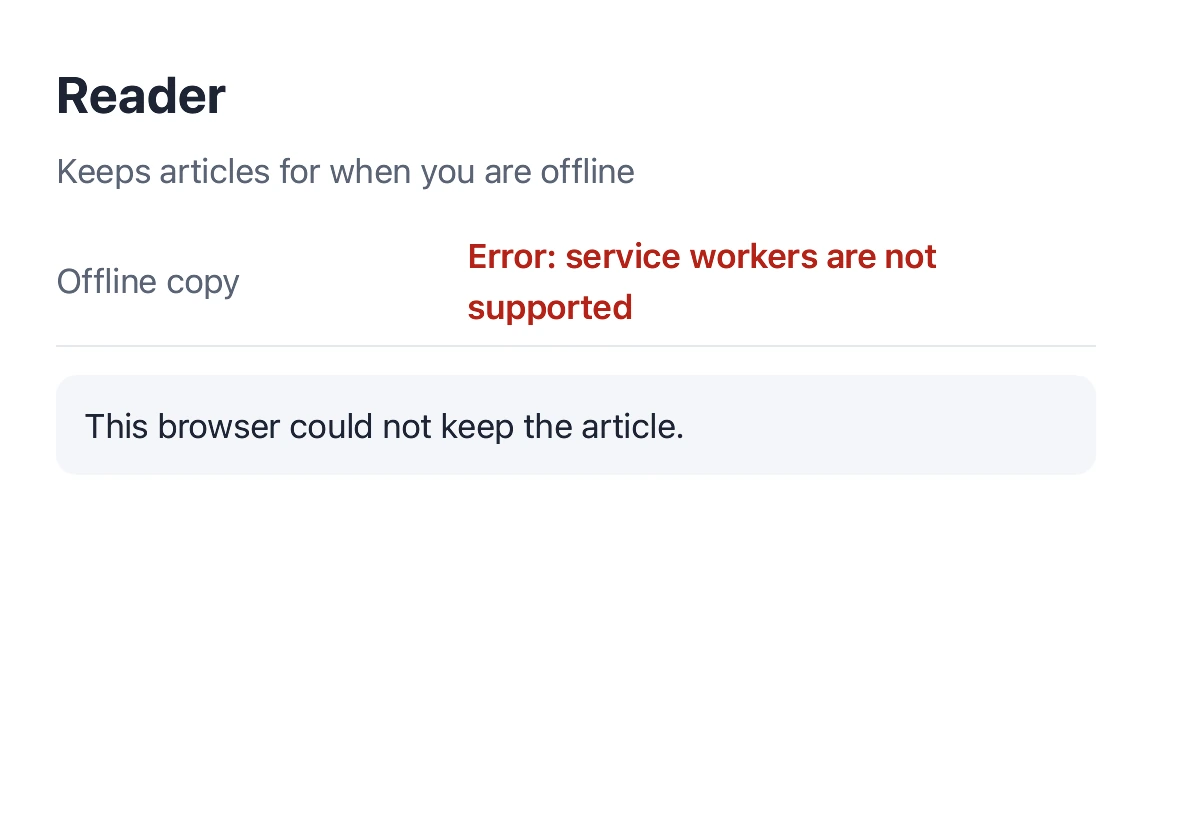
Voor: a reader app keeping an article with its service worker
Voor
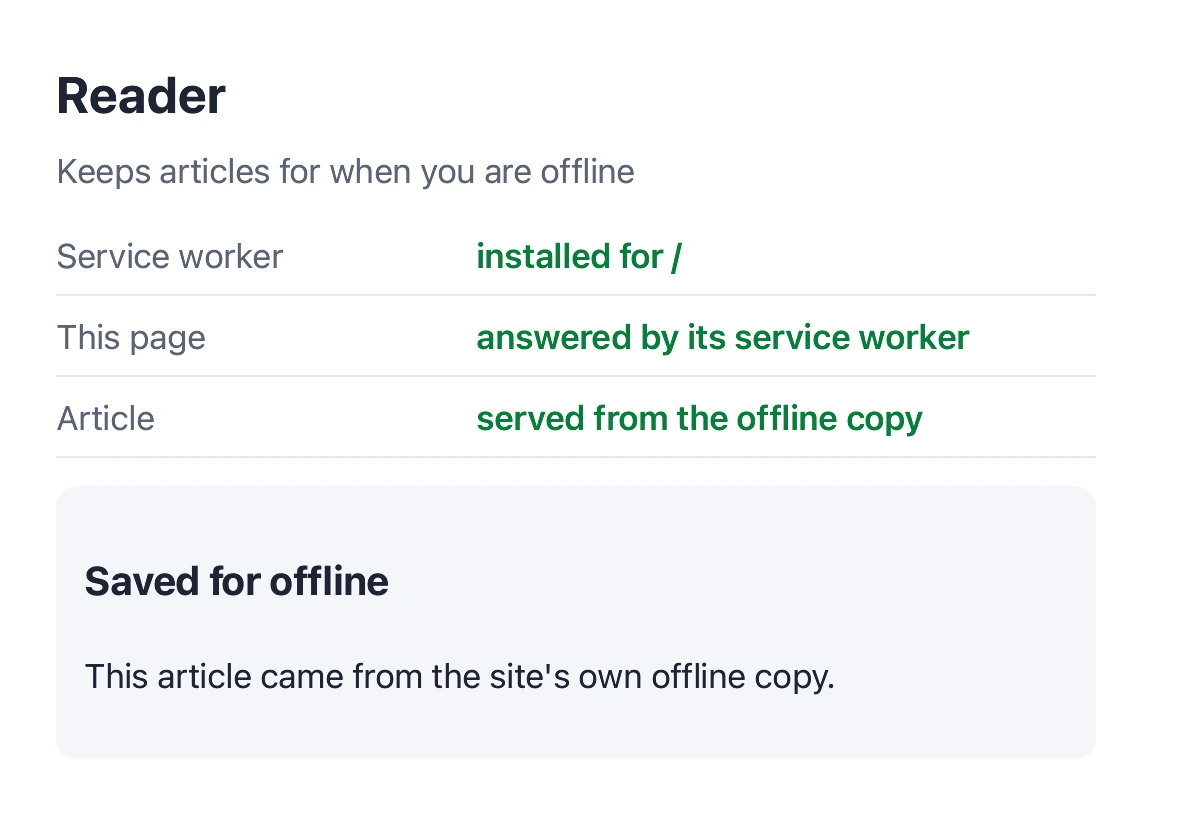
Na: a reader app keeping an article with its service worker
Na · v0.1.369
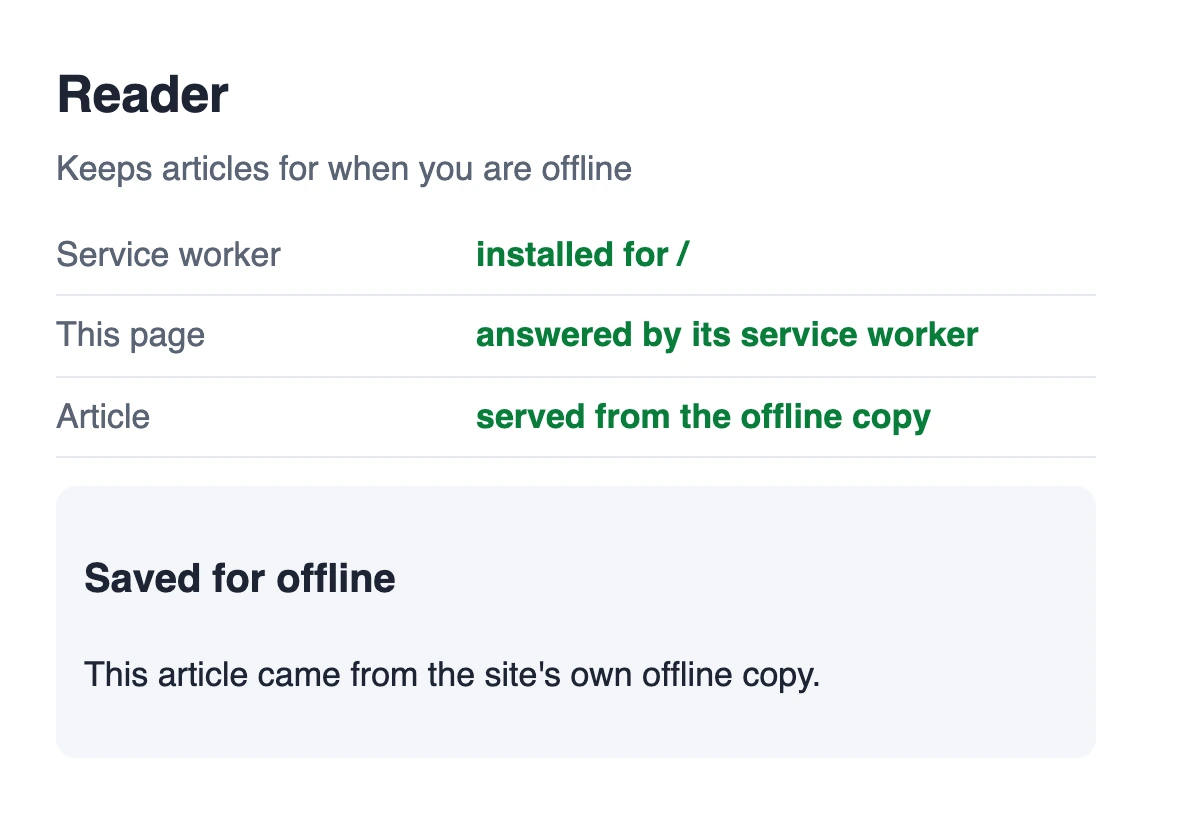
Dezelfde pagina in de referentiebrowser
Referentiebrowser

A service worker is a site's own small script that sits between its pages and the network: it can keep a copy of an article, an inbox or an app so they open with no connection. Floati now runs them: register, install, activate and claim, the page's requests answered by the worker's fetch handler (pages, images, scripts and styles, not only fetch calls), messages both ways, and Cache Storage shared with the page. The registration and its cached files are kept for the site on this device, so a site you set up opens offline even after Floati restarts. A worker runs only while one of its site's pages is open, and the site card's new In the background section lists it with a Remove button.

a reader app keeping an article with its service worker

Service worker and notification checks matching the reference11 of 13 (two better by design)

Notifications you allow, and no one can wake your computer

A site can ask to show notifications only after you click something on it, so a page cannot greet you with a prompt. Once you allow it, its notifications appear in Floati with the site's name on each; clicking one opens its tab, and the page hears the click. What no site can do is reach you after its page is closed: push messages need a push service, a server that knows which sites you follow and can wake your computer for them, and Floati keeps none. A site that tries to subscribe is told the service is not available, exactly as the reference browser says when it has none, and the site card says it plainly: cannot wake your computer or message you once the page is closed.

Devices and permissions, asked first and listed

Every permission a page can ask for now goes through one broker: location (from the computer's own location service, only after you allow it), motion sensors, MIDI instruments, keeping the screen awake, clipboard, window placement and more. Asking needs a click; a remembered Allow or Never is applied per site; Only this time lasts for the page. Bluetooth, USB, HID and serial devices answer a page exactly as the reference browser does when you close its device chooser, and a page asking without a click is refused, so no device is ever shared. The site card's Asked on this page list shows every permission and device the page reached for, how often, and what it got, including the ones refused without bothering you. A screen kept awake goes back to sleep when you leave the tab.

Highlights a page can paint without changing itself
VoorNa
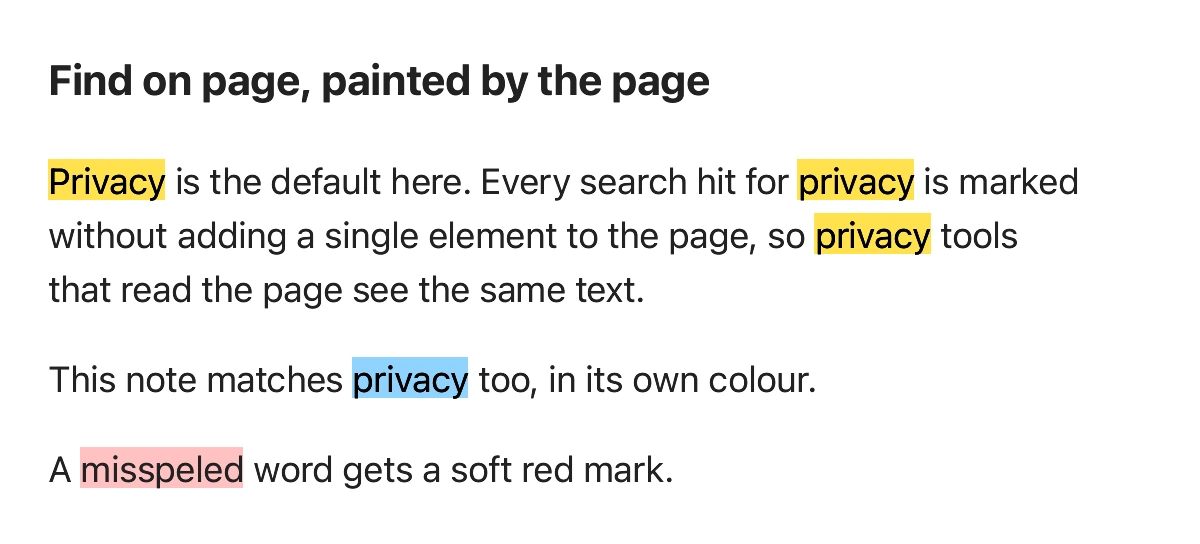
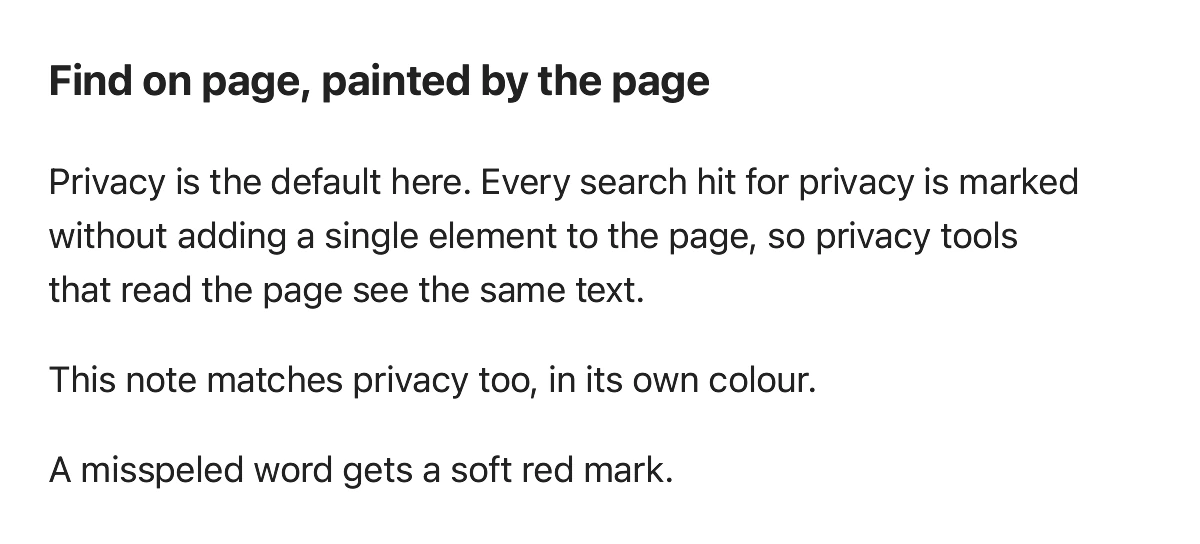
Voor: search hits and a spelling mark painted as highlights
Voor
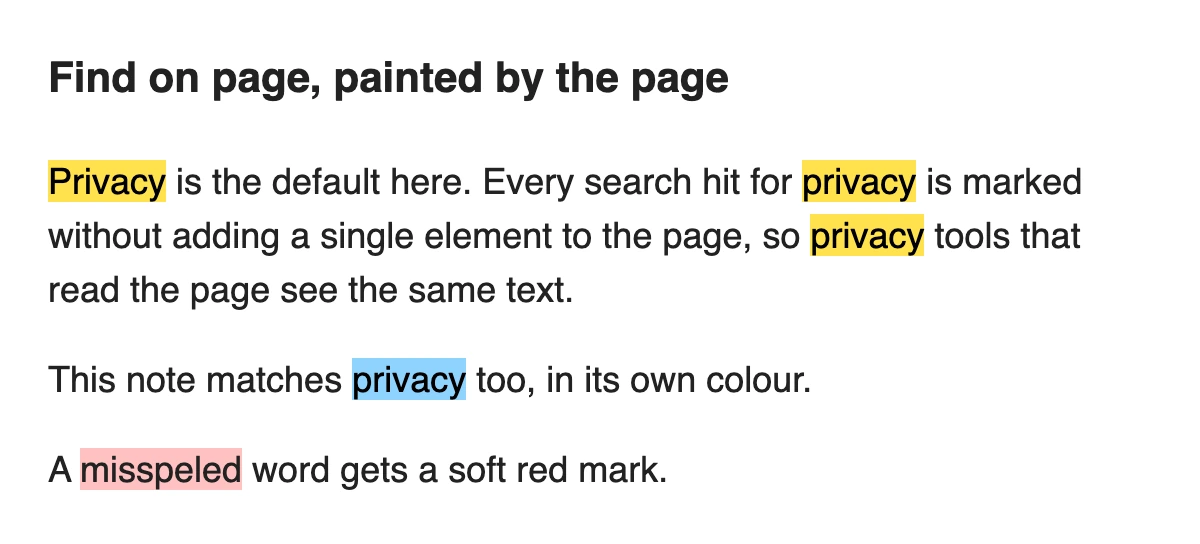
Na: search hits and a spelling mark painted as highlights
Na · v0.1.369
Dezelfde pagina in de referentiebrowser
Referentiebrowser

The CSS Custom Highlight API lets a page mark text, such as search hits, spelling or the current sentence being read aloud, without wrapping it in extra elements: the page registers ranges with CSS.highlights and styles them with ::highlight(name). Floati paints them under the text in the colours the page's styles give, follows the ranges as the page changes, and answers highlightsFromPoint. Because the page itself is never modified, tools that read the page (screen readers, reader view, privacy checks) see exactly the same text.

search hits and a spelling mark painted as highlights

Scheduling, locks, observer and highlight checks matching the reference29 of 30 (one pending: XSLT and EditContext)

Signatures and keys a page can trust
VoorNa
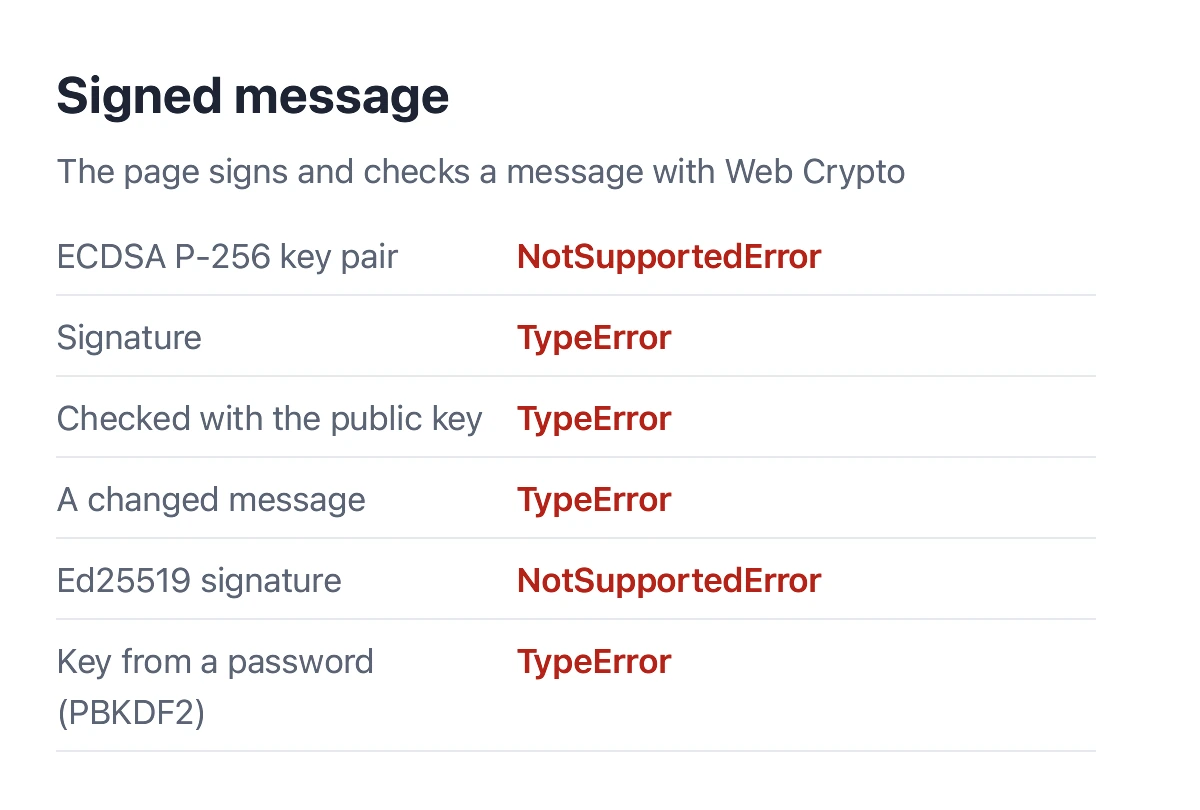
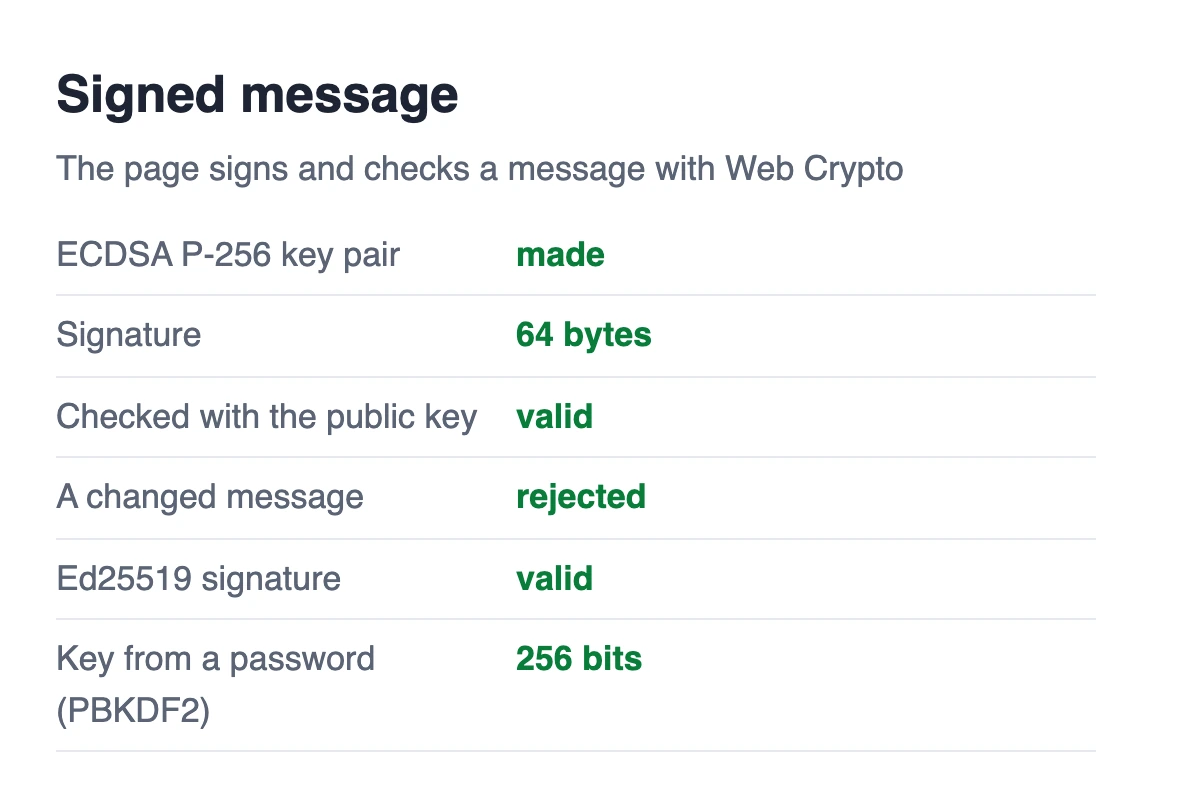
Voor: a page signing a message and checking it with Web Crypto
Voor
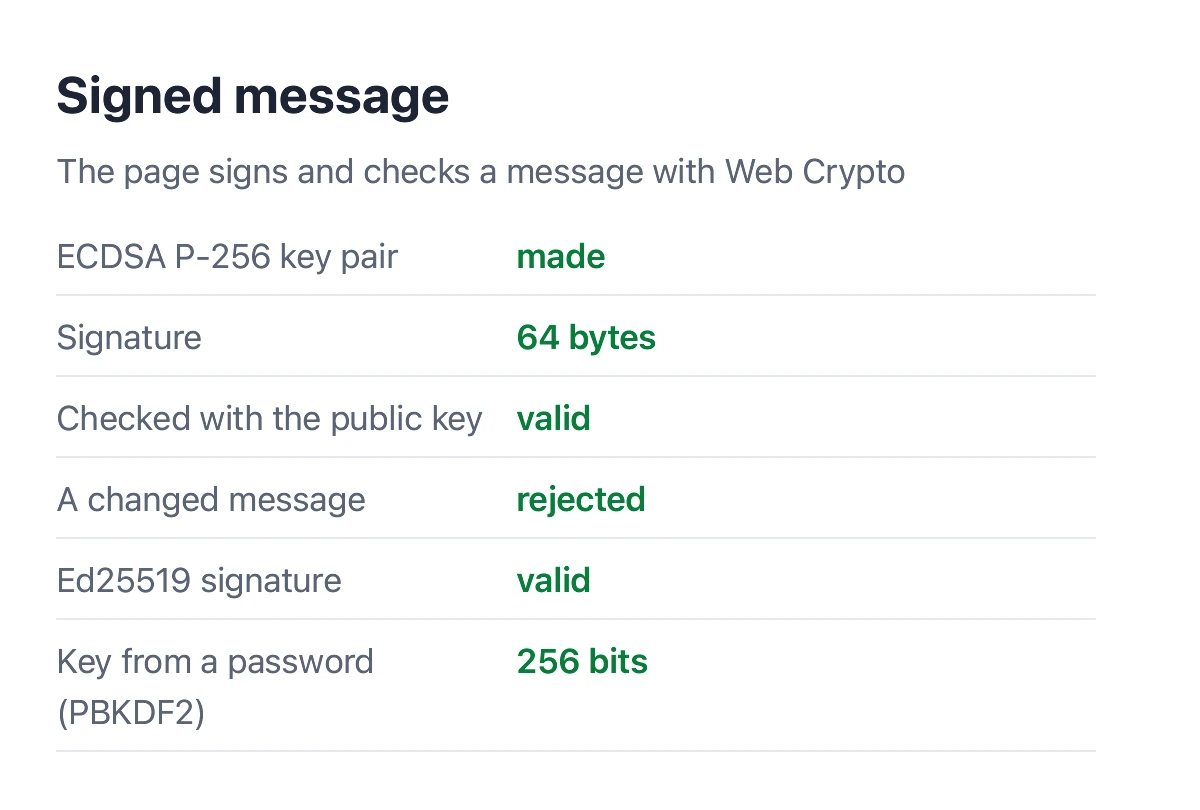
Na: a page signing a message and checking it with Web Crypto
Na · v0.1.369
Dezelfde pagina in de referentiebrowser
Referentiebrowser

Web Crypto gains the public-key half: ECDSA on P-256 and P-384, Ed25519, RSA signatures (PKCS#1 v1.5 and PSS) with imported keys, and keys derived from a password or a secret with PBKDF2 and HKDF, with spki, pkcs8, raw and JWK import and export. Sites use these to check signed messages, verify a passkey sign-in on the page, or encrypt with a key made from a password, and they now run on the same audited cryptography library as Floati's network security.

a page signing a message and checking it with Web Crypto

Public-key and key-derivation checks matching the reference7 of 7

Files, schedules and locks for web apps

Web apps gain the tools they reach for: the site's own private file system (navigator.storage.getDirectory: files and folders kept for the site on this device, written through streams), storage buckets, prioritized tasks (scheduler.postTask, scheduler.yield, TaskController), Web Locks between tabs, real ResizeObserver entries and MutationRecords, caretPositionFromPoint, and a compute pressure reading that always says nominal, so a site cannot use your machine's load to tell you apart.

File system and bucket checks matching the reference10 of 10

Every page starts faster and leaves nothing behind

Profiling the start of a page found that setting up the browser's built-in interfaces was quadratic in places: one interface with three hundred constants cost 7 ms on every page load. It now takes a third of the time it did, so every page starts about 10 ms sooner, more than paying for everything this release adds. And a leak that left about 12 KB behind each time a page closed (a compiled-code cache that outlived its page) is fixed: an evening of browsing no longer grows the browser's memory page by page.

Interface set-up per page15 ms -> 5 msMemory left after a page closes12 KB -> 0

Wat er veranderd is

9 wijzigingen
  1. Privacy en ShieldsPasskeys: made and used with Touch ID or Windows Hello, kept in the vault on this device, attestation none.
  2. NetwerkService workers: sites keep working offline, after a restart too; the site card lists them with Remove.
  3. Privacy en ShieldsNotifications you allow, asked only after a click; no push service, so no site can wake your computer.
  4. Privacy en ShieldsOne permission broker for location, sensors, MIDI, wake lock and more; the site card lists what a page asked for.
  5. Web-API’s en DOMCSS Custom Highlight API, painted without changing the page.
  6. WeergaveWeb Crypto: ECDSA, Ed25519, RSA signatures, HKDF and PBKDF2.
  7. WeergaveThe site's private file system, storage buckets, scheduler, Web Locks, observer records.
  8. Geheugen en lezenEvery page starts about 10 ms faster; a per-page memory leak fixed.
  9. Web-API’s en DOMWeb APIs measured against the reference browser: 63.8 -> 73.5 percent of the surface; all 14 test sites free of reference-only script errors.

Probeer in je browser

Elke test draait live in de browser waarmee je leest. Er wordt niets verstuurd.

ControleerJouw browserFloati
a highlight registered by the pageBezig met controlerenJa
passkey interfaces and the JSON helpersBezig met controlerenJa
creation options decoded from base64urlBezig met controlerenJa
service workers and pushBezig met controlerenJa
a task signal changes priorityBezig met controlerenJa
Web Locks, observer records, caret positionsBezig met controlerenJa
the site's private file system and storage bucketsBezig met controlerenJa
a typed array's buffer is an ArrayBufferBezig met controlerenJa
device interfaces a page cannot constructBezig met controlerenJa
a permission queryBezig met controlerenJa
Geslaagd 10 / 10
Alles sinds v0.1.369 op één plek

Versies

v0.1.0 - 0.1.9 · 10 Jul 2026418v0.1.427 · 25 Nov 2026

november2026 · 13 versies

oktober2026 · 32 versies

38530 OktAhead of the reference runtime on 7 of 8 workloadsv0.1.385 · Geheugen en lezen32 38429 OktSafety review, a rare crash fixed, functions compiled soonerv0.1.384 · Geheugen en lezen46 38327 OktJavaScript ahead of the reference runtime on six of eight speed testsv0.1.383 · JavaScript en JIT36 38225 OktClosed tabs give their memory back, and XML pages read as XMLv0.1.382 · Geheugen en lezen12 38125 OktLighter script code, and calls between scripts that run as ordinary callsv0.1.381 · Geheugen en lezen15 38025 OktScrolling boxes scroll, pages look right, and scripts from other sites need permissionv0.1.380 · Weergave16 37924 OktPages laid out the way their authors wrote them, and less memory againv0.1.379 · Weergave22 37823 OktOther sites' data stays private, and less memory againv0.1.378 · Geheugen en lezen 37723 OktAbout half the memory of the reference browser on everyday sitesv0.1.377 · Geheugen en lezen15 37622 OktA minimized window stops piling up graphics memoryv0.1.376 · Geheugen en lezen 37522 OktClosed pages let go, sites stay apart, and fonts stop costing memoryv0.1.375 · Geheugen en lezen9 37421 OktA floating video you can move, that opens without a black flashv0.1.374 · Tabbladen en interface 37321 OktEvery page on our own engine, two pages side by side, videos that keep playing, and your own clockv0.1.373 · Tabbladen en interface17 37021 OktOpen your files, share to your phone, have pages read aloud, install sites as apps, play with a controller, and accented text drawn rightv0.1.370 · Privacy en Shields · probeer het11 36920 OktPasskeys with Touch ID and Windows Hello, sites that work offline, notifications you allow, and devices asked for first, all kept on your devicev0.1.369 · Privacy en Shields · probeer het9 36519 OktThe code-size budget fits your processor, and code that has gone cold makes room for code that is hot nowv0.1.365 · JavaScript en JIT · probeer het 36419 OktCompiled code that fits the processor's caches: big pages up to 1.8 times faster, and fast compiled code on Windows and Intel machinesv0.1.364 · JavaScript en JIT · probeer het 36319 OktThermal runs on one code generator, building strings is up to 8 times faster, and two slow paths that grew with the square of their input are linearv0.1.363 · JavaScript en JIT · probeer het12 35816 OktThermal, Floati's own optimizing compiler, is on: hot loops keep their numbers and strings in registersv0.1.358 · JavaScript en JIT · probeer het 35715 OktLoops that test a number run as machine code, more of your functions compile, and reading page nodes is three times fasterv0.1.357 · JavaScript en JIT · probeer het14 35614 OktRecursion makes a fraction of the calls, loops keep objects in registers, and element writes stop searchingv0.1.356 · JavaScript en JIT · probeer het 35514 OktA hot loop changes compiler without stopping, property writes skip the detour, and pure recursion remembers its answersv0.1.355 · JavaScript en JIT · probeer het 35413 OktFloati compiles JavaScript with its own compiler, Updraft: about a hundred times faster to compile, and compiled code no longer piles upv0.1.354 · JavaScript en JIT · probeer het 35211 OktCode that loads on demand starts at once, images decode beside their downloads, writes run compiledv0.1.352 · Weergave · probeer het10 35010 OktHelpers that compile, strings that stay small, and events that fire fastv0.1.350 · JavaScript en JIT · probeer het14 3436 OktSign-ins that stay signed in, a real IndexedDB, and a storage button that shows what sites keepv0.1.343 · Privacy en Shields · probeer het25 3385 OktPages load faster, render truer and gain a dozen modern web features, each one checked against the reference browserv0.1.338 · Web-API’s en DOM · probeer het19 3352 OktA developer-docs site works like the reference browser, and every frame gets its own built-insv0.1.335 · Weergave12 3342 OktIframes that cost what a paragraph costs, live selections, and rounder cornersv0.1.334 · Weergave10 3331 OktFewer script errors on real sites, and finished pages give all their memory backv0.1.333 · JavaScript en JIT10 3311 OktA crash on busy news sites fixed, and pages lighter on the processorv0.1.331 · Weergave 3301 OktJavaScript scores 100, and big pages stop stuttering when they clean upv0.1.330 · JavaScript en JIT11

september2026 · 29 versies

32930 SepThe JavaScript engine proves what it can skipv0.1.329 · JavaScript en JIT9 32830 SepJavaScript runs at the reference browser's speed on 41 of our 42 measured workloadsv0.1.328 · JavaScript en JIT 32528 SepDeep recursion runs like it does in the reference browserv0.1.325 · JavaScript en JIT 32327 SepJavaScript measured at 94, JSON three times faster, and a round of fixes found against the reference browserv0.1.323 · JavaScript en JIT11 32227 SepClosed pages give their memory back whole, and JavaScript measured at 87v0.1.322 · JavaScript en JIT11 32127 SepHalf the memory, and JavaScript measured at 80v0.1.321 · JavaScript en JIT14 32026 SepPages no longer freeze while a script waits on the networkv0.1.320 · JavaScript en JIT 31926 SepA PDF viewer that does what Acrobat Pro charges forv0.1.319 · Tabbladen en interface16 31025 SepPages stay alive, repaints never block your scroll, and type matches the reference browser'sv0.1.310 · Weergave10 30924 SepPages arrive like they do in the reference browser, in a fraction of the memoryv0.1.309 · Netwerk13 30824 SepPages drawn by your graphics card, and scrolling that never waitsv0.1.308 · Weergave 30122 SepSites can no longer follow you between other sites, and the next page starts soonerv0.1.301 · Privacy en Shields 30019 SepReads the newest web compression, reuses secure connections, and remembers where sites livev0.1.300 · Geheugen en lezen 29717 SepSetting up and filling arrays of numbers is now several times faster, and faster than the reference browserv0.1.297 · JavaScript en JIT 29116 SepA private wayback machine for pages you seal, cited answers that open where you read them, and a privacy report that is ready the instant a page loadsv0.1.291 · Geheugen en lezen 29015 SepFloati spots trackers no list has caught, answers your questions from your own reading, and gets even closer to the pixelv0.1.290 · Privacy en Shields 28815 SepThe pages where you type a password stay out of your memory, and text renders truer to the pagev0.1.288 · Geheugen en lezen 28311 SepMessages between windows now prove who sent themv0.1.283 · Weergave 28111 SepSee a site's own rules protect you, and what it was never toldv0.1.281 · Weergave 27410 SepFingerprint Shield: see and prove what a page tried to learn about youv0.1.274 · Geheugen en lezen 2468 SepMemory: your browser remembers what you read, and can prove itv0.1.246 · Geheugen en lezen 2346 SepWebAssembly SIMD lands, completing the WebAssembly platformv0.1.234 · Weergave 2335 SepReal WebAssembly apps that share memory with the page now workv0.1.233 · Geheugen en lezen 2173 SepYour passwords, the Floati wayv0.1.217 · Tabbladen en interface 2112 SepA correctness fix for today's list-speed improvementv0.1.211 · JavaScript en JIT 2102 SepThe most common way people work with lists of data now runs at full speedv0.1.210 · JavaScript en JIT 2092 SepBig objects are instant now, instead of getting slower the more you addv0.1.209 · Geheugen en lezen 2082 SepFloati's own engine got dramatically faster at the code real pages run every framev0.1.208 · JavaScript en JIT 2061 SepExplain this page: the browser now understands what a site does, and can prove itv0.1.206 · Privacy en Shields

augustus2026 · 19 versies

20328 AugPages you open with the Floati engine now render on your graphics cardv0.1.203 · Weergave 19421 AugFaster on pages that change as you use them - plus a tab-hover fixv0.1.194 · Tabbladen en interface 19321 AugSelect text, find on the page, and zoom - plus faster renderingv0.1.193 · Tabbladen en interface 18619 AugEngine tabs remember where you werev0.1.186 · Tabbladen en interface 14814 AugWebAssembly numbers stay exact: 64-bit integers cross as BigIntv0.1.148 · JavaScript en JIT 14714 AugWebAssembly interop rounds out: imported globals and memoryv0.1.147 · Geheugen en lezen 13914 AugWebGL can texture from an image or a canvasv0.1.139 · Weergave 13414 AugWebAssembly now runs real compiled modules, not just toy onesv0.1.134 · Geheugen en lezen 13313 AugThe engine now runs WebAssemblyv0.1.133 · Geheugen en lezen 12813 AugHSTS: sites that demand https are never reached over plaintext, not even oncev0.1.128 · Netwerk 1097 AugWeb Audio convolution reverb + stereo sample playbackv0.1.109 · Media 785 AugAsk knows when to stop, and forms can edit their fieldsv0.1.78 · Web-API’s en DOM 775 AugAsk joins the dots across sentencesv0.1.77 · JavaScript en JIT 745 AugBracket property access gets fast, and Ask follows your timelinev0.1.74 · Weergave 735 AugBuilding a list gets fast, and Ask hears whole phrasesv0.1.73 · JavaScript en JIT 725 AugMethod calls get up to speed, and Ask spreads its sourcesv0.1.72 · Geheugen en lezen 715 AugRecursion gets its speed back, and Ask reads the roomv0.1.71 · JavaScript en JIT 704 AugOne press, and you are on the new versionv0.1.70 · Tabbladen en interface 661 AugThe worst score on the board turned out to be a cookie bannerv0.1.66 · Weergave9

juli2026 · 11 versies