Todas as versões v0.1.35514 Out 2026Renderização, JavaScript e JIT, Memória e leitura Feed

As notas de versão são escritas em inglês.

A hot loop changes compiler without stopping, property writes skip the detour, and pure recursion remembers its answers

This release builds on Updraft, the compiler Floati wrote for itself. A long loop can now move between the interpreter, Gust and the optimizing compiler in the middle of a run, on one shared frame, so hot code reaches fast code sooner; and because a Gust compile costs about a microsecond per operation, Floati now compiles warm code much earlier, which makes eleven real pages about 1% faster. Compiled code writes object properties itself instead of calling a general helper, one array with a named property no longer slows down every other array on the page, and functions that only compute from their arguments remember the answers they have already worked out.

123 -> 77 msWarm-up runs with 20,000-step loops
25 -> 9.5 nsA function that writes a property, per call
7 -> under 1 ms (reference engine 3 ms)fib(30)
Destaques3

A loop changes compiler without stopping

A hot loop moves from the interpreter to Gust to the optimizing compiler, on one frame

Floati runs new code in its interpreter, compiles warm code with Gust, and moves code that stays hot to its optimizing compiler. Until now a function could only change compiler between calls: a long loop that started in the interpreter, or in Gust, stayed there until it finished. Because all three tiers keep a function's state in the same frame, a loop can now switch at the top of an iteration with nothing to translate: a loop in a function that is still warming up enters Gust there, and once it has run long enough to pay for the bigger compile, Gust hands the same frame to the optimizing compiler at a loop edge. Floati also prices the first compile at what a Gust compile really costs, about a microsecond per operation instead of the hundred the old code generator needed, so warm code is compiled far sooner.

Warm-up runs with 20,000-step loops123 -> 77 msScript time on eleven real pages1.0% lower, no page slower

Property writes without the detour

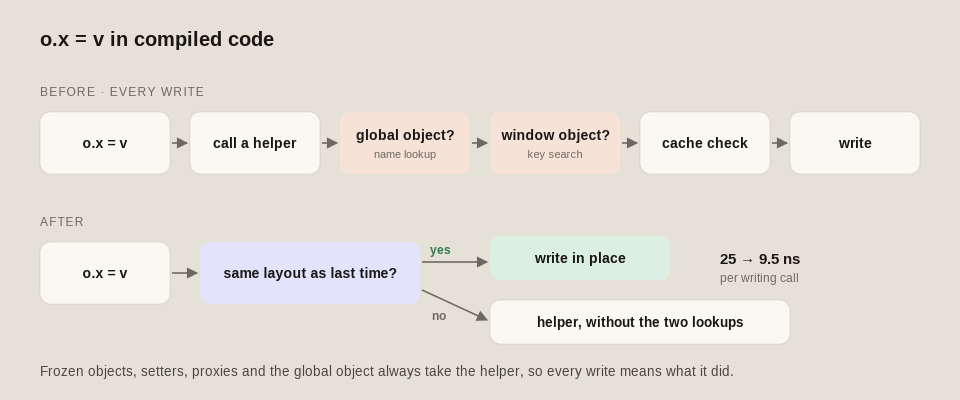
A property write before (six steps) and after (a layout check and a write)

Every o.x = v in compiled code used to call a general helper, and that helper first looked up the global object by name and searched the object for a window marker before it even reached its cache. Compiled code now checks that the object has the layout this write saw last time and writes the value in place. Anything unusual (a frozen or sealed object, a read-only property, a setter, a proxy, the global object) still takes the helper, so every write means exactly what it did, and the helper itself now skips the two lookups. A second slowdown is gone too: as soon as one array anywhere on a page got a named property, as some libraries do, push, pop and the other array methods lost their fast path on every array for the rest of the session. Now only that array is treated differently.

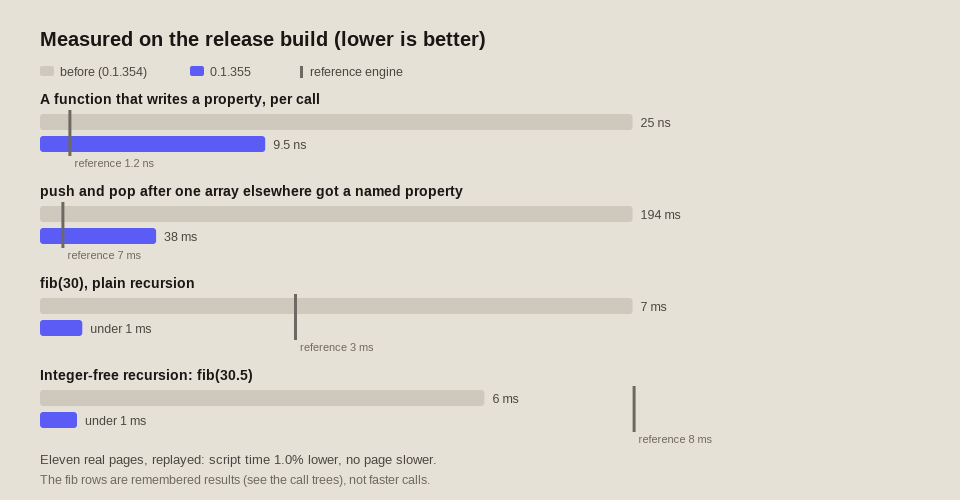
A function that writes a property, per call25 -> 9.5 nspush and pop after one array elsewhere got a named property194 -> 38 ms

Pure recursion remembers its answers

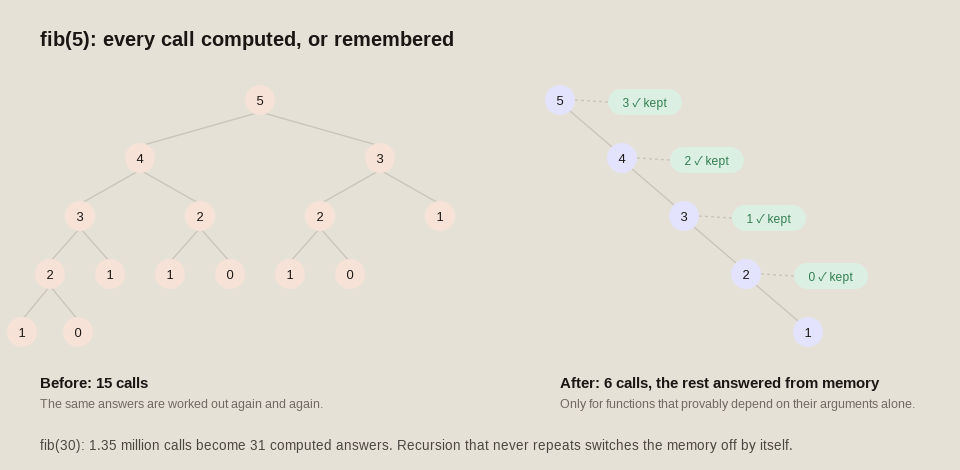
fib(5) without memory: 15 calls; with remembered answers: 6
Before, after and the reference engine for four measurements

Some recursive functions compute their result from their arguments and nothing else: no writes, no objects, no random numbers. Floati's recursion tier can prove that, and for such a function it now remembers each result for the arguments it was computed for, within one run. Asking again for an answer it already has costs a lookup instead of a whole subtree of calls, so a naive fib(30) does 31 computations instead of 1.35 million. The answers are exactly the ones recomputing would give, and the call stack goes as deep as before, so a runaway recursion still stops where it did. The memory resets on every new call into the function, so a value it captures can change between runs, and a recursion that never repeats a call switches the memory off by itself after a few thousand calls. This is a different kind of speed from faster calls: recursion that does not repeat work, such as walking a tree, runs as before.

fib(30)7 -> under 1 ms (reference engine 3 ms)Recursion that never repeats a callunchanged

O que mudou

6 mudanças
  1. JavaScript e JITA long loop in a function that is still warming up continues in compiled code from the top of the loop, and a hot loop moves on to the optimizing compiler at a loop edge instead of waiting for the next call.
  2. JavaScript e JITThe first compile is priced at what it really costs (about a microsecond per operation), so warm code is compiled much sooner: script time on eleven real pages is 1.0% lower, with no page slower.
  3. JavaScript e JITCompiled code writes an object property in place when the object has the layout the write saw before: a function that writes a property costs 9.5 instead of 25 nanoseconds.
  4. RenderizaçãoWrites that still need the general path skip two lookups they never needed.
  5. JavaScript e JITGiving one array a named property no longer slows push, pop and other array methods on every other array: 194 -> 38 ms in a test loop.
  6. Memória e leituraRecursive functions that compute only from their arguments remember their answers within a run; a recursion that never repeats a call turns this off by itself.

Teste no seu navegador

Cada teste roda ao vivo no navegador em que você está lendo. Nada é enviado para lugar nenhum.

VerificarSeu navegadorFloati
A loop handed between compilers mid-run keeps its stateVerificandoSim
A remembered recursive result follows a changed captured valueVerificandoSim
A remembered result tells -0 from 0VerificandoSim
Math.random is never rememberedVerificandoSim
A frozen object refuses a compiled write in strict codeVerificandoSim
A setter defined after warm-up runs on a compiled writeVerificandoSim
An array that overrides push keeps its own after compileVerificandoSim
Aprovados 7 / 7
Tudo desde a v0.1.355 em um só lugar

Versões

v0.1.0 - 0.1.9 · 10 Jul 2026418v0.1.427 · 25 Nov 2026

Novembro2026 · 19 versões

4088 Nov3D at 120 frames a secondv0.1.408 · Renderização23 4077 NovWebGL 2v0.1.407 · Renderização36 4066 NovA stuck tab stops at oncev0.1.406 · Renderização16 4055 NovSmall WebGL drawings get smooth edgesv0.1.405 · Renderização 4045 NovWebGL pages finally movev0.1.404 · Renderização25 4035 NovWebGPU is herev0.1.403 · Renderização35 4004 NovSmooth turns, the same bytes on every chip, and fields that keep their textv0.1.400 · Renderização15 3994 NovAnimations on the GPU compositor, and text that stays in its boxv0.1.399 · Renderização22 3984 NovGradient patterns that tile, animations that keep up, and a much faster canvasv0.1.398 · Renderização14 3973 NovTransitions that ease, and a GPU that draws 94% of real pages itselfv0.1.397 · Renderização 3963 NovAnimations on the GPU compositor, and spinners that spin as arcsv0.1.396 · Renderização 3953 NovCarousels that fade, badges that stay put, and floats that stay insidev0.1.395 · Renderização12 3943 NovBackground images over their colour, interlaced pictures, and borders in every colourv0.1.394 · Renderização 3932 NovStyle sheets in page order, and symbols that fall back like macOSv0.1.393 · Renderização 3922 NovIcon fonts loaded by script, and colour emoji on Windowsv0.1.392 · Abas e interface 3911 NovEmoji in colour, sized as in the reference browserv0.1.391 · JavaScript e JIT 3901 NovA classified ads site's front page: blank before, whole nowv0.1.390 · JavaScript e JIT12 3891 NovA computer maker's home page: navigation labels back, buttons apartv0.1.389 · Renderização 3881 NovA space agency's home page, a news section and a language site's header now match the referencev0.1.388 · Renderização18

Outubro2026 · 40 versões

38731 OutNews pages line up: a news site from 19.9% to 10.9% differentv0.1.387 · Renderização 38631 OutReal sites render closer to the reference browserv0.1.386 · Renderização14 38327 OutJavaScript ahead of the reference runtime on six of eight speed testsv0.1.383 · JavaScript e JIT36 38025 OutScrolling boxes scroll, pages look right, and scripts from other sites need permissionv0.1.380 · Renderização16 37924 OutPages laid out the way their authors wrote them, and less memory againv0.1.379 · Renderização22 37823 OutOther sites' data stays private, and less memory againv0.1.378 · Memória e leitura 37723 OutAbout half the memory of the reference browser on everyday sitesv0.1.377 · Memória e leitura15 37622 OutA minimized window stops piling up graphics memoryv0.1.376 · Memória e leitura 37522 OutClosed pages let go, sites stay apart, and fonts stop costing memoryv0.1.375 · Memória e leitura9 37421 OutA floating video you can move, that opens without a black flashv0.1.374 · Abas e interface 37321 OutEvery page on our own engine, two pages side by side, videos that keep playing, and your own clockv0.1.373 · Abas e interface17 37221 OutYour data stays put, your choices stick, and dictation that really listensv0.1.372 · Renderização 37121 OutDrop files onto pages, dictate without your voice leaving the Mac, and controllers that rumblev0.1.371 · APIs web e DOM · teste 37021 OutOpen your files, share to your phone, have pages read aloud, install sites as apps, play with a controller, and accented text drawn rightv0.1.370 · Privacidade e Shields · teste11 36920 OutPasskeys with Touch ID and Windows Hello, sites that work offline, notifications you allow, and devices asked for first, all kept on your devicev0.1.369 · Privacidade e Shields · teste9 36820 OutA site's own security rules are kept the whole time the page runs, Trusted Types, a map of every unsafe write in DevTools, and animations from scriptv0.1.368 · Privacidade e Shields · teste 36720 OutEvents, form controls, performance timing, URL patterns, live streams and the newest JavaScript: the Web APIs score rises from 59 to 62v0.1.367 · APIs web e DOM · teste10 36619 OutEvents, custom form controls, fonts and navigation work the way the web standards say: the Web APIs score rises from 53 to 59v0.1.366 · APIs web e DOM · teste9 36519 OutThe code-size budget fits your processor, and code that has gone cold makes room for code that is hot nowv0.1.365 · JavaScript e JIT · teste 36419 OutCompiled code that fits the processor's caches: big pages up to 1.8 times faster, and fast compiled code on Windows and Intel machinesv0.1.364 · JavaScript e JIT · teste 36319 OutThermal runs on one code generator, building strings is up to 8 times faster, and two slow paths that grew with the square of their input are linearv0.1.363 · JavaScript e JIT · teste12 36219 OutA page scheduler that stalled now runs, try / finally and spreads compile, and deleting thousands of properties is 180 times fasterv0.1.362 · Renderização · teste 36118 OutThermal runs on Windows and Intel machines, a register fix for compiled code on Windows, try / catch compiles, and reading a growing string is 200 times fasterv0.1.361 · JavaScript e JIT · teste 36018 OutEvery byte of machine code is Floati's own, a news site that showed blank renders, Gust's code is half the size, and closures and ?? compilev0.1.360 · JavaScript e JIT · teste9 35916 OutThermal reads object members and folds Math, string building compiles, and methods, Array subclasses and globals behave as the standard saysv0.1.359 · JavaScript e JIT · teste 35816 OutThermal, Floati's own optimizing compiler, is on: hot loops keep their numbers and strings in registersv0.1.358 · JavaScript e JIT · teste 35715 OutLoops that test a number run as machine code, more of your functions compile, and reading page nodes is three times fasterv0.1.357 · JavaScript e JIT · teste14 35614 OutRecursion makes a fraction of the calls, loops keep objects in registers, and element writes stop searchingv0.1.356 · JavaScript e JIT · teste 35514 OutA hot loop changes compiler without stopping, property writes skip the detour, and pure recursion remembers its answersv0.1.355 · JavaScript e JIT · teste 34910 OutScripts that grow in step with their work, layouts laid out once, and colours mixed like the referencev0.1.349 · Renderização · teste13 3489 OutScripts that only compile when it pays, cards that line up, and bold that stays boldv0.1.348 · Renderização · teste14 3478 OutCards inside links, small print at its real size, and errors you can followv0.1.347 · Renderização · teste17 3467 OutA real performance timeline, site icons from the engine with a lookalike check, and forms that lay out rightv0.1.346 · Renderização · teste14 3457 OutReal WebGL, a real 2D canvas, and canvas text that matches the reference browserv0.1.345 · Renderização · teste10 3446 OutRetina text that keeps its spacing, embeds at their real size, and an address bar that keeps upv0.1.344 · Renderização 3436 OutSign-ins that stay signed in, a real IndexedDB, and a storage button that shows what sites keepv0.1.343 · Privacidade e Shields · teste25 3425 OutTheme switchers, chart labels sized by CSS, and SVG text you can measurev0.1.342 · APIs web e DOM · teste 3415 OutCanvas text measured and drawn like the reference browser, and SVG shapes you can measurev0.1.341 · Renderização · teste 3405 OutScripts can read and change SVG the way they do in the reference browser, and a hidden hang is gonev0.1.340 · Renderização · teste10 3385 OutPages load faster, render truer and gain a dozen modern web features, each one checked against the reference browserv0.1.338 · APIs web e DOM · teste19