Todas as versões v0.1.36219 Out 2026Renderização, JavaScript e JIT Feed

As notas de versão são escritas em inglês.

A page scheduler that stalled now runs, try / finally and spreads compile, and deleting thousands of properties is 180 times faster

A break or continue that left a try block skipped its finally block. That broke more than tidy-up code: a widely used UI library's scheduler clears its "busy" flag in a finally that it leaves with break, so in Floati the flag stayed set after the first batch of work and every later batch waited forever. Pages built with that library looked right but never ran their later work (effects, an embedded code editor). break and continue now run every finally they leave, innermost first, as the standard says, and those pages do all their startup work, as in the reference browser. try / finally, object and array spread, destructuring from a Set, a Map or a generator, unary plus and regular-expression literals now run on the plan interpreter instead of the slowest tier, and so do for (let x of ..) loops over anything that is not an array. Deleting 64,000 properties one by one went from 5,993 to 33 ms, a function with try / finally called 2 million times from 430 to 243 ms, and on x86-64 Thermal keeps values in registers across calls in rarely run code (a float loop 315 -> 160 ms). Object spread now runs getters before converting a later computed key, and spreading null into an array throws a TypeError, as the standard says.

9 of 9 the sameRelease checks against the reference browser
5,993 -> 33 ms (reference engine 19)Delete 64,000 properties
Destaques2

break, continue and finally

A scheduler that leaves a labelled block with break: before, its finally never ran; now it does

A finally block runs however its try block ends: normally, by return, by a throw, or by break and continue. Floati handled the first three, but a break or continue out of a try jumped straight to its target and skipped the finally. That mattered on real pages. A widely used UI library runs queued work inside a labelled block, sets a "busy" flag, and clears it in a finally it leaves with break. In Floati the flag was never cleared, so after the first batch the scheduler believed it was still working and never started another: effects never ran, and an embedded code editor never parsed its text. The pages still looked complete, which is why the page checks did not catch it. Now a break or continue that crosses finally blocks runs each one, innermost first, with its own state restored, then lands where it was going. Each finally body resumes its own completion, so a try / finally inside a finally no longer takes an outer return or throw at its end, and a return routed into a finally closes the try's handlers first. The two pages built with that library now spend more time in JavaScript, because they do the work the reference browser does. The code they now run is compiled: a for (let x of ..) loop over a Set, a Map, a generator or a string used to be refused a plan because of the jump that ends it when the iterator is done, and now it is planned.

Release checks against the reference browser9 of 9 the same

More of every page compiles, and deletes are linear
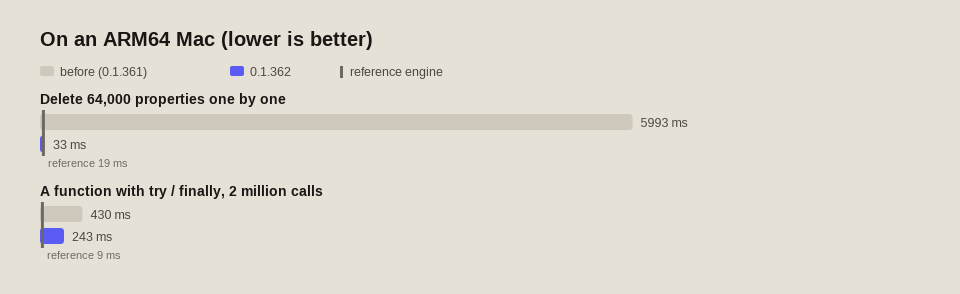
Before, after and the reference engine on an ARM64 Mac

The plan interpreter runs most hot functions. Several common constructs kept a function out of it, in the bytecode interpreter: try / finally, object and array spread ({ ...a, ...b }, [...set]), destructuring from anything iterable, unary plus on objects, and regular-expression literals (the most common refusal on a news site's load). Each is now a plan operation, checked against the interpreter in every tier on new test maps. Deleting a property from a large object shifted every property after it, so deleting n properties took time proportional to n squared. Deletes now leave a marker that is cleaned up in bulk, so the remaining properties keep their order and deleting 64,000 takes 33 ms instead of 5,993. On x86-64, Updraft IR's register allocator now keeps values in registers that a call may change, across calls in rarely run blocks, saving them only around those calls; a float loop with a rare slow path went from 315 to 160 ms.

Delete 64,000 properties5,993 -> 33 ms (reference engine 19)try / finally, 2 million calls430 -> 243 ms (reference engine 9)

O que mudou

7 mudanças
  1. Renderizaçãobreak and continue out of a try run its finally block; a UI library's scheduler no longer stalls after its first batch.
  2. RenderizaçãoEach finally body resumes its own completion, and a throw in a finally after a return is no longer caught by its own try.
  3. JavaScript e JITtry / finally, spread, destructuring from iterables, unary plus and regex literals run on the plan interpreter.
  4. JavaScript e JITfor (let x of ..) over a Set, a Map, a generator or a string is compiled instead of interpreted.
  5. RenderizaçãoDeleting many properties from one object is linear: 64,000 deletes 5,993 -> 33 ms.
  6. JavaScript e JITx86-64: values stay in registers across calls in rarely run code (a float loop 315 -> 160 ms).
  7. RenderizaçãoObject spread runs getters before a later computed key is converted, and [...null] throws a TypeError.

Teste no seu navegador

Cada teste roda ao vivo no navegador em que você está lendo. Nada é enviado para lugar nenhum.

VerificarSeu navegadorFloati
a break out of a labelled block runs its finally (a page scheduler no longer stalls)VerificandoSim
break and continue out of try run the finally blockVerificandoSim
a finally that returns overrides a throw, in a hot functionVerificandoSim
object spread runs getters before a later computed key is convertedVerificandoSim
spreading null into an array throws a TypeErrorVerificandoSim
destructuring and spread from Set, Map and generators in a hot functionVerificandoSim
a regex literal is a new object each evaluationVerificandoSim
deleting thousands of properties keeps the remaining orderVerificandoSim
unary plus converts objects through valueOf and Symbol.toPrimitiveVerificandoSim
Aprovados 9 / 9
Tudo desde a v0.1.362 em um só lugar

Versões

v0.1.0 - 0.1.9 · 10 Jul 2026418v0.1.427 · 25 Nov 2026

Novembro2026 · 40 versões

42725 NovLayouts that remember their workMais recente · v0.1.427 · Renderização9 42625 NovCompiled with what real pages runv0.1.426 · JavaScript e JIT 42525 NovBuilt with whole-program optimizationv0.1.425 · Renderização 42425 NovMore layout reused after a script changes the pagev0.1.424 · Renderização 42324 NovThe optimizing compiler works off the main threadv0.1.423 · Renderização 42222 NovText-reading loops and element-tree builders run fasterv0.1.422 · JavaScript e JIT14 42122 NovCalls from loops run inside the loop's own machine codev0.1.421 · JavaScript e JIT9 42021 NovPages you come back to run their scripts soonerv0.1.420 · Renderização17 41918 NovA faster interpreter runs the page's codev0.1.419 · JavaScript e JIT12 41815 NovScripts run faster on busy pagesv0.1.418 · JavaScript e JIT34 41711 NovPages wait less for their own scripts and stylesv0.1.417 · JavaScript e JIT13 41611 NovWebGPU loops run 2 to 3 times faster on Macsv0.1.416 · JavaScript e JIT 41510 NovWebGPU loops count right on Macsv0.1.415 · JavaScript e JIT 41410 NovWebGPU runs in its own graphics processv0.1.414 · Renderização 41310 NovA graphics card reset no longer takes the browser downv0.1.413 · Renderização 4129 NovVideo moves to the graphics cardv0.1.412 · Mídia 4119 NovNo canvas stall on Windows, patterns and every blend mode on the graphics cardv0.1.411 · Renderização 4109 NovCanvas drawing moves to the graphics cardv0.1.410 · Renderização27 4098 NovEvery tile on the GPUv0.1.409 · Renderização26 4088 Nov3D at 120 frames a secondv0.1.408 · Renderização23 4077 NovWebGL 2v0.1.407 · Renderização36 4066 NovA stuck tab stops at oncev0.1.406 · Renderização16 4055 NovSmall WebGL drawings get smooth edgesv0.1.405 · Renderização 4045 NovWebGL pages finally movev0.1.404 · Renderização25 4035 NovWebGPU is herev0.1.403 · Renderização35 4024 NovA canvas that moves itself to the GPUv0.1.402 · Renderização 4014 Nov99% of real pages decided by the GPUv0.1.401 · Renderização9 4004 NovSmooth turns, the same bytes on every chip, and fields that keep their textv0.1.400 · Renderização15 3994 NovAnimations on the GPU compositor, and text that stays in its boxv0.1.399 · Renderização22 3984 NovGradient patterns that tile, animations that keep up, and a much faster canvasv0.1.398 · Renderização14 3973 NovTransitions that ease, and a GPU that draws 94% of real pages itselfv0.1.397 · Renderização 3963 NovAnimations on the GPU compositor, and spinners that spin as arcsv0.1.396 · Renderização 3953 NovCarousels that fade, badges that stay put, and floats that stay insidev0.1.395 · Renderização12 3943 NovBackground images over their colour, interlaced pictures, and borders in every colourv0.1.394 · Renderização 3932 NovStyle sheets in page order, and symbols that fall back like macOSv0.1.393 · Renderização 3922 NovIcon fonts loaded by script, and colour emoji on Windowsv0.1.392 · Abas e interface 3911 NovEmoji in colour, sized as in the reference browserv0.1.391 · JavaScript e JIT 3901 NovA classified ads site's front page: blank before, whole nowv0.1.390 · JavaScript e JIT12 3891 NovA computer maker's home page: navigation labels back, buttons apartv0.1.389 · Renderização 3881 NovA space agency's home page, a news section and a language site's header now match the referencev0.1.388 · Renderização18

Outubro2026 · 58 versões

Mostrar mais 57
Setembro2026124 versões Agosto2026140 versões Julho202656 versões


















