Tüm sürümler v0.1.35614 Eki 2026JavaScript ve JIT, Bellek ve okuma, Sekmeler ve arayüz Akış

Sürüm notları İngilizce yazılmıştır.

Recursion makes a fraction of the calls, loops keep objects in registers, and element writes stop searching

This release makes three kinds of everyday JavaScript faster. Recursive functions now answer their simplest cases where they are called and run every other level inside their parent, so walking a tree makes a fraction of the calls, and recursion whose last step returns a property now compiles at all. Long loops that walk a list, keep the best object seen so far, copy objects, compare them or ask typeof now run in Floati's fastest loop tier, 20 to 40 times faster than before. Setting a property on page elements no longer searches every element prototype each time, so building elements is almost three times faster, and a getter a page puts on an element prototype now answers reads as it does in the reference browser. One crash is fixed: freeing a long linked list made inside a function no longer overflows the stack.

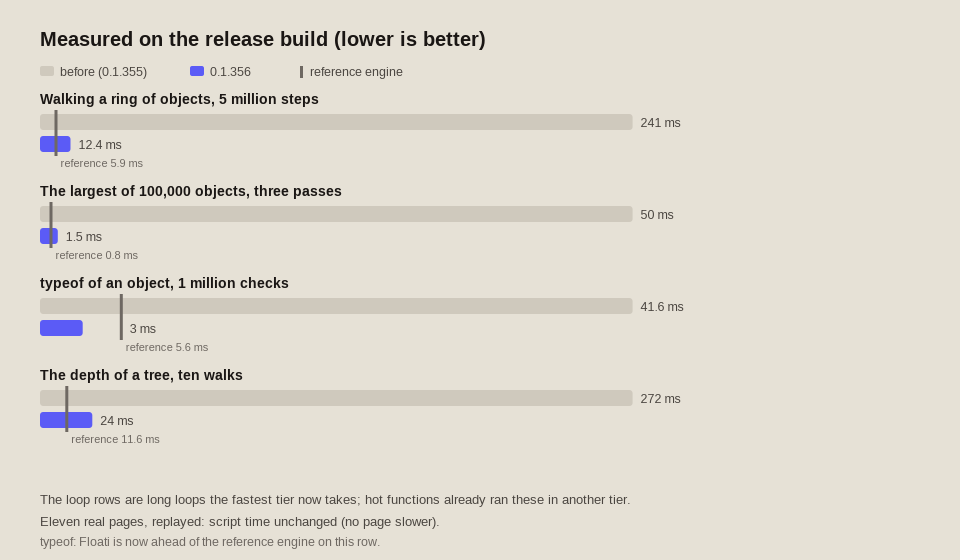
272 -> 24 msThe depth of a tree, ten walks
241 -> 12.4 ms (reference engine 5.9)Walking a ring of objects, 5 million steps
10 -> 3.5 msBuilding 3,000 elements, twenty times
Öne çıkanlar3

Recursion makes a fraction of the calls

A tree sum before and after: 31 calls become 5

A recursive function usually starts with its simplest case: if the tree is empty, return 0; if n is below 2, return n. Floati's recursion tier now runs that test where the call is made, so a call that would only answer the simple case is never made, and it copies one level of the function into its parent, so every other level of a tree runs without a call at all (a technique from research on divide-and-conquer programs). Each copy still counts toward the call-depth limit and the work budget exactly as a call would, so a runaway recursion stops where it did. Once a recursive function has run, its property reads are compiled again with the object layouts they saw built in. Recursion whose last step returns a property, like the depth of a tree that returns a leaf's value, used to fall back to slower code because one path returned a number and the other a value of any type; now the two paths meet as a number, and anything else hands the work back to the interpreter.

The depth of a tree, ten walks272 -> 24 msA count whose base case returns a property80 -> 4.7 ms

Loops keep objects in registers

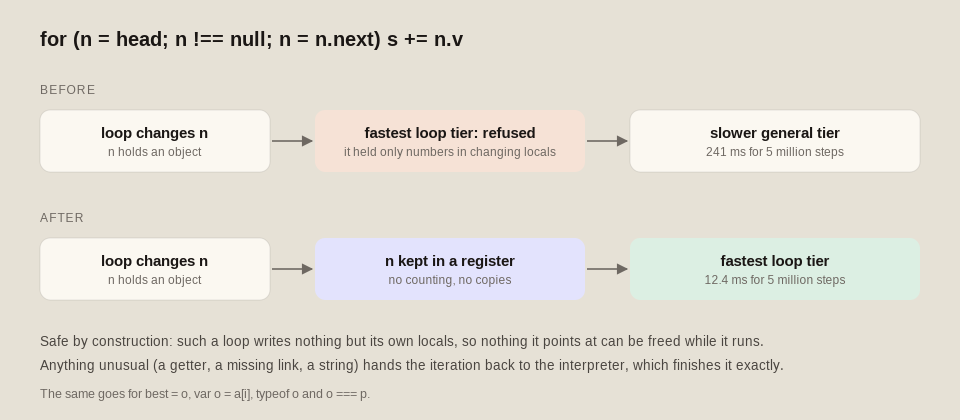
A list walk before and after: refused by the fastest loop tier, then run there with the object in a register
Before, after and the reference engine for four measurements

Floati's fastest loop tier kept numbers in registers, and objects only when the loop never changed which object a variable held. A loop like for (n = head; n !== null; n = n.next), or one that remembers the largest object seen so far, was refused and ran in a slower tier. Now such a variable holds the object directly, with no counting or copying, because these loops write nothing but their own variables: nothing they point at can be freed while they run. They can read properties, compare with null and with each other, copy, ask typeof and test truthiness; anything unusual, a getter, a missing link or a string compared by identity, hands that iteration back to the interpreter, which finishes it exactly. These are long loops the fastest tier now takes; a function that is already hot ran them in another tier and is unchanged.

Walking a ring of objects, 5 million steps241 -> 12.4 ms (reference engine 5.9)typeof of an object, 1 million checks41.6 -> 3 ms (reference engine 5.6)

Element writes stop searching

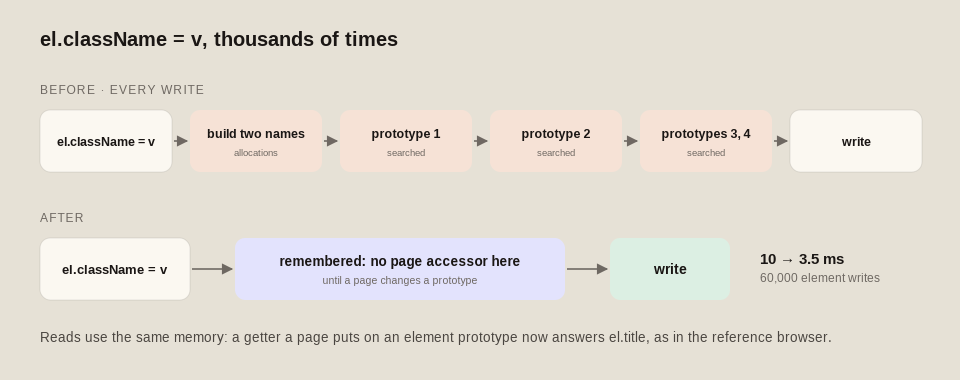
An element property write before and after: from a search of four prototypes to a remembered answer

Every el.className = v or el.textContent = v checked whether a page script had defined that property as an accessor on one of the element's prototypes: it built two names and searched four prototypes, every time, to learn that nothing was there. On a page that builds elements this was most of its script time. Floati now remembers the answer per element type until a page changes a prototype, which makes element-building three times faster. Reads use the same memory, which fixed a gap: a getter a page defines on an element prototype, as some monitoring and compatibility scripts do, now answers reads of that property as it does in the reference browser; before, Floati answered from its own value.

Building 3,000 elements, twenty times10 -> 3.5 msA getter on an element prototypenow answers reads

Neler değişti

8 değişiklik
  1. JavaScript ve JITRecursive functions answer their simple case where they are called and run alternate levels inside their parent: a tree walk makes a fraction of the calls.
  2. JavaScript ve JITRecursion whose last step returns a property (a tree's depth, a count) now compiles: a tree depth 272 -> 24 ms.
  3. JavaScript ve JITOnce a recursive function has run, its property reads are compiled again with the layouts they saw built in.
  4. JavaScript ve JITLong loops that walk a list, keep the best object so far, copy or compare objects, or ask typeof run in the fastest loop tier: a 5 million step walk 241 -> 12.4 ms.
  5. Bellek ve okumaSetting properties on page elements remembers that no page accessor intercepts them: building elements is three times faster.
  6. JavaScript ve JITA getter a page defines on an element prototype now answers reads of that property, as in the reference browser.
  7. Bellek ve okumaFixed: freeing a long linked list built inside a function no longer overflows the stack and closes the page.
  8. Sekmeler ve arayüzFloati's pages and update notes now open at browser.floati.life.

Tarayıcınızda deneyin

Her denetim, okuduğunuz tarayıcıda canlı çalışır. Hiçbir yere bir şey gönderilmez.

Kontrol etTarayıcınızFloati
A recursive base case that returns a property still adds upDenetleniyorEvet
An unrolled recursion keeps its arguments in orderDenetleniyorEvet
A setter added to an element prototype after many writes runsDenetleniyorEvet
A long walk around a ring of objects keeps its placeDenetleniyorEvet
The largest object found in a loop is that very objectDenetleniyorEvet
Equal strings compare equal in a hot loopDenetleniyorEvet
Typeof in a hot loop tells functions, arrays and null apartDenetleniyorEvet
A long list built in a function is freed when it returnsDenetleniyorEvet
Geçti 8 / 8
v0.1.356 sürümünden bu yana her şey tek yerde

Sürümler

v0.1.0 - 0.1.9 · 10 Tem 2026418v0.1.427 · 25 Kas 2026

Ekim2026 · 33 sürüm

37121 EkiDrop files onto pages, dictate without your voice leaving the Mac, and controllers that rumblev0.1.371 · Web API’leri ve DOM · deneyin 37021 EkiOpen your files, share to your phone, have pages read aloud, install sites as apps, play with a controller, and accented text drawn rightv0.1.370 · Gizlilik ve Shields · deneyin11 36920 EkiPasskeys with Touch ID and Windows Hello, sites that work offline, notifications you allow, and devices asked for first, all kept on your devicev0.1.369 · Gizlilik ve Shields · deneyin9 36820 EkiA site's own security rules are kept the whole time the page runs, Trusted Types, a map of every unsafe write in DevTools, and animations from scriptv0.1.368 · Gizlilik ve Shields · deneyin 36720 EkiEvents, form controls, performance timing, URL patterns, live streams and the newest JavaScript: the Web APIs score rises from 59 to 62v0.1.367 · Web API’leri ve DOM · deneyin10 36619 EkiEvents, custom form controls, fonts and navigation work the way the web standards say: the Web APIs score rises from 53 to 59v0.1.366 · Web API’leri ve DOM · deneyin9 36519 EkiThe code-size budget fits your processor, and code that has gone cold makes room for code that is hot nowv0.1.365 · JavaScript ve JIT · deneyin 36419 EkiCompiled code that fits the processor's caches: big pages up to 1.8 times faster, and fast compiled code on Windows and Intel machinesv0.1.364 · JavaScript ve JIT · deneyin 36319 EkiThermal runs on one code generator, building strings is up to 8 times faster, and two slow paths that grew with the square of their input are linearv0.1.363 · JavaScript ve JIT · deneyin12 36219 EkiA page scheduler that stalled now runs, try / finally and spreads compile, and deleting thousands of properties is 180 times fasterv0.1.362 · Görüntü oluşturma · deneyin 36118 EkiThermal runs on Windows and Intel machines, a register fix for compiled code on Windows, try / catch compiles, and reading a growing string is 200 times fasterv0.1.361 · JavaScript ve JIT · deneyin 36018 EkiEvery byte of machine code is Floati's own, a news site that showed blank renders, Gust's code is half the size, and closures and ?? compilev0.1.360 · JavaScript ve JIT · deneyin9 35916 EkiThermal reads object members and folds Math, string building compiles, and methods, Array subclasses and globals behave as the standard saysv0.1.359 · JavaScript ve JIT · deneyin 35816 EkiThermal, Floati's own optimizing compiler, is on: hot loops keep their numbers and strings in registersv0.1.358 · JavaScript ve JIT · deneyin 35715 EkiLoops that test a number run as machine code, more of your functions compile, and reading page nodes is three times fasterv0.1.357 · JavaScript ve JIT · deneyin14 35614 EkiRecursion makes a fraction of the calls, loops keep objects in registers, and element writes stop searchingv0.1.356 · JavaScript ve JIT · deneyin 35514 EkiA hot loop changes compiler without stopping, property writes skip the detour, and pure recursion remembers its answersv0.1.355 · JavaScript ve JIT · deneyin 35413 EkiFloati compiles JavaScript with its own compiler, Updraft: about a hundred times faster to compile, and compiled code no longer piles upv0.1.354 · JavaScript ve JIT · deneyin 35311 EkiStyle matching tries a third of the rules, queries prepare their selector once, sibling walks stay fastv0.1.353 · Görüntü oluşturma · deneyin 35211 EkiCode that loads on demand starts at once, images decode beside their downloads, writes run compiledv0.1.352 · Görüntü oluşturma · deneyin10 35111 EkiStyles read once, layouts redone only where they changed, built-ins in compiled loopsv0.1.351 · JavaScript ve JIT · deneyin12 35010 EkiHelpers that compile, strings that stay small, and events that fire fastv0.1.350 · JavaScript ve JIT · deneyin14 34910 EkiScripts that grow in step with their work, layouts laid out once, and colours mixed like the referencev0.1.349 · Görüntü oluşturma · deneyin13 3489 EkiScripts that only compile when it pays, cards that line up, and bold that stays boldv0.1.348 · Görüntü oluşturma · deneyin14 3478 EkiCards inside links, small print at its real size, and errors you can followv0.1.347 · Görüntü oluşturma · deneyin17 3467 EkiA real performance timeline, site icons from the engine with a lookalike check, and forms that lay out rightv0.1.346 · Görüntü oluşturma · deneyin14 3457 EkiReal WebGL, a real 2D canvas, and canvas text that matches the reference browserv0.1.345 · Görüntü oluşturma · deneyin10 3436 EkiSign-ins that stay signed in, a real IndexedDB, and a storage button that shows what sites keepv0.1.343 · Gizlilik ve Shields · deneyin25 3425 EkiTheme switchers, chart labels sized by CSS, and SVG text you can measurev0.1.342 · Web API’leri ve DOM · deneyin 3415 EkiCanvas text measured and drawn like the reference browser, and SVG shapes you can measurev0.1.341 · Görüntü oluşturma · deneyin 3405 EkiScripts can read and change SVG the way they do in the reference browser, and a hidden hang is gonev0.1.340 · Görüntü oluşturma · deneyin10 3395 EkiEvery computed style, real stylesheet objects and full 3D geometry, each checked against the reference browserv0.1.339 · Web API’leri ve DOM · deneyin12 3385 EkiPages load faster, render truer and gain a dozen modern web features, each one checked against the reference browserv0.1.338 · Web API’leri ve DOM · deneyin19