Versions nyinaa v0.1.36118 Oct 2026Krataafa nhyehyɛeɛ, JavaScript ne JIT, DevTools Feed

Wɔakyerɛw release ho nsɛm no wɔ Borɔfo kasa mu.

Thermal runs on Windows and Intel machines, a register fix for compiled code on Windows, try / catch compiles, and reading a growing string is 200 times faster

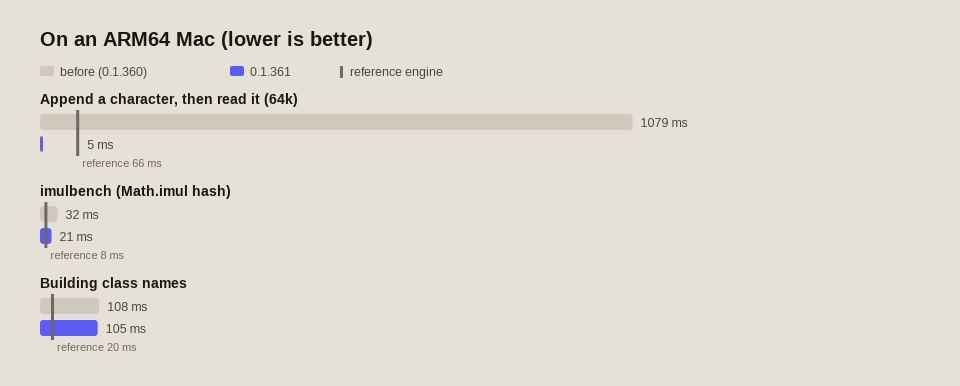
Thermal, the optimizing compiler Floati writes for itself, now runs on x86-64 as well as on ARM64: it builds Updraft IR, Floati's own compiler core, which lowers it for both processors. On an x86-64 machine a murmur3 hash went from 1,606 to 166 ms and a Math.imul hash from 1,844 to 87 ms, so Windows and Intel machines now sit as close to the reference engine as Apple silicon Macs do. This release also fixes a bug on Windows: compiled code used three floating-point registers the Windows calling convention says a function must leave as it found them, and compiled code now saves them; it also tells Windows how to walk through its frames, so crash reports and debuggers see the whole stack. Functions with try / catch now run on the plan interpreter instead of the slowest tier, a loop that adds to a string and reads the newest character went from 1,079 to 5 ms (the reference engine takes 66), and two places where Floati differed from the standard are fixed: a throwing Symbol.hasInstance getter, and a getter defined over a built-in array method.

1,606 -> 166 ms (reference engine 69)A murmur3 hash on x86-64
about 4 microsecondsRegistering a function with the unwinder
1,079 -> 5 ms (reference engine 66)Append a character, read it (64k)
Nsɛm titiriw3

One Thermal for both processors

Hash loops on x86-64 before and after Thermal, with the reference engine on the same machine
Before, after and the reference engine on an ARM64 Mac

Thermal compiles a hot loop with its numbers kept in the processor's registers. Until now it wrote ARM64 instructions directly, so on x86-64 hot hashing and numeric loops never reached it. Thermal now builds Updraft IR, the compiler core every other Floati compiler already uses, and Updraft lowers it for ARM64 and x86-64 alike: one Thermal, both processors, with the IR's register allocation and loop optimizations underneath. Two refinements came with it, on both processors. A parameter that has only ever held integers is kept as an integer (checked at the function's entry, and any other value runs the function in its other tiers), so a hash whose state starts from a parameter stays in an integer register instead of becoming a double at the top of its loop. And a 32-bit value that was just widened is not narrowed again by a separate instruction. The IR version is checked against the ARM64 emitter on every test map in two more test configurations, one of which leaves compiled code at every third operation, on Apple silicon and on x86-64 Linux.

A murmur3 hash on x86-641,606 -> 166 ms (reference engine 69)A Math.imul hash on x86-641,844 -> 87 ms (reference engine 24)

Compiled code on Windows keeps the caller's registers

On Windows, the registers xmm6 to xmm15 belong to the caller: a function that uses one must put back what it held. Floati's compiled code used xmm13 to xmm15 as scratch registers without saving them, which is fine on macOS and Linux and wrong on Windows. A new test that fills every register Windows says must survive a call, calls compiled code, and checks each one afterwards found it at once. Compiled code on Windows now saves and restores them. Compiled code is also registered with Windows' unwinder now: each function's prologue is described the way the operating system expects, so a crash report, a debugger or a profiler can walk from compiled code back to its caller.

Registering a function with the unwinderabout 4 microseconds

try / catch, growing strings, and two standard fixes

A function with try / catch used to stay in the bytecode interpreter, the slowest tier, and minified code often names a catch binding after a parameter (function(e){ try {...} catch(e) {...} }), which also kept a function there. Both now run on the plan interpreter: a thrown error inside a try goes to its catch with the operand stack restored, an error a callee throws is caught the same way, and a caught error carries the stack trace it would have had. Budget stops and interrupts stay uncatchable, as they are in the interpreter. Appending to a long string builds a rope (the pieces are not copied each time), but reading one character flattened the whole rope into a flat string, so a loop that appends and reads the newest character was quadratic. Characters are now read from the rope where they sit. A Symbol.hasInstance defined as a getter that throws now throws from instanceof, as the standard says, and a getter defined over a built-in array method such as push is what arrays call.

Append a character, read it (64k)1,079 -> 5 ms (reference engine 66)Release checks against the reference browser8 of 8 the same

Deɛ asesa

nsesaeɛ 7
  1. JavaScript ne JITThermal, Floati's optimizing compiler, runs on x86-64 (Windows, Intel Macs, Linux): hash loops 10 to 21 times faster there.
  2. JavaScript ne JITFixed on Windows: compiled code left three floating-point registers changed that a function must preserve.
  3. DevToolsCompiled code is registered with Windows' unwinder, so crash reports, debuggers and profilers see through it.
  4. Krataafa nhyehyɛeɛInteger parameters stay integers in Thermal: a hash seeded from a parameter a third faster on Apple silicon.
  5. Krataafa nhyehyɛeɛFunctions with try / catch run on the plan interpreter instead of the slowest tier.
  6. JavaScript ne JITReading a character of a string that is still being built no longer copies it: 1,079 -> 5 ms on a 64k-character loop.
  7. JavaScript ne JITinstanceof calls a Symbol.hasInstance getter as the standard says, and a getter over a built-in array method is honoured.

Sɔ hwɛ wɔ wo browser mu

Nhwehwɛmu biara di dwuma wɔ browser a woreyɛ ho akenkan no mu. Wɔmmfa hwee nkɔ baabiara.

HwɛWo browserFloati
try / catch in a hot function catches, rethrows and restores the stackƐrehwɛAane
a catch binding that shadows a parameter keeps the parameterƐrehwɛAane
reading the newest character of a growing string is the right code unitƐrehwɛAane
a split surrogate pair joins when appended, then reads as one code pointƐrehwɛAane
a throwing Symbol.hasInstance getter propagates from instanceofƐrehwɛAane
a getter defined over Array.prototype.push is what arrays callƐrehwɛAane
a murmur3 hash with an integer seed gives 32-bit answers in a hot functionƐrehwɛAane
a hash seeded with a fraction after integers gives the same answerƐrehwɛAane
Atwam 8 / 8
Biribiara fi v0.1.361 wɔ baabi korɔ

Versions

v0.1.0 - 0.1.9 · 10 Jul 2026418v0.1.427 · 25 Nov 2026

October2026 · versions 33

37121 OctDrop files onto pages, dictate without your voice leaving the Mac, and controllers that rumblev0.1.371 · Web APIs ne DOM · sɔ hwɛ 37021 OctOpen your files, share to your phone, have pages read aloud, install sites as apps, play with a controller, and accented text drawn rightv0.1.370 · Kokoam ne Shields · sɔ hwɛ11 36920 OctPasskeys with Touch ID and Windows Hello, sites that work offline, notifications you allow, and devices asked for first, all kept on your devicev0.1.369 · Kokoam ne Shields · sɔ hwɛ9 36820 OctA site's own security rules are kept the whole time the page runs, Trusted Types, a map of every unsafe write in DevTools, and animations from scriptv0.1.368 · Kokoam ne Shields · sɔ hwɛ 36720 OctEvents, form controls, performance timing, URL patterns, live streams and the newest JavaScript: the Web APIs score rises from 59 to 62v0.1.367 · Web APIs ne DOM · sɔ hwɛ10 36619 OctEvents, custom form controls, fonts and navigation work the way the web standards say: the Web APIs score rises from 53 to 59v0.1.366 · Web APIs ne DOM · sɔ hwɛ9 36519 OctThe code-size budget fits your processor, and code that has gone cold makes room for code that is hot nowv0.1.365 · JavaScript ne JIT · sɔ hwɛ 36419 OctCompiled code that fits the processor's caches: big pages up to 1.8 times faster, and fast compiled code on Windows and Intel machinesv0.1.364 · JavaScript ne JIT · sɔ hwɛ 36319 OctThermal runs on one code generator, building strings is up to 8 times faster, and two slow paths that grew with the square of their input are linearv0.1.363 · JavaScript ne JIT · sɔ hwɛ12 36219 OctA page scheduler that stalled now runs, try / finally and spreads compile, and deleting thousands of properties is 180 times fasterv0.1.362 · Krataafa nhyehyɛeɛ · sɔ hwɛ 36118 OctThermal runs on Windows and Intel machines, a register fix for compiled code on Windows, try / catch compiles, and reading a growing string is 200 times fasterv0.1.361 · JavaScript ne JIT · sɔ hwɛ 36018 OctEvery byte of machine code is Floati's own, a news site that showed blank renders, Gust's code is half the size, and closures and ?? compilev0.1.360 · JavaScript ne JIT · sɔ hwɛ9 35916 OctThermal reads object members and folds Math, string building compiles, and methods, Array subclasses and globals behave as the standard saysv0.1.359 · JavaScript ne JIT · sɔ hwɛ 35816 OctThermal, Floati's own optimizing compiler, is on: hot loops keep their numbers and strings in registersv0.1.358 · JavaScript ne JIT · sɔ hwɛ 35715 OctLoops that test a number run as machine code, more of your functions compile, and reading page nodes is three times fasterv0.1.357 · JavaScript ne JIT · sɔ hwɛ14 35614 OctRecursion makes a fraction of the calls, loops keep objects in registers, and element writes stop searchingv0.1.356 · JavaScript ne JIT · sɔ hwɛ 35514 OctA hot loop changes compiler without stopping, property writes skip the detour, and pure recursion remembers its answersv0.1.355 · JavaScript ne JIT · sɔ hwɛ 35413 OctFloati compiles JavaScript with its own compiler, Updraft: about a hundred times faster to compile, and compiled code no longer piles upv0.1.354 · JavaScript ne JIT · sɔ hwɛ 35311 OctStyle matching tries a third of the rules, queries prepare their selector once, sibling walks stay fastv0.1.353 · Krataafa nhyehyɛeɛ · sɔ hwɛ 35211 OctCode that loads on demand starts at once, images decode beside their downloads, writes run compiledv0.1.352 · Krataafa nhyehyɛeɛ · sɔ hwɛ10 35111 OctStyles read once, layouts redone only where they changed, built-ins in compiled loopsv0.1.351 · JavaScript ne JIT · sɔ hwɛ12 35010 OctHelpers that compile, strings that stay small, and events that fire fastv0.1.350 · JavaScript ne JIT · sɔ hwɛ14 34910 OctScripts that grow in step with their work, layouts laid out once, and colours mixed like the referencev0.1.349 · Krataafa nhyehyɛeɛ · sɔ hwɛ13 3489 OctScripts that only compile when it pays, cards that line up, and bold that stays boldv0.1.348 · Krataafa nhyehyɛeɛ · sɔ hwɛ14 3478 OctCards inside links, small print at its real size, and errors you can followv0.1.347 · Krataafa nhyehyɛeɛ · sɔ hwɛ17 3467 OctA real performance timeline, site icons from the engine with a lookalike check, and forms that lay out rightv0.1.346 · Krataafa nhyehyɛeɛ · sɔ hwɛ14 3457 OctReal WebGL, a real 2D canvas, and canvas text that matches the reference browserv0.1.345 · Krataafa nhyehyɛeɛ · sɔ hwɛ10 3436 OctSign-ins that stay signed in, a real IndexedDB, and a storage button that shows what sites keepv0.1.343 · Kokoam ne Shields · sɔ hwɛ25 3425 OctTheme switchers, chart labels sized by CSS, and SVG text you can measurev0.1.342 · Web APIs ne DOM · sɔ hwɛ 3415 OctCanvas text measured and drawn like the reference browser, and SVG shapes you can measurev0.1.341 · Krataafa nhyehyɛeɛ · sɔ hwɛ 3405 OctScripts can read and change SVG the way they do in the reference browser, and a hidden hang is gonev0.1.340 · Krataafa nhyehyɛeɛ · sɔ hwɛ10 3395 OctEvery computed style, real stylesheet objects and full 3D geometry, each checked against the reference browserv0.1.339 · Web APIs ne DOM · sɔ hwɛ12 3385 OctPages load faster, render truer and gain a dozen modern web features, each one checked against the reference browserv0.1.338 · Web APIs ne DOM · sɔ hwɛ19