Tất cả phiên bản v0.1.35816 Tháng 10 2026Hiển thị, JavaScript và JIT, Bộ nhớ và đọc Feed

Ghi chú phát hành được viết bằng tiếng Anh.

Thermal, Floati's own optimizing compiler, is on: hot loops keep their numbers and strings in registers

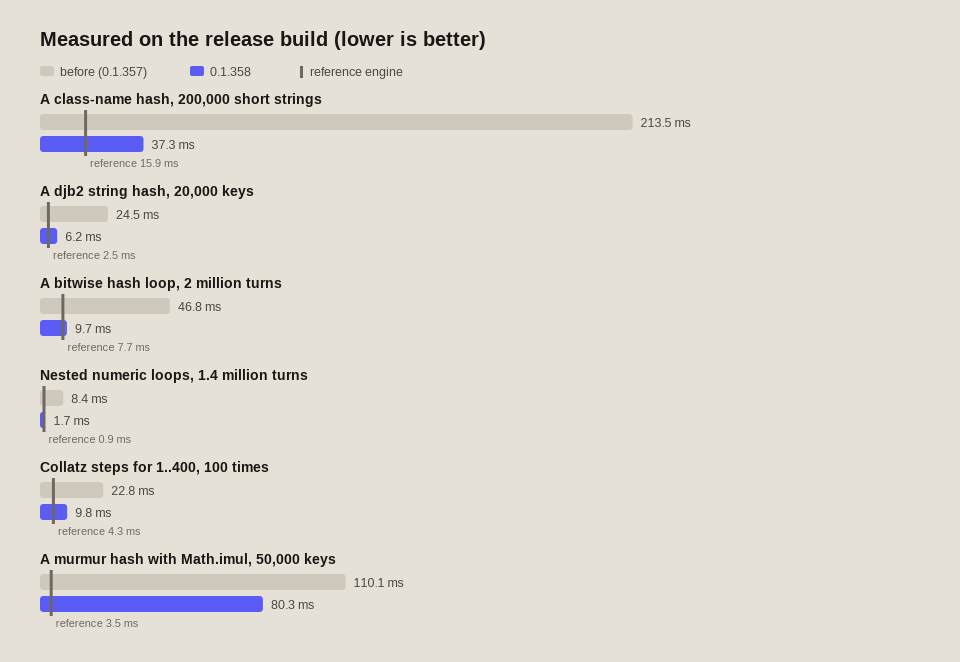
This release switches on Thermal, the optimizing tier of Updraft, the compiler Floati writes for itself. When a function with a loop gets hot, Thermal compiles it straight to ARM64 machine code with its numbers, whole numbers, true/false values and plain-text strings held in the processor's registers instead of in memory, and reads a string's characters where they already are. Loops that hash strings, mix bits or count run 2.4 to 5.8 times faster than in 0.1.357, and a class-name hash of the kind news sites run is now within about twice the reference engine. Functions with a short loop called many times now compile as a whole instead of entering the loop tier on every call, functions that use the bitwise NOT (~) compile at all, and very large functions no longer pay a big optimizing compile that did not make them faster. Eleven real pages measure the same as before, and every page in Floati's test set draws pixel for pixel as it did.

214 -> 37 ms (reference engine 16)A class-name hash, 200,000 short strings
unchangedAnswers with Thermal leaving at every 3rd op
0.997 (no page slower)Eleven real pages, Thermal on vs off
Điểm nổi bật3

Thermal: values in registers, not in memory

How Thermal runs a loop: values in registers, the string read in place, and a failed guess writing the shared frame for the interpreter
Before, after and the reference engine for six measurements

Gust, Updraft's first tier, compiles a function in well under a microsecond per operation, but keeps every value boxed in memory: each turn of a loop loads its variables, checks what kind of value each one holds, and stores them back. Thermal is the second tier. It reads the shape of a hot function, works out how long each value lives, gives the busiest ones a processor register for the whole loop, and writes ARM64 code directly, still in about half a microsecond per operation where the general-purpose code generator Floati still uses needs 80 to 400. Numbers stay as numbers, whole numbers stay as integers so bitwise operators and counters need no conversions, and a string the function was given is read in place: s.charCodeAt(i) becomes one byte read, checked once when the function starts rather than on every turn, which is safe because Thermal code never runs other scripts that could change String.prototype in between.

A class-name hash, 200,000 short strings214 -> 37 ms (reference engine 16)A djb2 string hash, 20,000 keys24.5 -> 6.2 ms

When a guess is wrong, nothing is lost

Thermal compiles for what a function has done so far: that a sum stays a whole number, that a position is inside the string. When one of those guesses fails, a sum past 2^53 or a position past the end, it writes the function's values into the frame the interpreter uses and the interpreter finishes the call from that exact operation; there is nothing to translate, because Floati's interpreter, Gust and Thermal all keep a call's values in the same frame. A function that keeps leaving, or that is called with values Thermal does not take (a string with accents, an object), is handed back to Gust and Cranelift as before. Every test map was also run with Thermal forced to leave at every third operation, and gave the same answers.

Answers with Thermal leaving at every 3rd opunchanged

Why Floati turned it on now

Updraft has one rule: a tier replaces what it replaces only once it is better on every measured axis. Before switching Thermal on, every page in Floati's test set was drawn with it and without it and compared pixel for pixel, and eleven recorded real pages were timed both ways. The comparison found three mistakes that tests had missed, among them a string returned from a compiled loop coming back as true or false, which broke a table on a documentation site; each is fixed and has a test that fails without the fix. With them fixed, all pages draw identically and the eleven pages time the same (0.997 of before), so Thermal is on for Apple Silicon. Intel and Windows machines still use Cranelift until Updraft can write x86-64 code.

Eleven real pages, Thermal on vs off0.997 (no page slower)

Những gì đã thay đổi

6 thay đổi
  1. JavaScript và JITThermal, Floati's own optimizing compiler, is on for Apple Silicon: hot loops keep numbers, whole numbers and plain-text strings in registers (2.4 to 5.8 times faster on hashes and counting loops).
  2. Hiển thịA string a hot function is given is read in place: s.charCodeAt(i) is one byte read, s.length one load.
  3. JavaScript và JITWhen a compiled guess fails, the interpreter finishes the call from that exact operation, with nothing to translate.
  4. JavaScript và JITA function with a short loop called many times compiles as a whole instead of entering the loop tier on every call: a murmur hash over short keys 110 -> 80 ms.
  5. Hiển thịFunctions that use the bitwise NOT (~) now compile.
  6. Bộ nhớ và đọcVery large functions stay on Gust instead of paying an optimizing compile that did not make them faster (8 MB less at the peak). A page that hashes with functions newly compiled in this release still peaks higher than in 0.1.357 (128 vs 119 MB), the cost of compiling them; Thermal taking them whole is next.

Thử trong trình duyệt của bạn

Mỗi phép kiểm tra chạy trực tiếp trong trình duyệt bạn đang đọc. Không có gì được gửi đi đâu cả.

Kiểm traTrình duyệt của bạnFloati
A class-name hash over concatenated strings is exactĐang kiểm traCó
A hot hash sees charCodeAt replaced on String.prototypeĐang kiểm traCó
A hot hash over non-ASCII text counts UTF-16 unitsĐang kiểm traCó
A hot function returns its string parameter as a stringĐang kiểm traCó
An empty string is false in a hot loopĐang kiểm traCó
~ in a hot function on numbers, strings, objects and BigIntĐang kiểm traCó
Integer sums past 2^31 and 2^53 in a hot loop stay exactĐang kiểm traCó
>>> results past 2^31 read as numbers in a hot loopĐang kiểm traCó
Đạt 8 / 8
Mọi thứ kể từ v0.1.358 ở một nơi

Phiên bản

v0.1.0 - 0.1.9 · 10 Tháng 7 2026418v0.1.427 · 25 Tháng 11 2026

Tháng 112026 · 3 phiên bản

Tháng 102026 · 7 phiên bản

Tháng 92026 · 14 phiên bản

32026 Tháng 9Pages no longer freeze while a script waits on the networkv0.1.320 · JavaScript và JIT 31725 Tháng 9Closer to the reference browser, and no more address bar tricksv0.1.317 · API web và DOM 30924 Tháng 9Pages arrive like they do in the reference browser, in a fraction of the memoryv0.1.309 · Mạng13 30322 Tháng 9HTTP/3 is on, and it is ours: the fastest web protocol, built from scratchv0.1.303 · Mạng 30222 Tháng 9The site you open stays your business, and the browser checks every certificate itselfv0.1.302 · Quyền riêng tư và Shields 30019 Tháng 9Reads the newest web compression, reuses secure connections, and remembers where sites livev0.1.300 · Bộ nhớ và đọc 29919 Tháng 9Pages start loading sooner: smarter connections and a faster path onto slow networksv0.1.299 · Mạng 29516 Tháng 9Class-based JavaScript runs dramatically faster: calling a method through a list of objects is now many times quickerv0.1.295 · JavaScript và JIT 29416 Tháng 9Integer, bitwise and pixel-processing JavaScript runs a lot faster, and the browser still proves every shortcut before it trusts itv0.1.294 · JavaScript và JIT 29316 Tháng 9Class-based and object-heavy JavaScript runs dramatically faster, with speed the browser proves before it trustsv0.1.293 · JavaScript và JIT 29216 Tháng 9Recursive JavaScript runs dramatically faster, so the heaviest in-page computation feels quickv0.1.292 · JavaScript và JIT 27811 Tháng 9A tracker can no longer follow you from one site to the nextv0.1.278 · Hiển thị 27610 Tháng 9Security you can check: an honest ledger, a referrer firewall, and mixed content shut downv0.1.276 · Quyền riêng tư và Shields 2122 Tháng 9Pages you render with Floati's own engine appear right away nowv0.1.212 · Hiển thị

Tháng 82026 · 14 phiên bản

19421 Tháng 8Faster on pages that change as you use them - plus a tab-hover fixv0.1.194 · Thẻ và giao diện 19321 Tháng 8Select text, find on the page, and zoom - plus faster renderingv0.1.193 · Thẻ và giao diện 19220 Tháng 8Crisp, high-resolution rendering on retina screensv0.1.192 · Hiển thị 18018 Tháng 8See how much of a whole page's download actually showed up on screenv0.1.180 · Quyền riêng tư và Shields 17618 Tháng 8Witness Mode: cryptographic, offline proof of what a site showed you (a world-first)v0.1.176 · Quyền riêng tư và Shields 17418 Tháng 8Counterfactual Browsing: see exactly what a script did to your page (a world-first)v0.1.174 · Quyền riêng tư và Shields 17016 Tháng 8Render Receipts: seal a page into proof the reference browser structurally cannot offerv0.1.170 · API web và DOM 12813 Tháng 8HSTS: sites that demand https are never reached over plaintext, not even oncev0.1.128 · Mạng 12713 Tháng 8Encrypted DNS (DoH) inside the engine, so your network cannot see which sites you look upv0.1.127 · Mạng 12613 Tháng 8Real HTTP/2 multiplexing: many streams share one connectionv0.1.126 · Mạng 1067 Tháng 8A real, deterministic AnalyserNode FFTv0.1.106 · Hiển thị 1057 Tháng 8HTTP/2: the modern web transport, from scratchv0.1.105 · Đa phương tiện 966 Tháng 8Stateful audio DSP: filters, delay and waveshapingv0.1.96 · Đa phương tiện 661 Tháng 8The worst score on the board turned out to be a cookie bannerv0.1.66 · Hiển thị9

Tháng 72026 · 4 phiên bản