Tất cả phiên bản v0.1.36219 Tháng 10 2026Hiển thị, JavaScript và JIT Feed

Ghi chú phát hành được viết bằng tiếng Anh.

A page scheduler that stalled now runs, try / finally and spreads compile, and deleting thousands of properties is 180 times faster

A break or continue that left a try block skipped its finally block. That broke more than tidy-up code: a widely used UI library's scheduler clears its "busy" flag in a finally that it leaves with break, so in Floati the flag stayed set after the first batch of work and every later batch waited forever. Pages built with that library looked right but never ran their later work (effects, an embedded code editor). break and continue now run every finally they leave, innermost first, as the standard says, and those pages do all their startup work, as in the reference browser. try / finally, object and array spread, destructuring from a Set, a Map or a generator, unary plus and regular-expression literals now run on the plan interpreter instead of the slowest tier, and so do for (let x of ..) loops over anything that is not an array. Deleting 64,000 properties one by one went from 5,993 to 33 ms, a function with try / finally called 2 million times from 430 to 243 ms, and on x86-64 Thermal keeps values in registers across calls in rarely run code (a float loop 315 -> 160 ms). Object spread now runs getters before converting a later computed key, and spreading null into an array throws a TypeError, as the standard says.

9 of 9 the sameRelease checks against the reference browser
5,993 -> 33 ms (reference engine 19)Delete 64,000 properties
Điểm nổi bật2

break, continue and finally

A scheduler that leaves a labelled block with break: before, its finally never ran; now it does

A finally block runs however its try block ends: normally, by return, by a throw, or by break and continue. Floati handled the first three, but a break or continue out of a try jumped straight to its target and skipped the finally. That mattered on real pages. A widely used UI library runs queued work inside a labelled block, sets a "busy" flag, and clears it in a finally it leaves with break. In Floati the flag was never cleared, so after the first batch the scheduler believed it was still working and never started another: effects never ran, and an embedded code editor never parsed its text. The pages still looked complete, which is why the page checks did not catch it. Now a break or continue that crosses finally blocks runs each one, innermost first, with its own state restored, then lands where it was going. Each finally body resumes its own completion, so a try / finally inside a finally no longer takes an outer return or throw at its end, and a return routed into a finally closes the try's handlers first. The two pages built with that library now spend more time in JavaScript, because they do the work the reference browser does. The code they now run is compiled: a for (let x of ..) loop over a Set, a Map, a generator or a string used to be refused a plan because of the jump that ends it when the iterator is done, and now it is planned.

Release checks against the reference browser9 of 9 the same

More of every page compiles, and deletes are linear
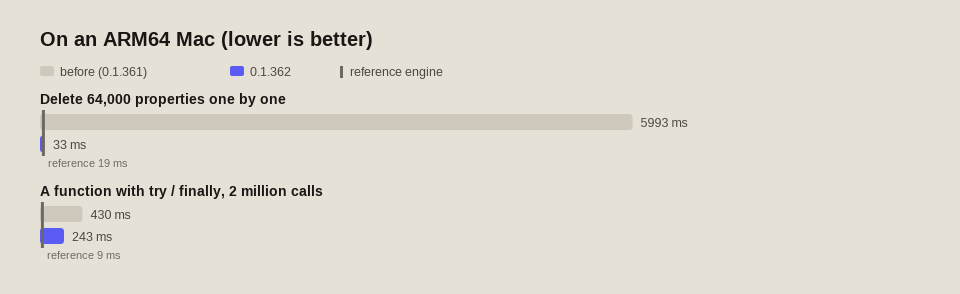
Before, after and the reference engine on an ARM64 Mac

The plan interpreter runs most hot functions. Several common constructs kept a function out of it, in the bytecode interpreter: try / finally, object and array spread ({ ...a, ...b }, [...set]), destructuring from anything iterable, unary plus on objects, and regular-expression literals (the most common refusal on a news site's load). Each is now a plan operation, checked against the interpreter in every tier on new test maps. Deleting a property from a large object shifted every property after it, so deleting n properties took time proportional to n squared. Deletes now leave a marker that is cleaned up in bulk, so the remaining properties keep their order and deleting 64,000 takes 33 ms instead of 5,993. On x86-64, Updraft IR's register allocator now keeps values in registers that a call may change, across calls in rarely run blocks, saving them only around those calls; a float loop with a rare slow path went from 315 to 160 ms.

Delete 64,000 properties5,993 -> 33 ms (reference engine 19)try / finally, 2 million calls430 -> 243 ms (reference engine 9)

Những gì đã thay đổi

7 thay đổi
  1. Hiển thịbreak and continue out of a try run its finally block; a UI library's scheduler no longer stalls after its first batch.
  2. Hiển thịEach finally body resumes its own completion, and a throw in a finally after a return is no longer caught by its own try.
  3. JavaScript và JITtry / finally, spread, destructuring from iterables, unary plus and regex literals run on the plan interpreter.
  4. JavaScript và JITfor (let x of ..) over a Set, a Map, a generator or a string is compiled instead of interpreted.
  5. Hiển thịDeleting many properties from one object is linear: 64,000 deletes 5,993 -> 33 ms.
  6. JavaScript và JITx86-64: values stay in registers across calls in rarely run code (a float loop 315 -> 160 ms).
  7. Hiển thịObject spread runs getters before a later computed key is converted, and [...null] throws a TypeError.

Thử trong trình duyệt của bạn

Mỗi phép kiểm tra chạy trực tiếp trong trình duyệt bạn đang đọc. Không có gì được gửi đi đâu cả.

Kiểm traTrình duyệt của bạnFloati
a break out of a labelled block runs its finally (a page scheduler no longer stalls)Đang kiểm traCó
break and continue out of try run the finally blockĐang kiểm traCó
a finally that returns overrides a throw, in a hot functionĐang kiểm traCó
object spread runs getters before a later computed key is convertedĐang kiểm traCó
spreading null into an array throws a TypeErrorĐang kiểm traCó
destructuring and spread from Set, Map and generators in a hot functionĐang kiểm traCó
a regex literal is a new object each evaluationĐang kiểm traCó
deleting thousands of properties keeps the remaining orderĐang kiểm traCó
unary plus converts objects through valueOf and Symbol.toPrimitiveĐang kiểm traCó
Đạt 9 / 9
Mọi thứ kể từ v0.1.362 ở một nơi

Phiên bản

v0.1.0 - 0.1.9 · 10 Tháng 7 2026418v0.1.427 · 25 Tháng 11 2026

Tháng 112026 · 3 phiên bản

Tháng 102026 · 7 phiên bản

Tháng 92026 · 14 phiên bản

32026 Tháng 9Pages no longer freeze while a script waits on the networkv0.1.320 · JavaScript và JIT 31725 Tháng 9Closer to the reference browser, and no more address bar tricksv0.1.317 · API web và DOM 30924 Tháng 9Pages arrive like they do in the reference browser, in a fraction of the memoryv0.1.309 · Mạng13 30322 Tháng 9HTTP/3 is on, and it is ours: the fastest web protocol, built from scratchv0.1.303 · Mạng 30222 Tháng 9The site you open stays your business, and the browser checks every certificate itselfv0.1.302 · Quyền riêng tư và Shields 30019 Tháng 9Reads the newest web compression, reuses secure connections, and remembers where sites livev0.1.300 · Bộ nhớ và đọc 29919 Tháng 9Pages start loading sooner: smarter connections and a faster path onto slow networksv0.1.299 · Mạng 29516 Tháng 9Class-based JavaScript runs dramatically faster: calling a method through a list of objects is now many times quickerv0.1.295 · JavaScript và JIT 29416 Tháng 9Integer, bitwise and pixel-processing JavaScript runs a lot faster, and the browser still proves every shortcut before it trusts itv0.1.294 · JavaScript và JIT 29316 Tháng 9Class-based and object-heavy JavaScript runs dramatically faster, with speed the browser proves before it trustsv0.1.293 · JavaScript và JIT 29216 Tháng 9Recursive JavaScript runs dramatically faster, so the heaviest in-page computation feels quickv0.1.292 · JavaScript và JIT 27811 Tháng 9A tracker can no longer follow you from one site to the nextv0.1.278 · Hiển thị 27610 Tháng 9Security you can check: an honest ledger, a referrer firewall, and mixed content shut downv0.1.276 · Quyền riêng tư và Shields 2122 Tháng 9Pages you render with Floati's own engine appear right away nowv0.1.212 · Hiển thị

Tháng 82026 · 14 phiên bản

19421 Tháng 8Faster on pages that change as you use them - plus a tab-hover fixv0.1.194 · Thẻ và giao diện 19321 Tháng 8Select text, find on the page, and zoom - plus faster renderingv0.1.193 · Thẻ và giao diện 19220 Tháng 8Crisp, high-resolution rendering on retina screensv0.1.192 · Hiển thị 18018 Tháng 8See how much of a whole page's download actually showed up on screenv0.1.180 · Quyền riêng tư và Shields 17618 Tháng 8Witness Mode: cryptographic, offline proof of what a site showed you (a world-first)v0.1.176 · Quyền riêng tư và Shields 17418 Tháng 8Counterfactual Browsing: see exactly what a script did to your page (a world-first)v0.1.174 · Quyền riêng tư và Shields 17016 Tháng 8Render Receipts: seal a page into proof the reference browser structurally cannot offerv0.1.170 · API web và DOM 12813 Tháng 8HSTS: sites that demand https are never reached over plaintext, not even oncev0.1.128 · Mạng 12713 Tháng 8Encrypted DNS (DoH) inside the engine, so your network cannot see which sites you look upv0.1.127 · Mạng 12613 Tháng 8Real HTTP/2 multiplexing: many streams share one connectionv0.1.126 · Mạng 1067 Tháng 8A real, deterministic AnalyserNode FFTv0.1.106 · Hiển thị 1057 Tháng 8HTTP/2: the modern web transport, from scratchv0.1.105 · Đa phương tiện 966 Tháng 8Stateful audio DSP: filters, delay and waveshapingv0.1.96 · Đa phương tiện 661 Tháng 8The worst score on the board turned out to be a cookie bannerv0.1.66 · Hiển thị9

Tháng 72026 · 4 phiên bản





