Toutes les versions v0.1.35614 Oct 2026JavaScript et JIT, Mémoire et lecture, Onglets et interface Flux

Les notes de version sont rédigées en anglais.

Recursion makes a fraction of the calls, loops keep objects in registers, and element writes stop searching

This release makes three kinds of everyday JavaScript faster. Recursive functions now answer their simplest cases where they are called and run every other level inside their parent, so walking a tree makes a fraction of the calls, and recursion whose last step returns a property now compiles at all. Long loops that walk a list, keep the best object seen so far, copy objects, compare them or ask typeof now run in Floati's fastest loop tier, 20 to 40 times faster than before. Setting a property on page elements no longer searches every element prototype each time, so building elements is almost three times faster, and a getter a page puts on an element prototype now answers reads as it does in the reference browser. One crash is fixed: freeing a long linked list made inside a function no longer overflows the stack.

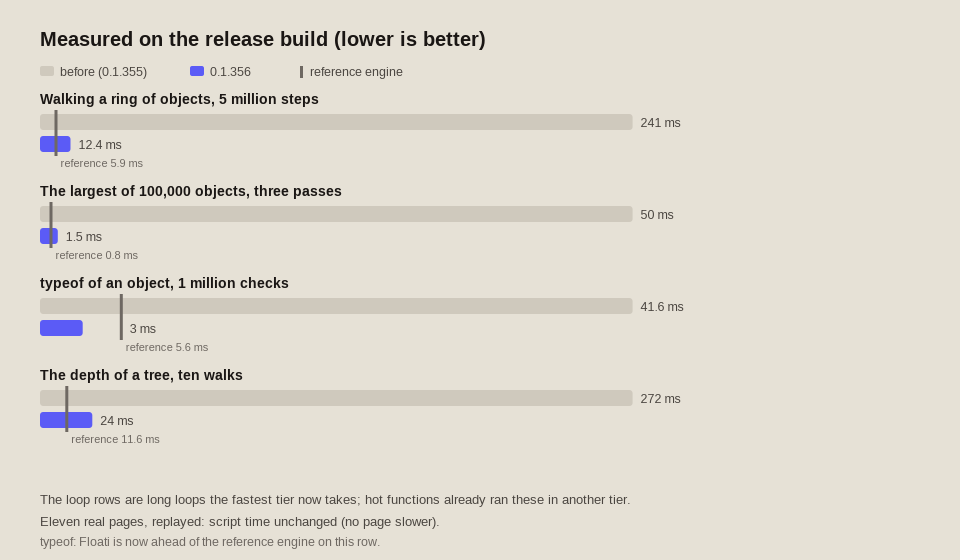
272 -> 24 msThe depth of a tree, ten walks
241 -> 12.4 ms (reference engine 5.9)Walking a ring of objects, 5 million steps
10 -> 3.5 msBuilding 3,000 elements, twenty times
Points forts3

Recursion makes a fraction of the calls

A tree sum before and after: 31 calls become 5

A recursive function usually starts with its simplest case: if the tree is empty, return 0; if n is below 2, return n. Floati's recursion tier now runs that test where the call is made, so a call that would only answer the simple case is never made, and it copies one level of the function into its parent, so every other level of a tree runs without a call at all (a technique from research on divide-and-conquer programs). Each copy still counts toward the call-depth limit and the work budget exactly as a call would, so a runaway recursion stops where it did. Once a recursive function has run, its property reads are compiled again with the object layouts they saw built in. Recursion whose last step returns a property, like the depth of a tree that returns a leaf's value, used to fall back to slower code because one path returned a number and the other a value of any type; now the two paths meet as a number, and anything else hands the work back to the interpreter.

The depth of a tree, ten walks272 -> 24 msA count whose base case returns a property80 -> 4.7 ms

Loops keep objects in registers

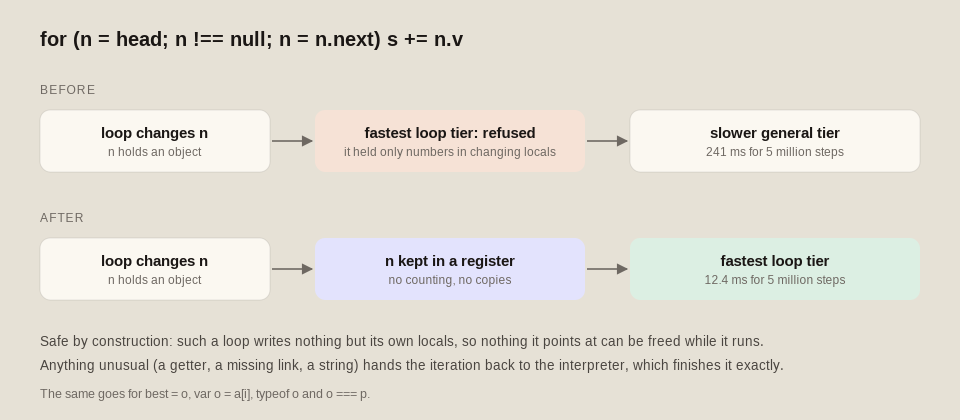
A list walk before and after: refused by the fastest loop tier, then run there with the object in a register
Before, after and the reference engine for four measurements

Floati's fastest loop tier kept numbers in registers, and objects only when the loop never changed which object a variable held. A loop like for (n = head; n !== null; n = n.next), or one that remembers the largest object seen so far, was refused and ran in a slower tier. Now such a variable holds the object directly, with no counting or copying, because these loops write nothing but their own variables: nothing they point at can be freed while they run. They can read properties, compare with null and with each other, copy, ask typeof and test truthiness; anything unusual, a getter, a missing link or a string compared by identity, hands that iteration back to the interpreter, which finishes it exactly. These are long loops the fastest tier now takes; a function that is already hot ran them in another tier and is unchanged.

Walking a ring of objects, 5 million steps241 -> 12.4 ms (reference engine 5.9)typeof of an object, 1 million checks41.6 -> 3 ms (reference engine 5.6)

Element writes stop searching

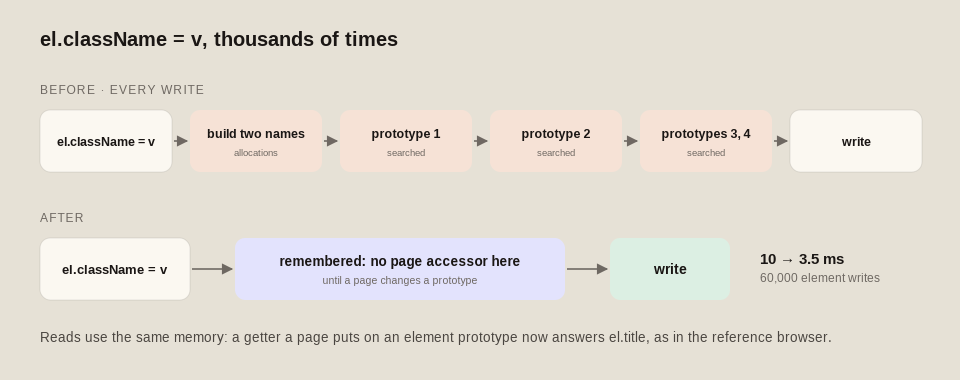
An element property write before and after: from a search of four prototypes to a remembered answer

Every el.className = v or el.textContent = v checked whether a page script had defined that property as an accessor on one of the element's prototypes: it built two names and searched four prototypes, every time, to learn that nothing was there. On a page that builds elements this was most of its script time. Floati now remembers the answer per element type until a page changes a prototype, which makes element-building three times faster. Reads use the same memory, which fixed a gap: a getter a page defines on an element prototype, as some monitoring and compatibility scripts do, now answers reads of that property as it does in the reference browser; before, Floati answered from its own value.

Building 3,000 elements, twenty times10 -> 3.5 msA getter on an element prototypenow answers reads

Ce qui a changé

8 changements
  1. JavaScript et JITRecursive functions answer their simple case where they are called and run alternate levels inside their parent: a tree walk makes a fraction of the calls.
  2. JavaScript et JITRecursion whose last step returns a property (a tree's depth, a count) now compiles: a tree depth 272 -> 24 ms.
  3. JavaScript et JITOnce a recursive function has run, its property reads are compiled again with the layouts they saw built in.
  4. JavaScript et JITLong loops that walk a list, keep the best object so far, copy or compare objects, or ask typeof run in the fastest loop tier: a 5 million step walk 241 -> 12.4 ms.
  5. Mémoire et lectureSetting properties on page elements remembers that no page accessor intercepts them: building elements is three times faster.
  6. JavaScript et JITA getter a page defines on an element prototype now answers reads of that property, as in the reference browser.
  7. Mémoire et lectureFixed: freeing a long linked list built inside a function no longer overflows the stack and closes the page.
  8. Onglets et interfaceFloati's pages and update notes now open at browser.floati.life.

À tester dans votre navigateur

Chaque test tourne en direct dans le navigateur avec lequel vous lisez. Rien n’est envoyé nulle part.


VérifierVotre navigateurFloati
A recursive base case that returns a property still adds upVérificationOui
An unrolled recursion keeps its arguments in orderVérificationOui
A setter added to an element prototype after many writes runsVérificationOui
A long walk around a ring of objects keeps its placeVérificationOui
The largest object found in a loop is that very objectVérificationOui
Equal strings compare equal in a hot loopVérificationOui
Typeof in a hot loop tells functions, arrays and null apartVérificationOui
A long list built in a function is freed when it returnsVérificationOui
Réussis 8 / 8
Tout depuis la v0.1.356 au même endroit

Versions

v0.1.0 - 0.1.9 · 10 Jul 2026418v0.1.427 · 25 Nov 2026

novembre2026 · 13 versions

octobre2026 · 32 versions

38530 OctAhead of the reference runtime on 7 of 8 workloadsv0.1.385 · Mémoire et lecture32 38429 OctSafety review, a rare crash fixed, functions compiled soonerv0.1.384 · Mémoire et lecture46 38327 OctJavaScript ahead of the reference runtime on six of eight speed testsv0.1.383 · JavaScript et JIT36 38225 OctClosed tabs give their memory back, and XML pages read as XMLv0.1.382 · Mémoire et lecture12 38125 OctLighter script code, and calls between scripts that run as ordinary callsv0.1.381 · Mémoire et lecture15 38025 OctScrolling boxes scroll, pages look right, and scripts from other sites need permissionv0.1.380 · Rendu16 37924 OctPages laid out the way their authors wrote them, and less memory againv0.1.379 · Rendu22 37823 OctOther sites' data stays private, and less memory againv0.1.378 · Mémoire et lecture 37723 OctAbout half the memory of the reference browser on everyday sitesv0.1.377 · Mémoire et lecture15 37622 OctA minimized window stops piling up graphics memoryv0.1.376 · Mémoire et lecture 37522 OctClosed pages let go, sites stay apart, and fonts stop costing memoryv0.1.375 · Mémoire et lecture9 37421 OctA floating video you can move, that opens without a black flashv0.1.374 · Onglets et interface 37321 OctEvery page on our own engine, two pages side by side, videos that keep playing, and your own clockv0.1.373 · Onglets et interface17 37021 OctOpen your files, share to your phone, have pages read aloud, install sites as apps, play with a controller, and accented text drawn rightv0.1.370 · Confidentialité et Shields · à tester11 36920 OctPasskeys with Touch ID and Windows Hello, sites that work offline, notifications you allow, and devices asked for first, all kept on your devicev0.1.369 · Confidentialité et Shields · à tester9 36519 OctThe code-size budget fits your processor, and code that has gone cold makes room for code that is hot nowv0.1.365 · JavaScript et JIT · à tester 36419 OctCompiled code that fits the processor's caches: big pages up to 1.8 times faster, and fast compiled code on Windows and Intel machinesv0.1.364 · JavaScript et JIT · à tester 36319 OctThermal runs on one code generator, building strings is up to 8 times faster, and two slow paths that grew with the square of their input are linearv0.1.363 · JavaScript et JIT · à tester12 35816 OctThermal, Floati's own optimizing compiler, is on: hot loops keep their numbers and strings in registersv0.1.358 · JavaScript et JIT · à tester 35715 OctLoops that test a number run as machine code, more of your functions compile, and reading page nodes is three times fasterv0.1.357 · JavaScript et JIT · à tester14 35614 OctRecursion makes a fraction of the calls, loops keep objects in registers, and element writes stop searchingv0.1.356 · JavaScript et JIT · à tester 35514 OctA hot loop changes compiler without stopping, property writes skip the detour, and pure recursion remembers its answersv0.1.355 · JavaScript et JIT · à tester 35413 OctFloati compiles JavaScript with its own compiler, Updraft: about a hundred times faster to compile, and compiled code no longer piles upv0.1.354 · JavaScript et JIT · à tester 35211 OctCode that loads on demand starts at once, images decode beside their downloads, writes run compiledv0.1.352 · Rendu · à tester10 35010 OctHelpers that compile, strings that stay small, and events that fire fastv0.1.350 · JavaScript et JIT · à tester14 3436 OctSign-ins that stay signed in, a real IndexedDB, and a storage button that shows what sites keepv0.1.343 · Confidentialité et Shields · à tester25 3385 OctPages load faster, render truer and gain a dozen modern web features, each one checked against the reference browserv0.1.338 · API web et DOM · à tester19 3352 OctA developer-docs site works like the reference browser, and every frame gets its own built-insv0.1.335 · Rendu12 3342 OctIframes that cost what a paragraph costs, live selections, and rounder cornersv0.1.334 · Rendu10 3331 OctFewer script errors on real sites, and finished pages give all their memory backv0.1.333 · JavaScript et JIT10 3311 OctA crash on busy news sites fixed, and pages lighter on the processorv0.1.331 · Rendu 3301 OctJavaScript scores 100, and big pages stop stuttering when they clean upv0.1.330 · JavaScript et JIT11

septembre2026 · 29 versions

32930 SepThe JavaScript engine proves what it can skipv0.1.329 · JavaScript et JIT9 32830 SepJavaScript runs at the reference browser's speed on 41 of our 42 measured workloadsv0.1.328 · JavaScript et JIT 32528 SepDeep recursion runs like it does in the reference browserv0.1.325 · JavaScript et JIT 32327 SepJavaScript measured at 94, JSON three times faster, and a round of fixes found against the reference browserv0.1.323 · JavaScript et JIT11 32227 SepClosed pages give their memory back whole, and JavaScript measured at 87v0.1.322 · JavaScript et JIT11 32127 SepHalf the memory, and JavaScript measured at 80v0.1.321 · JavaScript et JIT14 32026 SepPages no longer freeze while a script waits on the networkv0.1.320 · JavaScript et JIT 31926 SepA PDF viewer that does what Acrobat Pro charges forv0.1.319 · Onglets et interface16 31025 SepPages stay alive, repaints never block your scroll, and type matches the reference browser'sv0.1.310 · Rendu10 30924 SepPages arrive like they do in the reference browser, in a fraction of the memoryv0.1.309 · Réseau13 30824 SepPages drawn by your graphics card, and scrolling that never waitsv0.1.308 · Rendu 30122 SepSites can no longer follow you between other sites, and the next page starts soonerv0.1.301 · Confidentialité et Shields 30019 SepReads the newest web compression, reuses secure connections, and remembers where sites livev0.1.300 · Mémoire et lecture 29717 SepSetting up and filling arrays of numbers is now several times faster, and faster than the reference browserv0.1.297 · JavaScript et JIT 29116 SepA private wayback machine for pages you seal, cited answers that open where you read them, and a privacy report that is ready the instant a page loadsv0.1.291 · Mémoire et lecture 29015 SepFloati spots trackers no list has caught, answers your questions from your own reading, and gets even closer to the pixelv0.1.290 · Confidentialité et Shields 28815 SepThe pages where you type a password stay out of your memory, and text renders truer to the pagev0.1.288 · Mémoire et lecture 28311 SepMessages between windows now prove who sent themv0.1.283 · Rendu 28111 SepSee a site's own rules protect you, and what it was never toldv0.1.281 · Rendu 27410 SepFingerprint Shield: see and prove what a page tried to learn about youv0.1.274 · Mémoire et lecture 2468 SepMemory: your browser remembers what you read, and can prove itv0.1.246 · Mémoire et lecture 2346 SepWebAssembly SIMD lands, completing the WebAssembly platformv0.1.234 · Rendu 2335 SepReal WebAssembly apps that share memory with the page now workv0.1.233 · Mémoire et lecture 2173 SepYour passwords, the Floati wayv0.1.217 · Onglets et interface 2112 SepA correctness fix for today's list-speed improvementv0.1.211 · JavaScript et JIT 2102 SepThe most common way people work with lists of data now runs at full speedv0.1.210 · JavaScript et JIT 2092 SepBig objects are instant now, instead of getting slower the more you addv0.1.209 · Mémoire et lecture 2082 SepFloati's own engine got dramatically faster at the code real pages run every framev0.1.208 · JavaScript et JIT 2061 SepExplain this page: the browser now understands what a site does, and can prove itv0.1.206 · Confidentialité et Shields

août2026 · 19 versions

20328 AoûPages you open with the Floati engine now render on your graphics cardv0.1.203 · Rendu 19421 AoûFaster on pages that change as you use them - plus a tab-hover fixv0.1.194 · Onglets et interface 19321 AoûSelect text, find on the page, and zoom - plus faster renderingv0.1.193 · Onglets et interface 18619 AoûEngine tabs remember where you werev0.1.186 · Onglets et interface 14814 AoûWebAssembly numbers stay exact: 64-bit integers cross as BigIntv0.1.148 · JavaScript et JIT 14714 AoûWebAssembly interop rounds out: imported globals and memoryv0.1.147 · Mémoire et lecture 13914 AoûWebGL can texture from an image or a canvasv0.1.139 · Rendu 13414 AoûWebAssembly now runs real compiled modules, not just toy onesv0.1.134 · Mémoire et lecture 13313 AoûThe engine now runs WebAssemblyv0.1.133 · Mémoire et lecture 12813 AoûHSTS: sites that demand https are never reached over plaintext, not even oncev0.1.128 · Réseau 1097 AoûWeb Audio convolution reverb + stereo sample playbackv0.1.109 · Médias 785 AoûAsk knows when to stop, and forms can edit their fieldsv0.1.78 · API web et DOM 775 AoûAsk joins the dots across sentencesv0.1.77 · JavaScript et JIT 745 AoûBracket property access gets fast, and Ask follows your timelinev0.1.74 · Rendu 735 AoûBuilding a list gets fast, and Ask hears whole phrasesv0.1.73 · JavaScript et JIT 725 AoûMethod calls get up to speed, and Ask spreads its sourcesv0.1.72 · Mémoire et lecture 715 AoûRecursion gets its speed back, and Ask reads the roomv0.1.71 · JavaScript et JIT 704 AoûOne press, and you are on the new versionv0.1.70 · Onglets et interface 661 AoûThe worst score on the board turned out to be a cookie bannerv0.1.66 · Rendu9

juillet2026 · 11 versions