Toutes les versions v0.1.37924 Oct 2026Rendu, API web et DOM, Confidentialité et Shields, Accessibilité, Mémoire et lecture Flux

Les notes de version sont rédigées en anglais.

Pages laid out the way their authors wrote them, and less memory again

A page-drawing release with more memory saved. Comparing Floati's picture of a page with the reference browser's, pixel by pixel, on a set of well-known sites showed where Floati laid pages out wrongly, and fourteen of those mistakes are fixed: which style rule wins when two disagree, how a line break, a grid, a flexible row and a font size written as a sum behave, where a line of text sits, and more. A design framework's documentation page went from 26 percent of its pixels different to 5, a news front page from 35 to 20. On memory, the same 33 randomly picked popular sites now use 4,301 MB in Floati against 10,377 MB in the reference browser on the same Mac (59 percent less; 0.1.378 used 4,524), the average site settles at 130 MB, and Floati uses less than the reference browser on 29 of the 33. Pictures nobody can see, because they are fully transparent or hidden, now give back their memory, and pictures on sharp screens are kept at exactly the pixels they are drawn at. Measured and tested on a Mac; the Windows build passes the same engine tests.

26 -> 5 percentA design framework's documentation page, pixels different from the reference
reference browser 10,377 MB -> Floati 4,301 MB33 random sites, total memory
Points forts2

Pages look the way they were written
AvantAprès
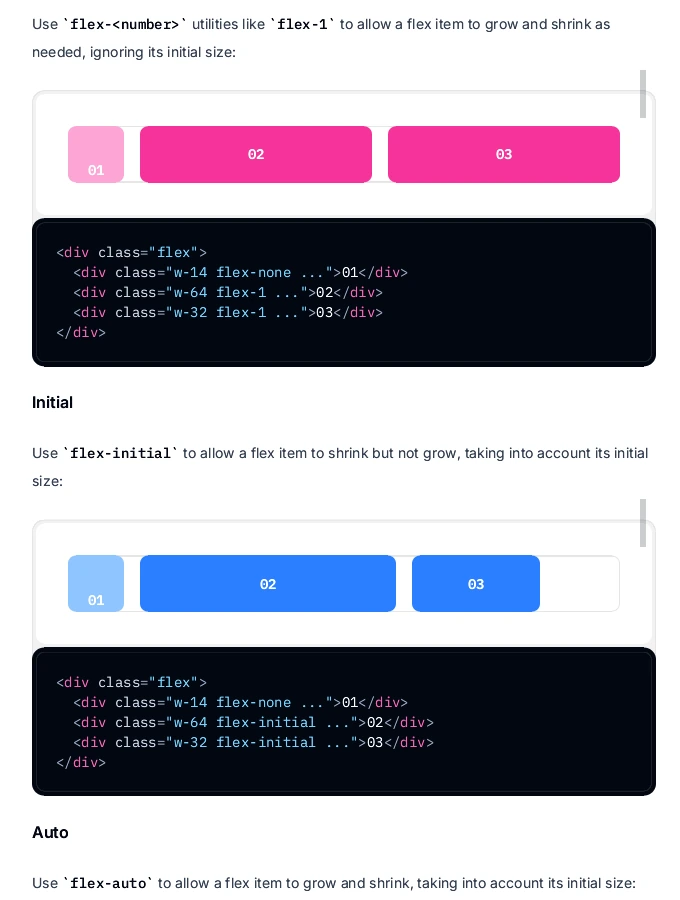
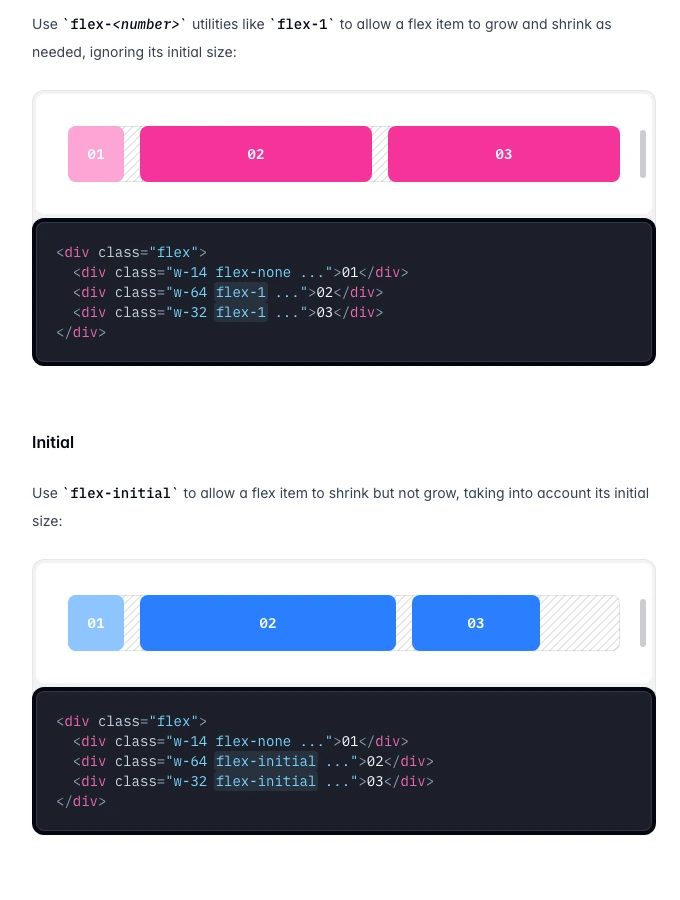
Avant: A design framework's documentation page: Floati 0.1.378, Floati 0.1.379 and the reference browser. The gaps under each example now match, so every heading below sits where the page puts it.
Avant
Après: A design framework's documentation page: Floati 0.1.378, Floati 0.1.379 and the reference browser. The gaps under each example now match, so every heading below sits where the page puts it.
Après · v0.1.379
La même page dans le navigateur de référence
Navigateur de référence

To find layout mistakes we draw well-known pages in Floati and in the reference browser and compare them pixel by pixel, then shrink each difference down to a few lines of page code and check that rule against the reference. Fourteen fixes came out of it. When a site's style sheet marks a rule as important it now beats a style written on the element itself, as the standard says; it used to lose, so menus and buttons sat in the wrong place. Rules written with the newer selector forms (is, where, not, has) now weigh exactly as much as they should, so the right one wins. A line break at the end of a line no longer starts an empty extra line. A font size written as a sum (a calc) is worked out once, so everything inside inherits the size and not the formula. A line height written in em or percent is fixed where it is written, so text inside a bigger heading does not grow its own gaps. Grids now share the height of a tall item among the rows it spans the way the reference does and understand rows named by the page, flexible rows stretch their items to the exact height the page set, an overlay over a picture covers the whole picture, labels meant only for screen readers no longer push the header down, and a button with a two-line label lines up with its neighbours. Every fix has a test that fails without it.

A design framework's documentation page: Floati 0.1.378, Floati 0.1.379 and the reference browser. The gaps under each example now match, so every heading below sits where the page puts it.

A design framework's documentation page, pixels different from the reference26 -> 5 percentA news front page35 -> 20 percent13 well-known sites, total difference181 -> about 140

Less memory on the same random sites

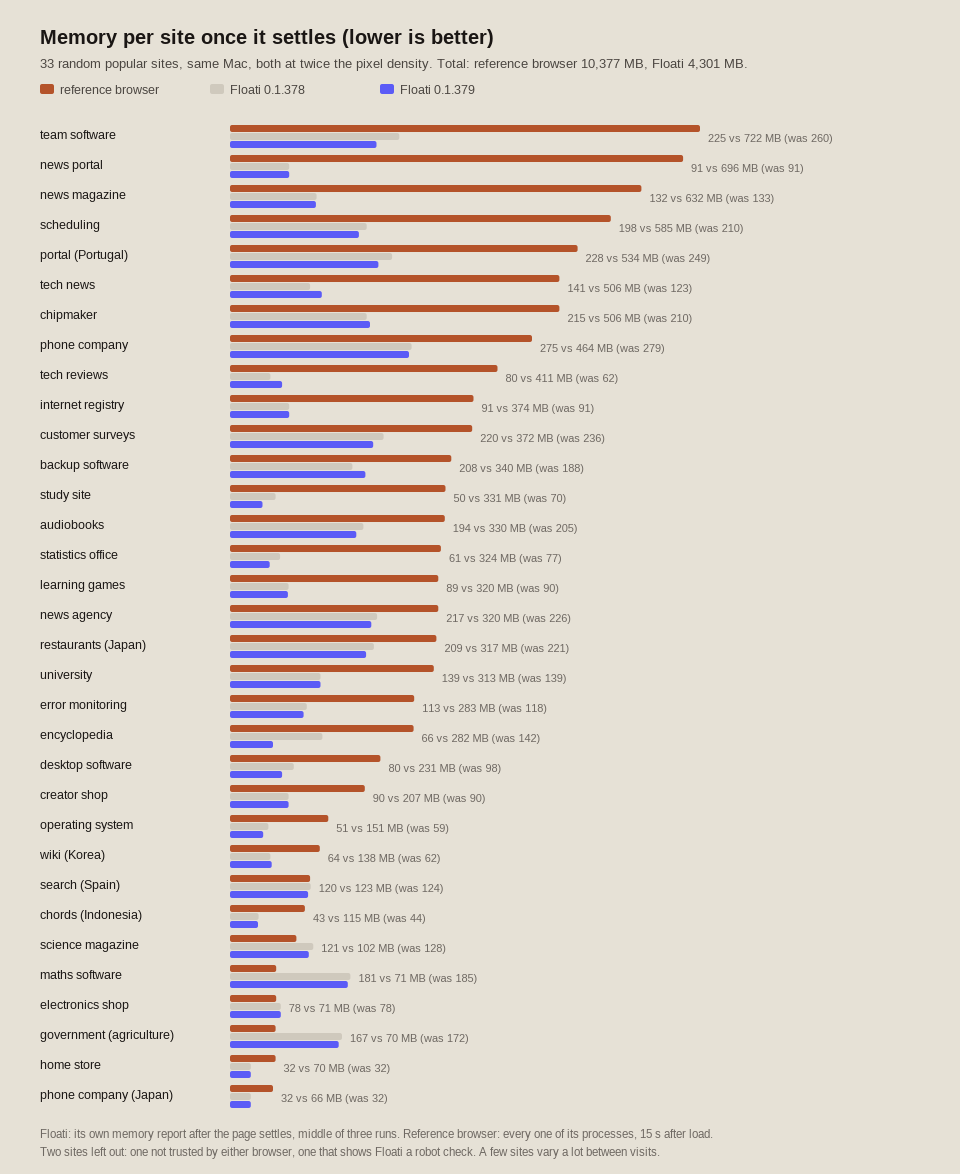
Memory per site after it settles: the reference browser, Floati 0.1.378 and Floati 0.1.379, same Mac, same screen density

The same 33 sites as in the last two releases, picked at random from a public list of the most visited websites, opened in Floati on the same Mac at twice the pixel density, three times each (the middle result is shown). Floati used 4,301 MB in total, against 10,377 MB for the reference browser and 4,524 MB for 0.1.378, and less than the reference browser on 29 of the 33. Three changes did most of it. A picture that is fully transparent or hidden (the resting slides of a fading slideshow, for example) is not drawn, so it now gives its memory back like a picture far down the page, and takes it again the moment it shows. On a sharp screen a picture is kept at exactly the pixels it is drawn at, where Floati used to keep a quarter more in case the box grew, and background pictures are kept at the size they are painted, not their full file size. And each picture keeps only one form: the compressed file or the drawn pixels, whichever it needs, never both. An encyclopedia went from 142 to 66 MB, a study site from 70 to 50, a team software site from 260 to 225. Four sites still use more than the reference browser: a maths software site, a government site, a science magazine and a shop, mostly because of large pictures and the compiled code of scripts that never run.

33 random sites, total memoryreference browser 10,377 MB -> Floati 4,301 MBFloati 0.1.378 -> 0.1.3794,524 -> 4,301 MBAverage site, settled130 MBSites where Floati uses less29 of 33

Ce qui a changé

22 changements
  1. RenduAn !important rule in a style sheet now beats a style written directly on the element, the order the standard sets (normal rules, then the element's own style, then important rules). A page that forces a margin with !important now gets it.
  2. RenduA scrolling panel inside a column of fixed height keeps the height the column gives it and scrolls its own content, instead of growing to fit everything and spilling over the panel below.
  3. API web et DOMSelector weights follow the newest standard: :where() adds nothing, while :is(), :not() and :has() weigh as much as their strongest part. A CSS framework's 'weakest' typography rules no longer beat stronger ones, so its documentation headings get the right spacing (pixel difference from the reference 26 -> 17 percent).
  4. RenduA line break (<br>) ends the line it sits on: one at the end of a line no longer opens an extra empty line, and one at the start breaks before what follows. Code blocks that end every line with a break were drawn twice as tall.
  5. RenduA font size written as a formula (calc(), such as 'one em minus 20 percent') is worked out once where it is written, so nested elements inherit the result instead of shrinking the text again at every level. A docs site's live code editor drew its code as faint dashes 4 pixels tall; it is 13.6 pixels now, as in the reference.
  6. RenduA line height written in em, percent or rem is turned into pixels where it is declared and passed down as pixels, so a large heading inside a smaller block no longer gets a line nearly twice too tall. Plain numbers still pass down as numbers, as the standard says.
  7. RenduA flexible row with a set height stretches its items to exactly that height; taller content now overflows instead of making the row taller (a news site's 32 pixel logo row had become 36).
  8. RenduAn inline block whose text sits inside nested boxes lines up on that text's baseline, so navigation bars and story lists built that way are no longer taller than they should be (one list was 107 pixels too tall).
  9. RenduA full-cover overlay inside a box whose height comes from its content now sizes against that box's final height; such overlays came out 0 pixels tall.
  10. RenduFlex items sized with fit-content, max-content or min-content keep that size instead of being stretched across the card.
  11. RenduA stretched flex column counts as having a known height for what is inside it, so footers pushed to the bottom with margin-top: auto now sit at the bottom of their card.
  12. AccessibilitéLabels hidden for screen readers (positioned off-screen) take no room in the line they sit in; they made a news site's masthead 31 pixels taller.
  13. RenduGrid items that span several rows share their extra height the way the standard describes, filling rows that can still grow first; four common shapes now match the reference exactly.
  14. RenduGrids understand named row lines (grid-row: headline), and row templates that name their lines size their rows correctly; the names used to be read as extra rows.
  15. Mémoire et lecturePictures that are invisible (inside something fully transparent or hidden) give their memory back and take it again only when they show. A fade carousel's waiting slides are exactly this.
  16. Mémoire et lectureEach picture now keeps only the smaller of its two forms it needs: a picture on screen keeps its pixels, a hidden or far one only its file. Photo PNGs could never be given back before. A restaurant guide went from 252 to 211 MB.
  17. Mémoire et lectureOn sharp (2x) screens a picture keeps exactly the pixels its box shows, with no extra quarter kept 'for zooming' (zooming decodes it again at the new size anyway), and is shrunk once it is 1.2 times too wide instead of 1.5. A chipmaker's site went from 230 to 199 MB.
  18. Mémoire et lectureBackground pictures are shrunk to the size their drawn copy needs, whether they are covered, contained or tiled, and grow back when the box gets bigger. A phone company kept a 3200 pixel strip behind a box 2 pixels tall.
  19. RenduGroundwork for compiling functions only when they first run: those functions now share their script's text instead of each keeping a copy.
  20. Mémoire et lectureMeasured before building: combining half-empty memory pages would give back only 1 to 2 MB on the heaviest sites, so that idea was set aside in favour of the image work above.
  21. Mémoire et lecture33 random popular sites: 4,301 MB in Floati (0.1.378: 4,524) against 10,377 MB in the reference browser; the average site settles at 130 MB.
  22. Confidentialité et ShieldsKnown: module scripts from another site are not yet checked like other requests; four sites still use more memory than the reference browser.

Tout depuis la v0.1.379 au même endroit

Versions

v0.1.0 - 0.1.9 · 10 Jul 2026418v0.1.427 · 25 Nov 2026

novembre2026 · 6 versions

octobre2026 · 19 versions

38631 OctReal sites render closer to the reference browserv0.1.386 · Rendu14 38429 OctSafety review, a rare crash fixed, functions compiled soonerv0.1.384 · Mémoire et lecture46 38025 OctScrolling boxes scroll, pages look right, and scripts from other sites need permissionv0.1.380 · Rendu16 37924 OctPages laid out the way their authors wrote them, and less memory againv0.1.379 · Rendu22 37823 OctOther sites' data stays private, and less memory againv0.1.378 · Mémoire et lecture 37522 OctClosed pages let go, sites stay apart, and fonts stop costing memoryv0.1.375 · Mémoire et lecture9 37321 OctEvery page on our own engine, two pages side by side, videos that keep playing, and your own clockv0.1.373 · Onglets et interface17 37221 OctYour data stays put, your choices stick, and dictation that really listensv0.1.372 · Rendu 37121 OctDrop files onto pages, dictate without your voice leaving the Mac, and controllers that rumblev0.1.371 · API web et DOM · à tester 37021 OctOpen your files, share to your phone, have pages read aloud, install sites as apps, play with a controller, and accented text drawn rightv0.1.370 · Confidentialité et Shields · à tester11 36920 OctPasskeys with Touch ID and Windows Hello, sites that work offline, notifications you allow, and devices asked for first, all kept on your devicev0.1.369 · Confidentialité et Shields · à tester9 36820 OctA site's own security rules are kept the whole time the page runs, Trusted Types, a map of every unsafe write in DevTools, and animations from scriptv0.1.368 · Confidentialité et Shields · à tester 36619 OctEvents, custom form controls, fonts and navigation work the way the web standards say: the Web APIs score rises from 53 to 59v0.1.366 · API web et DOM · à tester9 3467 OctA real performance timeline, site icons from the engine with a lookalike check, and forms that lay out rightv0.1.346 · Rendu · à tester14 3457 OctReal WebGL, a real 2D canvas, and canvas text that matches the reference browserv0.1.345 · Rendu · à tester10 3436 OctSign-ins that stay signed in, a real IndexedDB, and a storage button that shows what sites keepv0.1.343 · Confidentialité et Shields · à tester25 3385 OctPages load faster, render truer and gain a dozen modern web features, each one checked against the reference browserv0.1.338 · API web et DOM · à tester19 3362 OctSite controls that do what they say: permissions that really ask, and Shields per sitev0.1.336 · Confidentialité et Shields13 3321 OctPinned tabs on the left or the right, and an honest measure of the web platformv0.1.332 · Onglets et interface9

septembre2026 · 26 versions

31926 SepA PDF viewer that does what Acrobat Pro charges forv0.1.319 · Onglets et interface16 31725 SepCloser to the reference browser, and no more address bar tricksv0.1.317 · API web et DOM 30924 SepPages arrive like they do in the reference browser, in a fraction of the memoryv0.1.309 · Réseau13 30423 SepSound and video, decoded by our own codev0.1.304 · Médias 30322 SepHTTP/3 is on, and it is ours: the fastest web protocol, built from scratchv0.1.303 · Réseau 30222 SepThe site you open stays your business, and the browser checks every certificate itselfv0.1.302 · Confidentialité et Shields 30122 SepSites can no longer follow you between other sites, and the next page starts soonerv0.1.301 · Confidentialité et Shields 29116 SepA private wayback machine for pages you seal, cited answers that open where you read them, and a privacy report that is ready the instant a page loadsv0.1.291 · Mémoire et lecture 29015 SepFloati spots trackers no list has caught, answers your questions from your own reading, and gets even closer to the pixelv0.1.290 · Confidentialité et Shields 28915 SepA wave of rendering fixes: images, text wrapping, margins and flexible layouts closer to the pixelv0.1.289 · Rendu 28815 SepThe pages where you type a password stay out of your memory, and text renders truer to the pagev0.1.288 · Mémoire et lecture 28711 SepA downloads manager that looks out for you, and scan-free QR that reads any code on a pagev0.1.287 · Onglets et interface 28211 SepOne tracker can't follow you between the sites it sits on, and insecure content shown and healedv0.1.282 · Confidentialité et Shields 28011 SepAn honest block count, and font fingerprinting defeatedv0.1.280 · Confidentialité et Shields 27911 SepSee your protection at a glance, tap for the detailv0.1.279 · Rendu 27811 SepA tracker can no longer follow you from one site to the nextv0.1.278 · Rendu 27710 SepSee the security, do not just trust itv0.1.277 · Rendu 27610 SepSecurity you can check: an honest ledger, a referrer firewall, and mixed content shut downv0.1.276 · Confidentialité et Shields 27510 SepTiming Shield and a cleaner device surfacev0.1.275 · Rendu 27410 SepFingerprint Shield: see and prove what a page tried to learn about youv0.1.274 · Mémoire et lecture 2549 SepDialogs and popovers: modern overlays that layer correctlyv0.1.254 · Rendu 2468 SepMemory: your browser remembers what you read, and can prove itv0.1.246 · Mémoire et lecture 2183 SepA calmer launch and a tidier browserv0.1.218 · Onglets et interface 2173 SepYour passwords, the Floati wayv0.1.217 · Onglets et interface 2143 SepUpdates that put you back exactly where you left off, and tab groups that finally behavev0.1.214 · Onglets et interface 2061 SepExplain this page: the browser now understands what a site does, and can prove itv0.1.206 · Confidentialité et Shields

août2026 · 23 versions

20328 AoûPages you open with the Floati engine now render on your graphics cardv0.1.203 · Rendu 18418 AoûArticles with a sidebar box now flow around it, the way they shouldv0.1.184 · Confidentialité et Shields 18318 AoûOne report: what did this page actually do to me?v0.1.183 · Confidentialité et Shields 18218 AoûNow it also spots the audio version of that tracking trickv0.1.182 · Confidentialité et Shields 18118 AoûSee when a page tries to fingerprint you (and know it failed)v0.1.181 · Confidentialité et Shields 18018 AoûSee how much of a whole page's download actually showed up on screenv0.1.180 · Confidentialité et Shields 17718 AoûBytes-to-Pixels Ledger: which of a page's downloaded bytes actually painted anythingv0.1.177 · Confidentialité et Shields 17618 AoûWitness Mode: cryptographic, offline proof of what a site showed you (a world-first)v0.1.176 · Confidentialité et Shields 17418 AoûCounterfactual Browsing: see exactly what a script did to your page (a world-first)v0.1.174 · Confidentialité et Shields 17318 AoûPixel Provenance: a click can only reach what you actually see (a world-first)v0.1.173 · Confidentialité et Shields 17218 AoûSplit-motion video decodes: the VP8 inter path is complete, real WebM streams bit-exactv0.1.172 · Médias 17016 AoûRender Receipts: seal a page into proof the reference browser structurally cannot offerv0.1.170 · API web et DOM 14314 AoûUnmodified Puppeteer drives the engine end to endv0.1.143 · JavaScript et JIT 12813 AoûHSTS: sites that demand https are never reached over plaintext, not even oncev0.1.128 · Réseau 12713 AoûEncrypted DNS (DoH) inside the engine, so your network cannot see which sites you look upv0.1.127 · Réseau 12013 AoûDevTools: a WebSocket transport, so external tools can attachv0.1.120 · DevTools 1057 AoûHTTP/2: the modern web transport, from scratchv0.1.105 · Médias 1017 AoûAES-GCM: the authenticated encryption the real web actually usesv0.1.101 · Confidentialité et Shields 1006 AoûThe browser can be driven, not just watched: a DevTools Protocol that mutates the real pagev0.1.100 · DevTools 956 AoûReal, deterministic Web Audio (it used to be a silent stub)v0.1.95 · Médias 926 AoûReal encryption in the browser, and the fix that made it usablev0.1.92 · Rendu 916 AoûMethod calls run at machine speed - and a real crash fixed on the wayv0.1.91 · JavaScript et JIT 704 AoûOne press, and you are on the new versionv0.1.70 · Onglets et interface

juillet2026 · 7 versions