Toutes les versions v0.1.37924 Oct 2026Rendu, API web et DOM, Confidentialité et Shields, Accessibilité, Mémoire et lecture Flux

Les notes de version sont rédigées en anglais.

Pages laid out the way their authors wrote them, and less memory again

A page-drawing release with more memory saved. Comparing Floati's picture of a page with the reference browser's, pixel by pixel, on a set of well-known sites showed where Floati laid pages out wrongly, and fourteen of those mistakes are fixed: which style rule wins when two disagree, how a line break, a grid, a flexible row and a font size written as a sum behave, where a line of text sits, and more. A design framework's documentation page went from 26 percent of its pixels different to 5, a news front page from 35 to 20. On memory, the same 33 randomly picked popular sites now use 4,301 MB in Floati against 10,377 MB in the reference browser on the same Mac (59 percent less; 0.1.378 used 4,524), the average site settles at 130 MB, and Floati uses less than the reference browser on 29 of the 33. Pictures nobody can see, because they are fully transparent or hidden, now give back their memory, and pictures on sharp screens are kept at exactly the pixels they are drawn at. Measured and tested on a Mac; the Windows build passes the same engine tests.

26 -> 5 percentA design framework's documentation page, pixels different from the reference
reference browser 10,377 MB -> Floati 4,301 MB33 random sites, total memory
Points forts2

Pages look the way they were written
AvantAprès
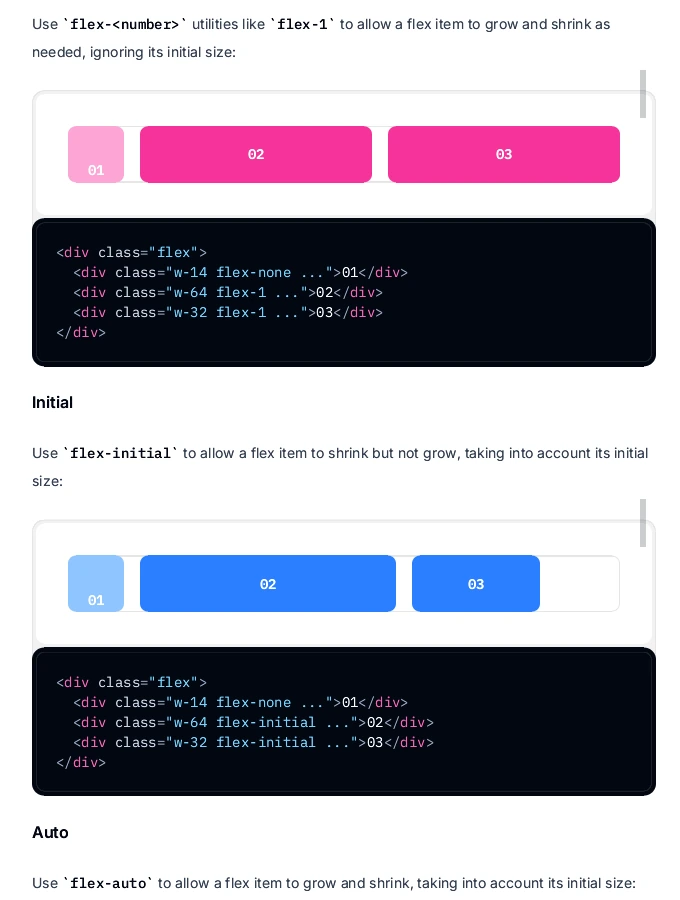
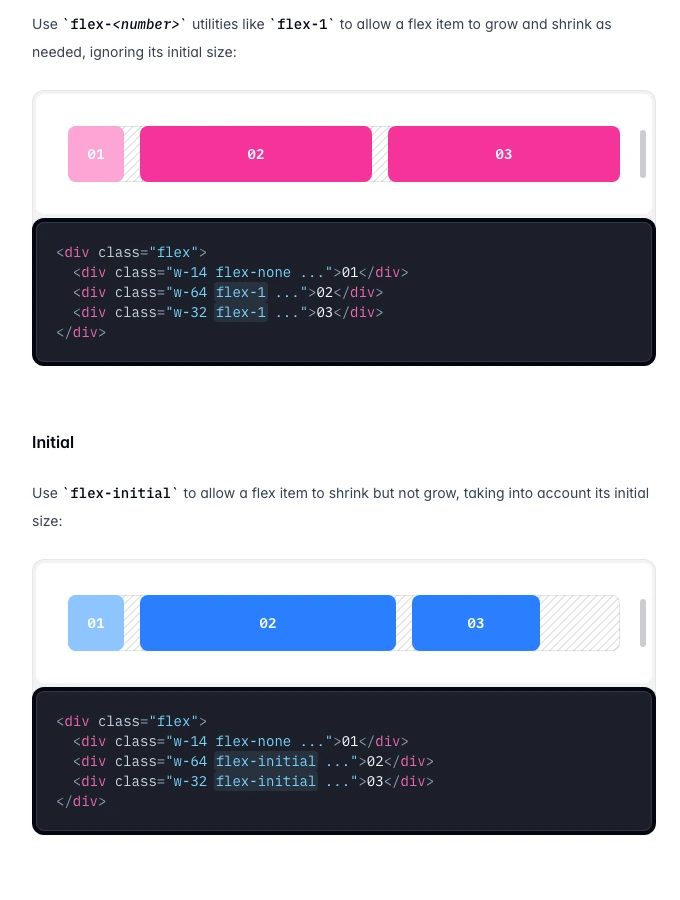
Avant: A design framework's documentation page: Floati 0.1.378, Floati 0.1.379 and the reference browser. The gaps under each example now match, so every heading below sits where the page puts it.
Avant
Après: A design framework's documentation page: Floati 0.1.378, Floati 0.1.379 and the reference browser. The gaps under each example now match, so every heading below sits where the page puts it.
Après · v0.1.379
La même page dans le navigateur de référence
Navigateur de référence

To find layout mistakes we draw well-known pages in Floati and in the reference browser and compare them pixel by pixel, then shrink each difference down to a few lines of page code and check that rule against the reference. Fourteen fixes came out of it. When a site's style sheet marks a rule as important it now beats a style written on the element itself, as the standard says; it used to lose, so menus and buttons sat in the wrong place. Rules written with the newer selector forms (is, where, not, has) now weigh exactly as much as they should, so the right one wins. A line break at the end of a line no longer starts an empty extra line. A font size written as a sum (a calc) is worked out once, so everything inside inherits the size and not the formula. A line height written in em or percent is fixed where it is written, so text inside a bigger heading does not grow its own gaps. Grids now share the height of a tall item among the rows it spans the way the reference does and understand rows named by the page, flexible rows stretch their items to the exact height the page set, an overlay over a picture covers the whole picture, labels meant only for screen readers no longer push the header down, and a button with a two-line label lines up with its neighbours. Every fix has a test that fails without it.

A design framework's documentation page: Floati 0.1.378, Floati 0.1.379 and the reference browser. The gaps under each example now match, so every heading below sits where the page puts it.

A design framework's documentation page, pixels different from the reference26 -> 5 percentA news front page35 -> 20 percent13 well-known sites, total difference181 -> about 140

Less memory on the same random sites

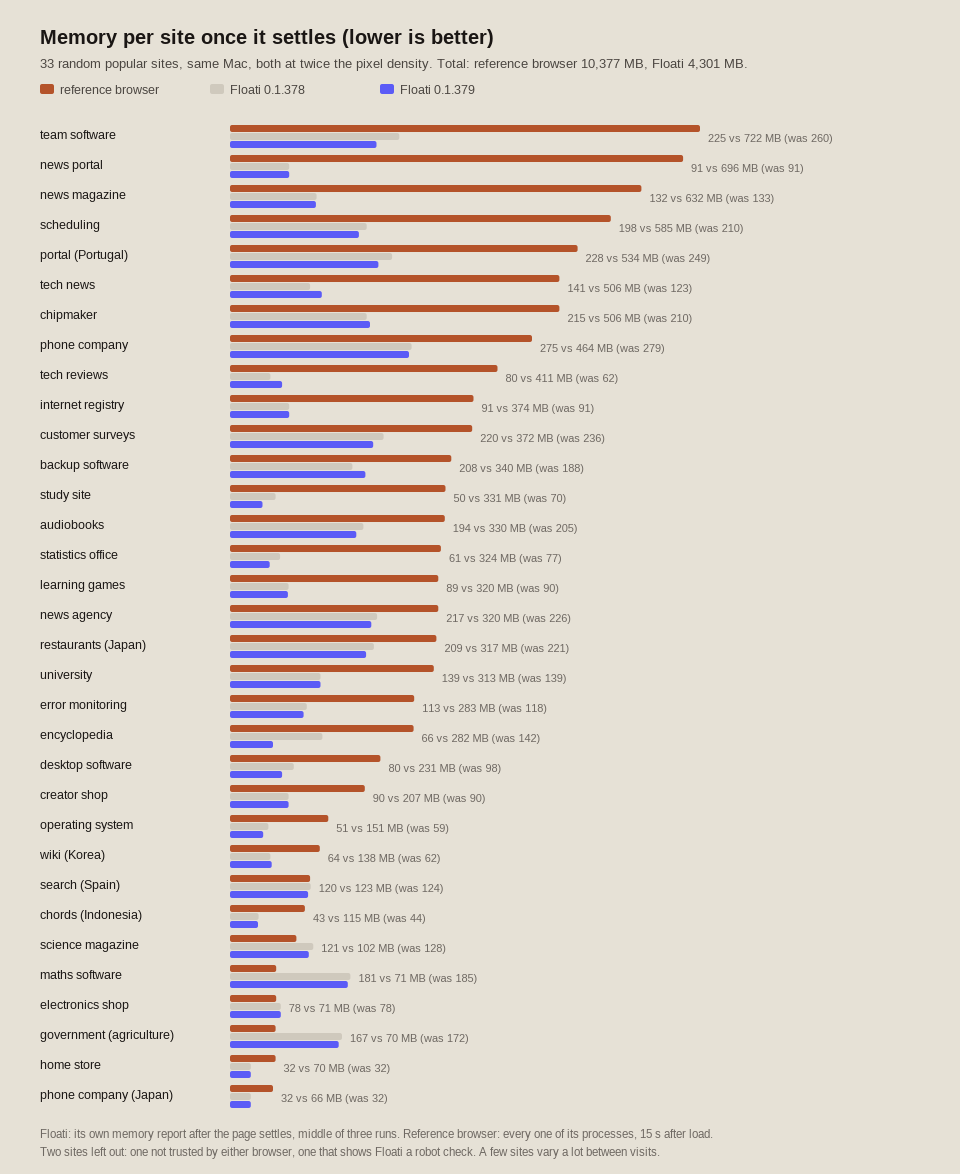
Memory per site after it settles: the reference browser, Floati 0.1.378 and Floati 0.1.379, same Mac, same screen density

The same 33 sites as in the last two releases, picked at random from a public list of the most visited websites, opened in Floati on the same Mac at twice the pixel density, three times each (the middle result is shown). Floati used 4,301 MB in total, against 10,377 MB for the reference browser and 4,524 MB for 0.1.378, and less than the reference browser on 29 of the 33. Three changes did most of it. A picture that is fully transparent or hidden (the resting slides of a fading slideshow, for example) is not drawn, so it now gives its memory back like a picture far down the page, and takes it again the moment it shows. On a sharp screen a picture is kept at exactly the pixels it is drawn at, where Floati used to keep a quarter more in case the box grew, and background pictures are kept at the size they are painted, not their full file size. And each picture keeps only one form: the compressed file or the drawn pixels, whichever it needs, never both. An encyclopedia went from 142 to 66 MB, a study site from 70 to 50, a team software site from 260 to 225. Four sites still use more than the reference browser: a maths software site, a government site, a science magazine and a shop, mostly because of large pictures and the compiled code of scripts that never run.

33 random sites, total memoryreference browser 10,377 MB -> Floati 4,301 MBFloati 0.1.378 -> 0.1.3794,524 -> 4,301 MBAverage site, settled130 MBSites where Floati uses less29 of 33

Ce qui a changé

22 changements
  1. RenduAn !important rule in a style sheet now beats a style written directly on the element, the order the standard sets (normal rules, then the element's own style, then important rules). A page that forces a margin with !important now gets it.
  2. RenduA scrolling panel inside a column of fixed height keeps the height the column gives it and scrolls its own content, instead of growing to fit everything and spilling over the panel below.
  3. API web et DOMSelector weights follow the newest standard: :where() adds nothing, while :is(), :not() and :has() weigh as much as their strongest part. A CSS framework's 'weakest' typography rules no longer beat stronger ones, so its documentation headings get the right spacing (pixel difference from the reference 26 -> 17 percent).
  4. RenduA line break (<br>) ends the line it sits on: one at the end of a line no longer opens an extra empty line, and one at the start breaks before what follows. Code blocks that end every line with a break were drawn twice as tall.
  5. RenduA font size written as a formula (calc(), such as 'one em minus 20 percent') is worked out once where it is written, so nested elements inherit the result instead of shrinking the text again at every level. A docs site's live code editor drew its code as faint dashes 4 pixels tall; it is 13.6 pixels now, as in the reference.
  6. RenduA line height written in em, percent or rem is turned into pixels where it is declared and passed down as pixels, so a large heading inside a smaller block no longer gets a line nearly twice too tall. Plain numbers still pass down as numbers, as the standard says.
  7. RenduA flexible row with a set height stretches its items to exactly that height; taller content now overflows instead of making the row taller (a news site's 32 pixel logo row had become 36).
  8. RenduAn inline block whose text sits inside nested boxes lines up on that text's baseline, so navigation bars and story lists built that way are no longer taller than they should be (one list was 107 pixels too tall).
  9. RenduA full-cover overlay inside a box whose height comes from its content now sizes against that box's final height; such overlays came out 0 pixels tall.
  10. RenduFlex items sized with fit-content, max-content or min-content keep that size instead of being stretched across the card.
  11. RenduA stretched flex column counts as having a known height for what is inside it, so footers pushed to the bottom with margin-top: auto now sit at the bottom of their card.
  12. AccessibilitéLabels hidden for screen readers (positioned off-screen) take no room in the line they sit in; they made a news site's masthead 31 pixels taller.
  13. RenduGrid items that span several rows share their extra height the way the standard describes, filling rows that can still grow first; four common shapes now match the reference exactly.
  14. RenduGrids understand named row lines (grid-row: headline), and row templates that name their lines size their rows correctly; the names used to be read as extra rows.
  15. Mémoire et lecturePictures that are invisible (inside something fully transparent or hidden) give their memory back and take it again only when they show. A fade carousel's waiting slides are exactly this.
  16. Mémoire et lectureEach picture now keeps only the smaller of its two forms it needs: a picture on screen keeps its pixels, a hidden or far one only its file. Photo PNGs could never be given back before. A restaurant guide went from 252 to 211 MB.
  17. Mémoire et lectureOn sharp (2x) screens a picture keeps exactly the pixels its box shows, with no extra quarter kept 'for zooming' (zooming decodes it again at the new size anyway), and is shrunk once it is 1.2 times too wide instead of 1.5. A chipmaker's site went from 230 to 199 MB.
  18. Mémoire et lectureBackground pictures are shrunk to the size their drawn copy needs, whether they are covered, contained or tiled, and grow back when the box gets bigger. A phone company kept a 3200 pixel strip behind a box 2 pixels tall.
  19. RenduGroundwork for compiling functions only when they first run: those functions now share their script's text instead of each keeping a copy.
  20. Mémoire et lectureMeasured before building: combining half-empty memory pages would give back only 1 to 2 MB on the heaviest sites, so that idea was set aside in favour of the image work above.
  21. Mémoire et lecture33 random popular sites: 4,301 MB in Floati (0.1.378: 4,524) against 10,377 MB in the reference browser; the average site settles at 130 MB.
  22. Confidentialité et ShieldsKnown: module scripts from another site are not yet checked like other requests; four sites still use more memory than the reference browser.

Tout depuis la v0.1.379 au même endroit

Versions

v0.1.0 - 0.1.9 · 10 Jul 2026418v0.1.427 · 25 Nov 2026

novembre2026 · 40 versions

42725 NovLayouts that remember their workPlus récente · v0.1.427 · Rendu9 42625 NovCompiled with what real pages runv0.1.426 · JavaScript et JIT 42525 NovBuilt with whole-program optimizationv0.1.425 · Rendu 42425 NovMore layout reused after a script changes the pagev0.1.424 · Rendu 42324 NovThe optimizing compiler works off the main threadv0.1.423 · Rendu 42222 NovText-reading loops and element-tree builders run fasterv0.1.422 · JavaScript et JIT14 42122 NovCalls from loops run inside the loop's own machine codev0.1.421 · JavaScript et JIT9 42021 NovPages you come back to run their scripts soonerv0.1.420 · Rendu17 41918 NovA faster interpreter runs the page's codev0.1.419 · JavaScript et JIT12 41815 NovScripts run faster on busy pagesv0.1.418 · JavaScript et JIT34 41711 NovPages wait less for their own scripts and stylesv0.1.417 · JavaScript et JIT13 41611 NovWebGPU loops run 2 to 3 times faster on Macsv0.1.416 · JavaScript et JIT 41510 NovWebGPU loops count right on Macsv0.1.415 · JavaScript et JIT 41410 NovWebGPU runs in its own graphics processv0.1.414 · Rendu 41310 NovA graphics card reset no longer takes the browser downv0.1.413 · Rendu 4129 NovVideo moves to the graphics cardv0.1.412 · Médias 4119 NovNo canvas stall on Windows, patterns and every blend mode on the graphics cardv0.1.411 · Rendu 4109 NovCanvas drawing moves to the graphics cardv0.1.410 · Rendu27 4098 NovEvery tile on the GPUv0.1.409 · Rendu26 4088 Nov3D at 120 frames a secondv0.1.408 · Rendu23 4077 NovWebGL 2v0.1.407 · Rendu36 4066 NovA stuck tab stops at oncev0.1.406 · Rendu16 4055 NovSmall WebGL drawings get smooth edgesv0.1.405 · Rendu 4045 NovWebGL pages finally movev0.1.404 · Rendu25 4035 NovWebGPU is herev0.1.403 · Rendu35 4024 NovA canvas that moves itself to the GPUv0.1.402 · Rendu 4014 Nov99% of real pages decided by the GPUv0.1.401 · Rendu9 4004 NovSmooth turns, the same bytes on every chip, and fields that keep their textv0.1.400 · Rendu15 3994 NovAnimations on the GPU compositor, and text that stays in its boxv0.1.399 · Rendu22 3984 NovGradient patterns that tile, animations that keep up, and a much faster canvasv0.1.398 · Rendu14 3973 NovTransitions that ease, and a GPU that draws 94% of real pages itselfv0.1.397 · Rendu 3963 NovAnimations on the GPU compositor, and spinners that spin as arcsv0.1.396 · Rendu 3953 NovCarousels that fade, badges that stay put, and floats that stay insidev0.1.395 · Rendu12 3943 NovBackground images over their colour, interlaced pictures, and borders in every colourv0.1.394 · Rendu 3932 NovStyle sheets in page order, and symbols that fall back like macOSv0.1.393 · Rendu 3922 NovIcon fonts loaded by script, and colour emoji on Windowsv0.1.392 · Onglets et interface 3911 NovEmoji in colour, sized as in the reference browserv0.1.391 · JavaScript et JIT 3901 NovA classified ads site's front page: blank before, whole nowv0.1.390 · JavaScript et JIT12 3891 NovA computer maker's home page: navigation labels back, buttons apartv0.1.389 · Rendu 3881 NovA space agency's home page, a news section and a language site's header now match the referencev0.1.388 · Rendu18

octobre2026 · 58 versions

38731 OctNews pages line up: a news site from 19.9% to 10.9% differentv0.1.387 · Rendu 38631 OctReal sites render closer to the reference browserv0.1.386 · Rendu14 38530 OctAhead of the reference runtime on 7 of 8 workloadsv0.1.385 · Mémoire et lecture32 38429 OctSafety review, a rare crash fixed, functions compiled soonerv0.1.384 · Mémoire et lecture46 38327 OctJavaScript ahead of the reference runtime on six of eight speed testsv0.1.383 · JavaScript et JIT36 38225 OctClosed tabs give their memory back, and XML pages read as XMLv0.1.382 · Mémoire et lecture12 38125 OctLighter script code, and calls between scripts that run as ordinary callsv0.1.381 · Mémoire et lecture15 38025 OctScrolling boxes scroll, pages look right, and scripts from other sites need permissionv0.1.380 · Rendu16 37924 OctPages laid out the way their authors wrote them, and less memory againv0.1.379 · Rendu22 37823 OctOther sites' data stays private, and less memory againv0.1.378 · Mémoire et lecture 37723 OctAbout half the memory of the reference browser on everyday sitesv0.1.377 · Mémoire et lecture15 37622 OctA minimized window stops piling up graphics memoryv0.1.376 · Mémoire et lecture 37522 OctClosed pages let go, sites stay apart, and fonts stop costing memoryv0.1.375 · Mémoire et lecture9 37421 OctA floating video you can move, that opens without a black flashv0.1.374 · Onglets et interface 37321 OctEvery page on our own engine, two pages side by side, videos that keep playing, and your own clockv0.1.373 · Onglets et interface17 37221 OctYour data stays put, your choices stick, and dictation that really listensv0.1.372 · Rendu 37121 OctDrop files onto pages, dictate without your voice leaving the Mac, and controllers that rumblev0.1.371 · API web et DOM · à tester 37021 OctOpen your files, share to your phone, have pages read aloud, install sites as apps, play with a controller, and accented text drawn rightv0.1.370 · Confidentialité et Shields · à tester11 36920 OctPasskeys with Touch ID and Windows Hello, sites that work offline, notifications you allow, and devices asked for first, all kept on your devicev0.1.369 · Confidentialité et Shields · à tester9 36820 OctA site's own security rules are kept the whole time the page runs, Trusted Types, a map of every unsafe write in DevTools, and animations from scriptv0.1.368 · Confidentialité et Shields · à tester 36720 OctEvents, form controls, performance timing, URL patterns, live streams and the newest JavaScript: the Web APIs score rises from 59 to 62v0.1.367 · API web et DOM · à tester10 36619 OctEvents, custom form controls, fonts and navigation work the way the web standards say: the Web APIs score rises from 53 to 59v0.1.366 · API web et DOM · à tester9 36519 OctThe code-size budget fits your processor, and code that has gone cold makes room for code that is hot nowv0.1.365 · JavaScript et JIT · à tester 36419 OctCompiled code that fits the processor's caches: big pages up to 1.8 times faster, and fast compiled code on Windows and Intel machinesv0.1.364 · JavaScript et JIT · à tester 36319 OctThermal runs on one code generator, building strings is up to 8 times faster, and two slow paths that grew with the square of their input are linearv0.1.363 · JavaScript et JIT · à tester12 36219 OctA page scheduler that stalled now runs, try / finally and spreads compile, and deleting thousands of properties is 180 times fasterv0.1.362 · Rendu · à tester 36118 OctThermal runs on Windows and Intel machines, a register fix for compiled code on Windows, try / catch compiles, and reading a growing string is 200 times fasterv0.1.361 · JavaScript et JIT · à tester 36018 OctEvery byte of machine code is Floati's own, a news site that showed blank renders, Gust's code is half the size, and closures and ?? compilev0.1.360 · JavaScript et JIT · à tester9 35916 OctThermal reads object members and folds Math, string building compiles, and methods, Array subclasses and globals behave as the standard saysv0.1.359 · JavaScript et JIT · à tester 35816 OctThermal, Floati's own optimizing compiler, is on: hot loops keep their numbers and strings in registersv0.1.358 · JavaScript et JIT · à tester 35715 OctLoops that test a number run as machine code, more of your functions compile, and reading page nodes is three times fasterv0.1.357 · JavaScript et JIT · à tester14 35614 OctRecursion makes a fraction of the calls, loops keep objects in registers, and element writes stop searchingv0.1.356 · JavaScript et JIT · à tester 35514 OctA hot loop changes compiler without stopping, property writes skip the detour, and pure recursion remembers its answersv0.1.355 · JavaScript et JIT · à tester 35413 OctFloati compiles JavaScript with its own compiler, Updraft: about a hundred times faster to compile, and compiled code no longer piles upv0.1.354 · JavaScript et JIT · à tester 35311 OctStyle matching tries a third of the rules, queries prepare their selector once, sibling walks stay fastv0.1.353 · Rendu · à tester 35211 OctCode that loads on demand starts at once, images decode beside their downloads, writes run compiledv0.1.352 · Rendu · à tester10 35111 OctStyles read once, layouts redone only where they changed, built-ins in compiled loopsv0.1.351 · JavaScript et JIT · à tester12 35010 OctHelpers that compile, strings that stay small, and events that fire fastv0.1.350 · JavaScript et JIT · à tester14 34910 OctScripts that grow in step with their work, layouts laid out once, and colours mixed like the referencev0.1.349 · Rendu · à tester13 3489 OctScripts that only compile when it pays, cards that line up, and bold that stays boldv0.1.348 · Rendu · à tester14 3478 OctCards inside links, small print at its real size, and errors you can followv0.1.347 · Rendu · à tester17 3467 OctA real performance timeline, site icons from the engine with a lookalike check, and forms that lay out rightv0.1.346 · Rendu · à tester14 3457 OctReal WebGL, a real 2D canvas, and canvas text that matches the reference browserv0.1.345 · Rendu · à tester10 3446 OctRetina text that keeps its spacing, embeds at their real size, and an address bar that keeps upv0.1.344 · Rendu 3436 OctSign-ins that stay signed in, a real IndexedDB, and a storage button that shows what sites keepv0.1.343 · Confidentialité et Shields · à tester25 3425 OctTheme switchers, chart labels sized by CSS, and SVG text you can measurev0.1.342 · API web et DOM · à tester 3415 OctCanvas text measured and drawn like the reference browser, and SVG shapes you can measurev0.1.341 · Rendu · à tester 3405 OctScripts can read and change SVG the way they do in the reference browser, and a hidden hang is gonev0.1.340 · Rendu · à tester10 3395 OctEvery computed style, real stylesheet objects and full 3D geometry, each checked against the reference browserv0.1.339 · API web et DOM · à tester12 3385 OctPages load faster, render truer and gain a dozen modern web features, each one checked against the reference browserv0.1.338 · API web et DOM · à tester19 3373 OctSites load like they do in the reference browser: every test site runs its scripts cleanlyv0.1.337 · API web et DOM11 3362 OctSite controls that do what they say: permissions that really ask, and Shields per sitev0.1.336 · Confidentialité et Shields13 3352 OctA developer-docs site works like the reference browser, and every frame gets its own built-insv0.1.335 · Rendu12 3342 OctIframes that cost what a paragraph costs, live selections, and rounder cornersv0.1.334 · Rendu10 3331 OctFewer script errors on real sites, and finished pages give all their memory backv0.1.333 · JavaScript et JIT10 3321 OctPinned tabs on the left or the right, and an honest measure of the web platformv0.1.332 · Onglets et interface9 3311 OctA crash on busy news sites fixed, and pages lighter on the processorv0.1.331 · Rendu 3301 OctJavaScript scores 100, and big pages stop stuttering when they clean upv0.1.330 · JavaScript et JIT11
septembre2026124 versions août2026140 versions juillet202656 versions