모든 버전 v0.1.35614 10월 2026JavaScript와 JIT, 기억과 읽기, 탭과 인터페이스 피드

릴리스 노트는 영어로 작성되어 있습니다.

Recursion makes a fraction of the calls, loops keep objects in registers, and element writes stop searching

This release makes three kinds of everyday JavaScript faster. Recursive functions now answer their simplest cases where they are called and run every other level inside their parent, so walking a tree makes a fraction of the calls, and recursion whose last step returns a property now compiles at all. Long loops that walk a list, keep the best object seen so far, copy objects, compare them or ask typeof now run in Floati's fastest loop tier, 20 to 40 times faster than before. Setting a property on page elements no longer searches every element prototype each time, so building elements is almost three times faster, and a getter a page puts on an element prototype now answers reads as it does in the reference browser. One crash is fixed: freeing a long linked list made inside a function no longer overflows the stack.

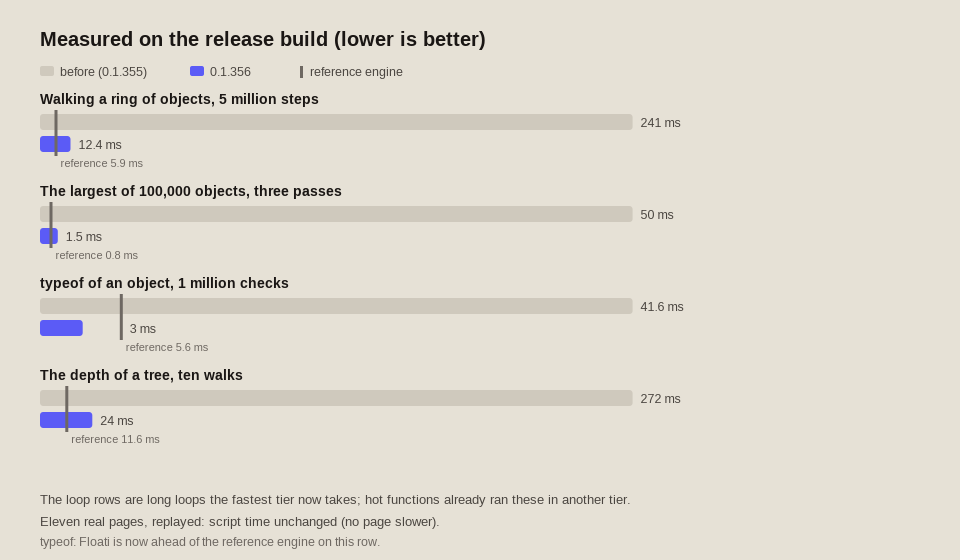
272 -> 24 msThe depth of a tree, ten walks
241 -> 12.4 ms (reference engine 5.9)Walking a ring of objects, 5 million steps
10 -> 3.5 msBuilding 3,000 elements, twenty times
주요 내용3

Recursion makes a fraction of the calls

A tree sum before and after: 31 calls become 5

A recursive function usually starts with its simplest case: if the tree is empty, return 0; if n is below 2, return n. Floati's recursion tier now runs that test where the call is made, so a call that would only answer the simple case is never made, and it copies one level of the function into its parent, so every other level of a tree runs without a call at all (a technique from research on divide-and-conquer programs). Each copy still counts toward the call-depth limit and the work budget exactly as a call would, so a runaway recursion stops where it did. Once a recursive function has run, its property reads are compiled again with the object layouts they saw built in. Recursion whose last step returns a property, like the depth of a tree that returns a leaf's value, used to fall back to slower code because one path returned a number and the other a value of any type; now the two paths meet as a number, and anything else hands the work back to the interpreter.

The depth of a tree, ten walks272 -> 24 msA count whose base case returns a property80 -> 4.7 ms

Loops keep objects in registers

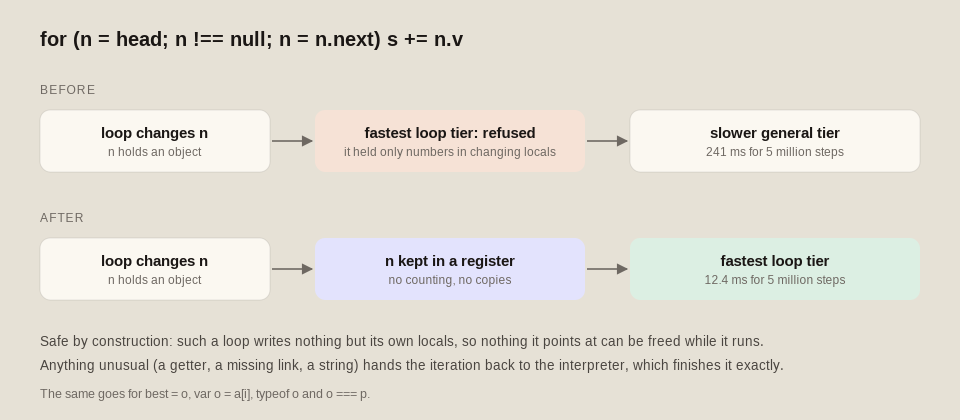
A list walk before and after: refused by the fastest loop tier, then run there with the object in a register
Before, after and the reference engine for four measurements

Floati's fastest loop tier kept numbers in registers, and objects only when the loop never changed which object a variable held. A loop like for (n = head; n !== null; n = n.next), or one that remembers the largest object seen so far, was refused and ran in a slower tier. Now such a variable holds the object directly, with no counting or copying, because these loops write nothing but their own variables: nothing they point at can be freed while they run. They can read properties, compare with null and with each other, copy, ask typeof and test truthiness; anything unusual, a getter, a missing link or a string compared by identity, hands that iteration back to the interpreter, which finishes it exactly. These are long loops the fastest tier now takes; a function that is already hot ran them in another tier and is unchanged.

Walking a ring of objects, 5 million steps241 -> 12.4 ms (reference engine 5.9)typeof of an object, 1 million checks41.6 -> 3 ms (reference engine 5.6)

Element writes stop searching

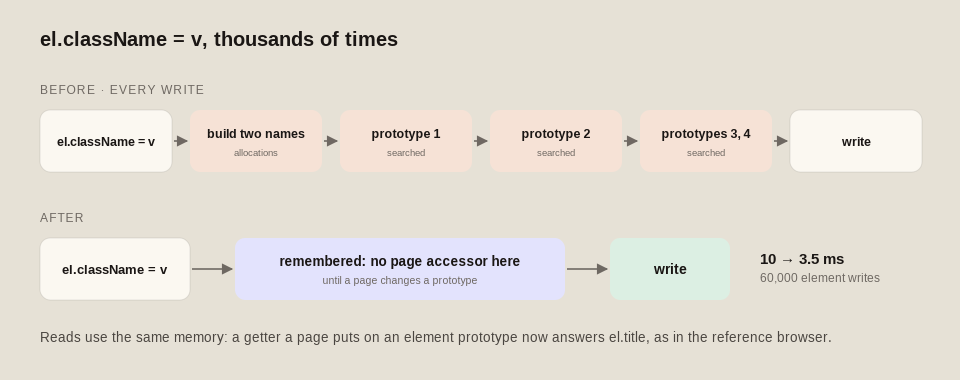
An element property write before and after: from a search of four prototypes to a remembered answer

Every el.className = v or el.textContent = v checked whether a page script had defined that property as an accessor on one of the element's prototypes: it built two names and searched four prototypes, every time, to learn that nothing was there. On a page that builds elements this was most of its script time. Floati now remembers the answer per element type until a page changes a prototype, which makes element-building three times faster. Reads use the same memory, which fixed a gap: a getter a page defines on an element prototype, as some monitoring and compatibility scripts do, now answers reads of that property as it does in the reference browser; before, Floati answered from its own value.

Building 3,000 elements, twenty times10 -> 3.5 msA getter on an element prototypenow answers reads

바뀐 점

변경 8개
  1. JavaScript와 JITRecursive functions answer their simple case where they are called and run alternate levels inside their parent: a tree walk makes a fraction of the calls.
  2. JavaScript와 JITRecursion whose last step returns a property (a tree's depth, a count) now compiles: a tree depth 272 -> 24 ms.
  3. JavaScript와 JITOnce a recursive function has run, its property reads are compiled again with the layouts they saw built in.
  4. JavaScript와 JITLong loops that walk a list, keep the best object so far, copy or compare objects, or ask typeof run in the fastest loop tier: a 5 million step walk 241 -> 12.4 ms.
  5. 기억과 읽기Setting properties on page elements remembers that no page accessor intercepts them: building elements is three times faster.
  6. JavaScript와 JITA getter a page defines on an element prototype now answers reads of that property, as in the reference browser.
  7. 기억과 읽기Fixed: freeing a long linked list built inside a function no longer overflows the stack and closes the page.
  8. 탭과 인터페이스Floati's pages and update notes now open at browser.floati.life.

내 브라우저에서 확인

각 확인 항목은 지금 읽고 있는 브라우저에서 바로 실행됩니다. 아무것도 전송되지 않습니다.

검사내 브라우저Floati
A recursive base case that returns a property still adds up확인 중예
An unrolled recursion keeps its arguments in order확인 중예
A setter added to an element prototype after many writes runs확인 중예
A long walk around a ring of objects keeps its place확인 중예
The largest object found in a loop is that very object확인 중예
Equal strings compare equal in a hot loop확인 중예
Typeof in a hot loop tells functions, arrays and null apart확인 중예
A long list built in a function is freed when it returns확인 중예
통과 8 / 8
v0.1.356 이후 전부를 한곳에서

버전

v0.1.0 - 0.1.9 · 10 7월 2026418v0.1.427 · 25 11월 2026

11월2026 · 버전 40개

42725 11월Layouts that remember their work최신 · v0.1.427 · 렌더링9 42625 11월Compiled with what real pages runv0.1.426 · JavaScript와 JIT 42525 11월Built with whole-program optimizationv0.1.425 · 렌더링 42425 11월More layout reused after a script changes the pagev0.1.424 · 렌더링 42324 11월The optimizing compiler works off the main threadv0.1.423 · 렌더링 42222 11월Text-reading loops and element-tree builders run fasterv0.1.422 · JavaScript와 JIT14 42122 11월Calls from loops run inside the loop's own machine codev0.1.421 · JavaScript와 JIT9 42021 11월Pages you come back to run their scripts soonerv0.1.420 · 렌더링17 41918 11월A faster interpreter runs the page's codev0.1.419 · JavaScript와 JIT12 41815 11월Scripts run faster on busy pagesv0.1.418 · JavaScript와 JIT34 41711 11월Pages wait less for their own scripts and stylesv0.1.417 · JavaScript와 JIT13 41611 11월WebGPU loops run 2 to 3 times faster on Macsv0.1.416 · JavaScript와 JIT 41510 11월WebGPU loops count right on Macsv0.1.415 · JavaScript와 JIT 41410 11월WebGPU runs in its own graphics processv0.1.414 · 렌더링 41310 11월A graphics card reset no longer takes the browser downv0.1.413 · 렌더링 4129 11월Video moves to the graphics cardv0.1.412 · 미디어 4119 11월No canvas stall on Windows, patterns and every blend mode on the graphics cardv0.1.411 · 렌더링 4109 11월Canvas drawing moves to the graphics cardv0.1.410 · 렌더링27 4098 11월Every tile on the GPUv0.1.409 · 렌더링26 4088 11월3D at 120 frames a secondv0.1.408 · 렌더링23 4077 11월WebGL 2v0.1.407 · 렌더링36 4066 11월A stuck tab stops at oncev0.1.406 · 렌더링16 4055 11월Small WebGL drawings get smooth edgesv0.1.405 · 렌더링 4045 11월WebGL pages finally movev0.1.404 · 렌더링25 4035 11월WebGPU is herev0.1.403 · 렌더링35 4024 11월A canvas that moves itself to the GPUv0.1.402 · 렌더링 4014 11월99% of real pages decided by the GPUv0.1.401 · 렌더링9 4004 11월Smooth turns, the same bytes on every chip, and fields that keep their textv0.1.400 · 렌더링15 3994 11월Animations on the GPU compositor, and text that stays in its boxv0.1.399 · 렌더링22 3984 11월Gradient patterns that tile, animations that keep up, and a much faster canvasv0.1.398 · 렌더링14 3973 11월Transitions that ease, and a GPU that draws 94% of real pages itselfv0.1.397 · 렌더링 3963 11월Animations on the GPU compositor, and spinners that spin as arcsv0.1.396 · 렌더링 3953 11월Carousels that fade, badges that stay put, and floats that stay insidev0.1.395 · 렌더링12 3943 11월Background images over their colour, interlaced pictures, and borders in every colourv0.1.394 · 렌더링 3932 11월Style sheets in page order, and symbols that fall back like macOSv0.1.393 · 렌더링 3922 11월Icon fonts loaded by script, and colour emoji on Windowsv0.1.392 · 탭과 인터페이스 3911 11월Emoji in colour, sized as in the reference browserv0.1.391 · JavaScript와 JIT 3901 11월A classified ads site's front page: blank before, whole nowv0.1.390 · JavaScript와 JIT12 3891 11월A computer maker's home page: navigation labels back, buttons apartv0.1.389 · 렌더링 3881 11월A space agency's home page, a news section and a language site's header now match the referencev0.1.388 · 렌더링18

10월2026 · 버전 58개

57개 더 보기
9월2026버전 124개 8월2026버전 140개 7월2026버전 56개