Versions nyinaa v0.1.36219 Oct 2026Krataafa nhyehyɛeɛ, JavaScript ne JIT Feed

Wɔakyerɛw release ho nsɛm no wɔ Borɔfo kasa mu.

A page scheduler that stalled now runs, try / finally and spreads compile, and deleting thousands of properties is 180 times faster

A break or continue that left a try block skipped its finally block. That broke more than tidy-up code: a widely used UI library's scheduler clears its "busy" flag in a finally that it leaves with break, so in Floati the flag stayed set after the first batch of work and every later batch waited forever. Pages built with that library looked right but never ran their later work (effects, an embedded code editor). break and continue now run every finally they leave, innermost first, as the standard says, and those pages do all their startup work, as in the reference browser. try / finally, object and array spread, destructuring from a Set, a Map or a generator, unary plus and regular-expression literals now run on the plan interpreter instead of the slowest tier, and so do for (let x of ..) loops over anything that is not an array. Deleting 64,000 properties one by one went from 5,993 to 33 ms, a function with try / finally called 2 million times from 430 to 243 ms, and on x86-64 Thermal keeps values in registers across calls in rarely run code (a float loop 315 -> 160 ms). Object spread now runs getters before converting a later computed key, and spreading null into an array throws a TypeError, as the standard says.

9 of 9 the sameRelease checks against the reference browser
5,993 -> 33 ms (reference engine 19)Delete 64,000 properties
Nsɛm titiriw2

break, continue and finally

A scheduler that leaves a labelled block with break: before, its finally never ran; now it does

A finally block runs however its try block ends: normally, by return, by a throw, or by break and continue. Floati handled the first three, but a break or continue out of a try jumped straight to its target and skipped the finally. That mattered on real pages. A widely used UI library runs queued work inside a labelled block, sets a "busy" flag, and clears it in a finally it leaves with break. In Floati the flag was never cleared, so after the first batch the scheduler believed it was still working and never started another: effects never ran, and an embedded code editor never parsed its text. The pages still looked complete, which is why the page checks did not catch it. Now a break or continue that crosses finally blocks runs each one, innermost first, with its own state restored, then lands where it was going. Each finally body resumes its own completion, so a try / finally inside a finally no longer takes an outer return or throw at its end, and a return routed into a finally closes the try's handlers first. The two pages built with that library now spend more time in JavaScript, because they do the work the reference browser does. The code they now run is compiled: a for (let x of ..) loop over a Set, a Map, a generator or a string used to be refused a plan because of the jump that ends it when the iterator is done, and now it is planned.

Release checks against the reference browser9 of 9 the same

More of every page compiles, and deletes are linear
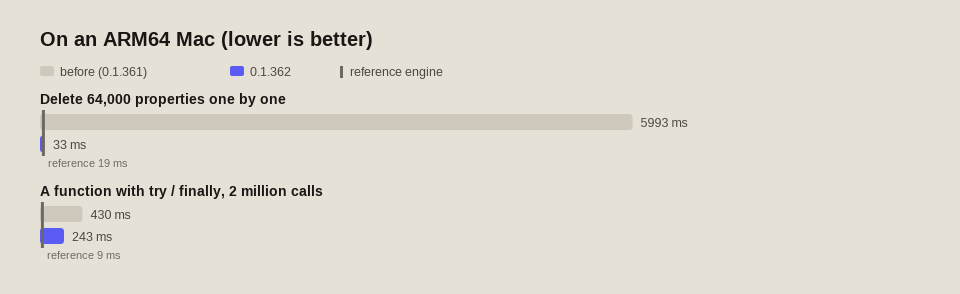
Before, after and the reference engine on an ARM64 Mac

The plan interpreter runs most hot functions. Several common constructs kept a function out of it, in the bytecode interpreter: try / finally, object and array spread ({ ...a, ...b }, [...set]), destructuring from anything iterable, unary plus on objects, and regular-expression literals (the most common refusal on a news site's load). Each is now a plan operation, checked against the interpreter in every tier on new test maps. Deleting a property from a large object shifted every property after it, so deleting n properties took time proportional to n squared. Deletes now leave a marker that is cleaned up in bulk, so the remaining properties keep their order and deleting 64,000 takes 33 ms instead of 5,993. On x86-64, Updraft IR's register allocator now keeps values in registers that a call may change, across calls in rarely run blocks, saving them only around those calls; a float loop with a rare slow path went from 315 to 160 ms.

Delete 64,000 properties5,993 -> 33 ms (reference engine 19)try / finally, 2 million calls430 -> 243 ms (reference engine 9)

Deɛ asesa

nsesaeɛ 7
  1. Krataafa nhyehyɛeɛbreak and continue out of a try run its finally block; a UI library's scheduler no longer stalls after its first batch.
  2. Krataafa nhyehyɛeɛEach finally body resumes its own completion, and a throw in a finally after a return is no longer caught by its own try.
  3. JavaScript ne JITtry / finally, spread, destructuring from iterables, unary plus and regex literals run on the plan interpreter.
  4. JavaScript ne JITfor (let x of ..) over a Set, a Map, a generator or a string is compiled instead of interpreted.
  5. Krataafa nhyehyɛeɛDeleting many properties from one object is linear: 64,000 deletes 5,993 -> 33 ms.
  6. JavaScript ne JITx86-64: values stay in registers across calls in rarely run code (a float loop 315 -> 160 ms).
  7. Krataafa nhyehyɛeɛObject spread runs getters before a later computed key is converted, and [...null] throws a TypeError.

Sɔ hwɛ wɔ wo browser mu

Nhwehwɛmu biara di dwuma wɔ browser a woreyɛ ho akenkan no mu. Wɔmmfa hwee nkɔ baabiara.

HwɛWo browserFloati
a break out of a labelled block runs its finally (a page scheduler no longer stalls)ƐrehwɛAane
break and continue out of try run the finally blockƐrehwɛAane
a finally that returns overrides a throw, in a hot functionƐrehwɛAane
object spread runs getters before a later computed key is convertedƐrehwɛAane
spreading null into an array throws a TypeErrorƐrehwɛAane
destructuring and spread from Set, Map and generators in a hot functionƐrehwɛAane
a regex literal is a new object each evaluationƐrehwɛAane
deleting thousands of properties keeps the remaining orderƐrehwɛAane
unary plus converts objects through valueOf and Symbol.toPrimitiveƐrehwɛAane
Atwam 9 / 9
Biribiara fi v0.1.362 wɔ baabi korɔ

Versions

v0.1.0 - 0.1.9 · 10 Jul 2026418v0.1.427 · 25 Nov 2026

November2026 · versions 19

4088 Nov3D at 120 frames a secondv0.1.408 · Krataafa nhyehyɛeɛ23 4077 NovWebGL 2v0.1.407 · Krataafa nhyehyɛeɛ36 4066 NovA stuck tab stops at oncev0.1.406 · Krataafa nhyehyɛeɛ16 4055 NovSmall WebGL drawings get smooth edgesv0.1.405 · Krataafa nhyehyɛeɛ 4045 NovWebGL pages finally movev0.1.404 · Krataafa nhyehyɛeɛ25 4035 NovWebGPU is herev0.1.403 · Krataafa nhyehyɛeɛ35 4004 NovSmooth turns, the same bytes on every chip, and fields that keep their textv0.1.400 · Krataafa nhyehyɛeɛ15 3994 NovAnimations on the GPU compositor, and text that stays in its boxv0.1.399 · Krataafa nhyehyɛeɛ22 3984 NovGradient patterns that tile, animations that keep up, and a much faster canvasv0.1.398 · Krataafa nhyehyɛeɛ14 3973 NovTransitions that ease, and a GPU that draws 94% of real pages itselfv0.1.397 · Krataafa nhyehyɛeɛ 3963 NovAnimations on the GPU compositor, and spinners that spin as arcsv0.1.396 · Krataafa nhyehyɛeɛ 3953 NovCarousels that fade, badges that stay put, and floats that stay insidev0.1.395 · Krataafa nhyehyɛeɛ12 3943 NovBackground images over their colour, interlaced pictures, and borders in every colourv0.1.394 · Krataafa nhyehyɛeɛ 3932 NovStyle sheets in page order, and symbols that fall back like macOSv0.1.393 · Krataafa nhyehyɛeɛ 3922 NovIcon fonts loaded by script, and colour emoji on Windowsv0.1.392 · Tabs ne interface 3911 NovEmoji in colour, sized as in the reference browserv0.1.391 · JavaScript ne JIT 3901 NovA classified ads site's front page: blank before, whole nowv0.1.390 · JavaScript ne JIT12 3891 NovA computer maker's home page: navigation labels back, buttons apartv0.1.389 · Krataafa nhyehyɛeɛ 3881 NovA space agency's home page, a news section and a language site's header now match the referencev0.1.388 · Krataafa nhyehyɛeɛ18

October2026 · versions 40

38731 OctNews pages line up: a news site from 19.9% to 10.9% differentv0.1.387 · Krataafa nhyehyɛeɛ 38631 OctReal sites render closer to the reference browserv0.1.386 · Krataafa nhyehyɛeɛ14 38327 OctJavaScript ahead of the reference runtime on six of eight speed testsv0.1.383 · JavaScript ne JIT36 38025 OctScrolling boxes scroll, pages look right, and scripts from other sites need permissionv0.1.380 · Krataafa nhyehyɛeɛ16 37924 OctPages laid out the way their authors wrote them, and less memory againv0.1.379 · Krataafa nhyehyɛeɛ22 37823 OctOther sites' data stays private, and less memory againv0.1.378 · Nkaeɛ ne akenkan 37723 OctAbout half the memory of the reference browser on everyday sitesv0.1.377 · Nkaeɛ ne akenkan15 37622 OctA minimized window stops piling up graphics memoryv0.1.376 · Nkaeɛ ne akenkan 37522 OctClosed pages let go, sites stay apart, and fonts stop costing memoryv0.1.375 · Nkaeɛ ne akenkan9 37421 OctA floating video you can move, that opens without a black flashv0.1.374 · Tabs ne interface 37321 OctEvery page on our own engine, two pages side by side, videos that keep playing, and your own clockv0.1.373 · Tabs ne interface17 37221 OctYour data stays put, your choices stick, and dictation that really listensv0.1.372 · Krataafa nhyehyɛeɛ 37121 OctDrop files onto pages, dictate without your voice leaving the Mac, and controllers that rumblev0.1.371 · Web APIs ne DOM · sɔ hwɛ 37021 OctOpen your files, share to your phone, have pages read aloud, install sites as apps, play with a controller, and accented text drawn rightv0.1.370 · Kokoam ne Shields · sɔ hwɛ11 36920 OctPasskeys with Touch ID and Windows Hello, sites that work offline, notifications you allow, and devices asked for first, all kept on your devicev0.1.369 · Kokoam ne Shields · sɔ hwɛ9 36820 OctA site's own security rules are kept the whole time the page runs, Trusted Types, a map of every unsafe write in DevTools, and animations from scriptv0.1.368 · Kokoam ne Shields · sɔ hwɛ 36720 OctEvents, form controls, performance timing, URL patterns, live streams and the newest JavaScript: the Web APIs score rises from 59 to 62v0.1.367 · Web APIs ne DOM · sɔ hwɛ10 36619 OctEvents, custom form controls, fonts and navigation work the way the web standards say: the Web APIs score rises from 53 to 59v0.1.366 · Web APIs ne DOM · sɔ hwɛ9 36519 OctThe code-size budget fits your processor, and code that has gone cold makes room for code that is hot nowv0.1.365 · JavaScript ne JIT · sɔ hwɛ 36419 OctCompiled code that fits the processor's caches: big pages up to 1.8 times faster, and fast compiled code on Windows and Intel machinesv0.1.364 · JavaScript ne JIT · sɔ hwɛ 36319 OctThermal runs on one code generator, building strings is up to 8 times faster, and two slow paths that grew with the square of their input are linearv0.1.363 · JavaScript ne JIT · sɔ hwɛ12 36219 OctA page scheduler that stalled now runs, try / finally and spreads compile, and deleting thousands of properties is 180 times fasterv0.1.362 · Krataafa nhyehyɛeɛ · sɔ hwɛ 36118 OctThermal runs on Windows and Intel machines, a register fix for compiled code on Windows, try / catch compiles, and reading a growing string is 200 times fasterv0.1.361 · JavaScript ne JIT · sɔ hwɛ 36018 OctEvery byte of machine code is Floati's own, a news site that showed blank renders, Gust's code is half the size, and closures and ?? compilev0.1.360 · JavaScript ne JIT · sɔ hwɛ9 35916 OctThermal reads object members and folds Math, string building compiles, and methods, Array subclasses and globals behave as the standard saysv0.1.359 · JavaScript ne JIT · sɔ hwɛ 35816 OctThermal, Floati's own optimizing compiler, is on: hot loops keep their numbers and strings in registersv0.1.358 · JavaScript ne JIT · sɔ hwɛ 35715 OctLoops that test a number run as machine code, more of your functions compile, and reading page nodes is three times fasterv0.1.357 · JavaScript ne JIT · sɔ hwɛ14 35614 OctRecursion makes a fraction of the calls, loops keep objects in registers, and element writes stop searchingv0.1.356 · JavaScript ne JIT · sɔ hwɛ 35514 OctA hot loop changes compiler without stopping, property writes skip the detour, and pure recursion remembers its answersv0.1.355 · JavaScript ne JIT · sɔ hwɛ 34910 OctScripts that grow in step with their work, layouts laid out once, and colours mixed like the referencev0.1.349 · Krataafa nhyehyɛeɛ · sɔ hwɛ13 3489 OctScripts that only compile when it pays, cards that line up, and bold that stays boldv0.1.348 · Krataafa nhyehyɛeɛ · sɔ hwɛ14 3478 OctCards inside links, small print at its real size, and errors you can followv0.1.347 · Krataafa nhyehyɛeɛ · sɔ hwɛ17 3467 OctA real performance timeline, site icons from the engine with a lookalike check, and forms that lay out rightv0.1.346 · Krataafa nhyehyɛeɛ · sɔ hwɛ14 3457 OctReal WebGL, a real 2D canvas, and canvas text that matches the reference browserv0.1.345 · Krataafa nhyehyɛeɛ · sɔ hwɛ10 3446 OctRetina text that keeps its spacing, embeds at their real size, and an address bar that keeps upv0.1.344 · Krataafa nhyehyɛeɛ 3436 OctSign-ins that stay signed in, a real IndexedDB, and a storage button that shows what sites keepv0.1.343 · Kokoam ne Shields · sɔ hwɛ25 3425 OctTheme switchers, chart labels sized by CSS, and SVG text you can measurev0.1.342 · Web APIs ne DOM · sɔ hwɛ 3415 OctCanvas text measured and drawn like the reference browser, and SVG shapes you can measurev0.1.341 · Krataafa nhyehyɛeɛ · sɔ hwɛ 3405 OctScripts can read and change SVG the way they do in the reference browser, and a hidden hang is gonev0.1.340 · Krataafa nhyehyɛeɛ · sɔ hwɛ10 3385 OctPages load faster, render truer and gain a dozen modern web features, each one checked against the reference browserv0.1.338 · Web APIs ne DOM · sɔ hwɛ19