همه نسخه‌ها v0.1.35514 اکتبر 2026نمایش صفحه, JavaScript و JIT, حافظه و خواندن خوراک

یادداشت‌های انتشار به انگلیسی نوشته شده‌اند.

A hot loop changes compiler without stopping, property writes skip the detour, and pure recursion remembers its answers

This release builds on Updraft, the compiler Floati wrote for itself. A long loop can now move between the interpreter, Gust and the optimizing compiler in the middle of a run, on one shared frame, so hot code reaches fast code sooner; and because a Gust compile costs about a microsecond per operation, Floati now compiles warm code much earlier, which makes eleven real pages about 1% faster. Compiled code writes object properties itself instead of calling a general helper, one array with a named property no longer slows down every other array on the page, and functions that only compute from their arguments remember the answers they have already worked out.

123 -> 77 msWarm-up runs with 20,000-step loops
25 -> 9.5 nsA function that writes a property, per call
7 -> under 1 ms (reference engine 3 ms)fib(30)
نکته‌های برجسته3

A loop changes compiler without stopping

A hot loop moves from the interpreter to Gust to the optimizing compiler, on one frame

Floati runs new code in its interpreter, compiles warm code with Gust, and moves code that stays hot to its optimizing compiler. Until now a function could only change compiler between calls: a long loop that started in the interpreter, or in Gust, stayed there until it finished. Because all three tiers keep a function's state in the same frame, a loop can now switch at the top of an iteration with nothing to translate: a loop in a function that is still warming up enters Gust there, and once it has run long enough to pay for the bigger compile, Gust hands the same frame to the optimizing compiler at a loop edge. Floati also prices the first compile at what a Gust compile really costs, about a microsecond per operation instead of the hundred the old code generator needed, so warm code is compiled far sooner.

Warm-up runs with 20,000-step loops123 -> 77 msScript time on eleven real pages1.0% lower, no page slower

Property writes without the detour

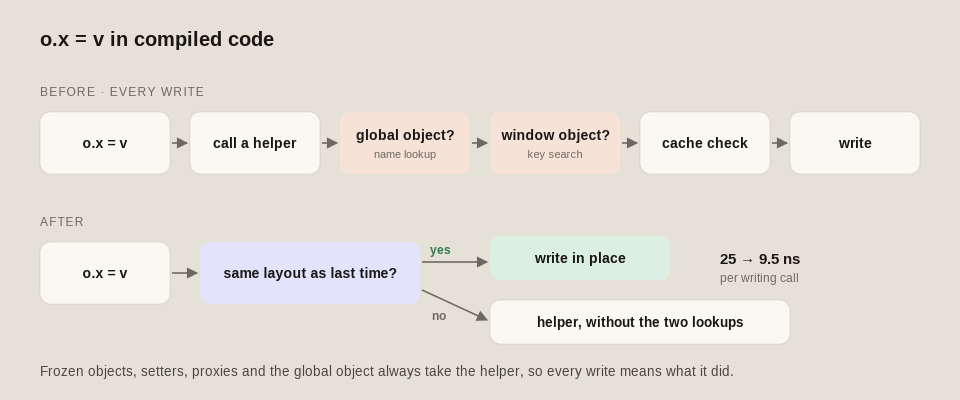
A property write before (six steps) and after (a layout check and a write)

Every o.x = v in compiled code used to call a general helper, and that helper first looked up the global object by name and searched the object for a window marker before it even reached its cache. Compiled code now checks that the object has the layout this write saw last time and writes the value in place. Anything unusual (a frozen or sealed object, a read-only property, a setter, a proxy, the global object) still takes the helper, so every write means exactly what it did, and the helper itself now skips the two lookups. A second slowdown is gone too: as soon as one array anywhere on a page got a named property, as some libraries do, push, pop and the other array methods lost their fast path on every array for the rest of the session. Now only that array is treated differently.

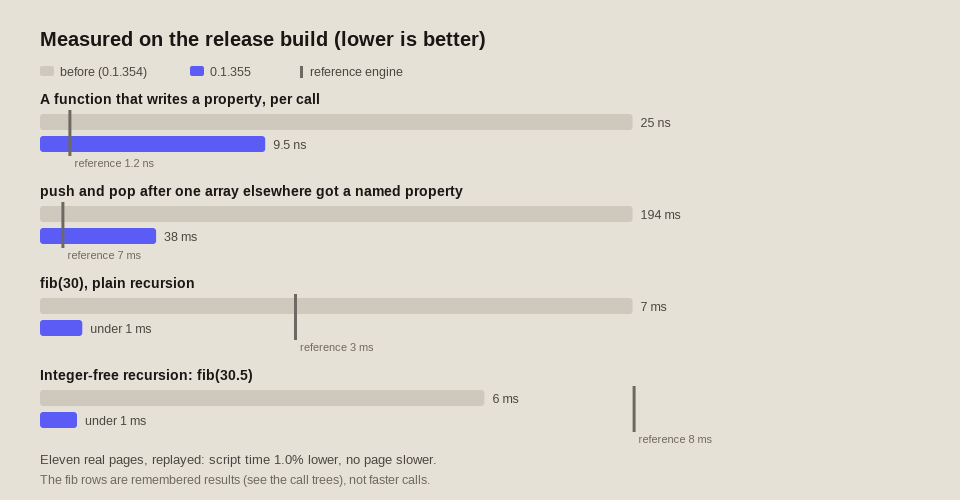
A function that writes a property, per call25 -> 9.5 nspush and pop after one array elsewhere got a named property194 -> 38 ms

Pure recursion remembers its answers

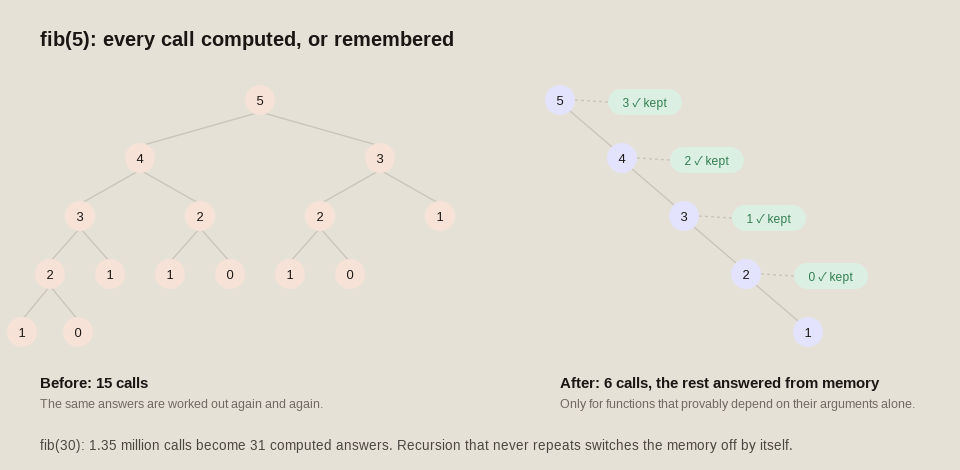
fib(5) without memory: 15 calls; with remembered answers: 6
Before, after and the reference engine for four measurements

Some recursive functions compute their result from their arguments and nothing else: no writes, no objects, no random numbers. Floati's recursion tier can prove that, and for such a function it now remembers each result for the arguments it was computed for, within one run. Asking again for an answer it already has costs a lookup instead of a whole subtree of calls, so a naive fib(30) does 31 computations instead of 1.35 million. The answers are exactly the ones recomputing would give, and the call stack goes as deep as before, so a runaway recursion still stops where it did. The memory resets on every new call into the function, so a value it captures can change between runs, and a recursion that never repeats a call switches the memory off by itself after a few thousand calls. This is a different kind of speed from faster calls: recursion that does not repeat work, such as walking a tree, runs as before.

fib(30)7 -> under 1 ms (reference engine 3 ms)Recursion that never repeats a callunchanged

چه چیزی تغییر کرد

6 تغییر
  1. JavaScript و JITA long loop in a function that is still warming up continues in compiled code from the top of the loop, and a hot loop moves on to the optimizing compiler at a loop edge instead of waiting for the next call.
  2. JavaScript و JITThe first compile is priced at what it really costs (about a microsecond per operation), so warm code is compiled much sooner: script time on eleven real pages is 1.0% lower, with no page slower.
  3. JavaScript و JITCompiled code writes an object property in place when the object has the layout the write saw before: a function that writes a property costs 9.5 instead of 25 nanoseconds.
  4. نمایش صفحهWrites that still need the general path skip two lookups they never needed.
  5. JavaScript و JITGiving one array a named property no longer slows push, pop and other array methods on every other array: 194 -> 38 ms in a test loop.
  6. حافظه و خواندنRecursive functions that compute only from their arguments remember their answers within a run; a recursion that never repeats a call turns this off by itself.

در مرورگر خودتان امتحان کنید

هر آزمون همین حالا در مرورگری که با آن می‌خوانید اجرا می‌شود. چیزی به جایی فرستاده نمی‌شود.

بررسیمرورگر شماFloati
A loop handed between compilers mid-run keeps its stateدر حال بررسیبله
A remembered recursive result follows a changed captured valueدر حال بررسیبله
A remembered result tells -0 from 0در حال بررسیبله
Math.random is never rememberedدر حال بررسیبله
A frozen object refuses a compiled write in strict codeدر حال بررسیبله
A setter defined after warm-up runs on a compiled writeدر حال بررسیبله
An array that overrides push keeps its own after compileدر حال بررسیبله
قبول 7 / 7
همه چیز از v0.1.355 به بعد در یک جا

نسخه‌ها

v0.1.0 - 0.1.9 · 10 ژوئیه 2026418v0.1.427 · 25 نوامبر 2026

نوامبر2026 · 3 نسخه

اکتبر2026 · 7 نسخه

سپتامبر2026 · 14 نسخه

32026 سپتامبرPages no longer freeze while a script waits on the networkv0.1.320 · JavaScript و JIT 31725 سپتامبرCloser to the reference browser, and no more address bar tricksv0.1.317 · APIهای وب و DOM 30924 سپتامبرPages arrive like they do in the reference browser, in a fraction of the memoryv0.1.309 · شبکه13 30322 سپتامبرHTTP/3 is on, and it is ours: the fastest web protocol, built from scratchv0.1.303 · شبکه 30222 سپتامبرThe site you open stays your business, and the browser checks every certificate itselfv0.1.302 · حریم خصوصی و Shields 30019 سپتامبرReads the newest web compression, reuses secure connections, and remembers where sites livev0.1.300 · حافظه و خواندن 29919 سپتامبرPages start loading sooner: smarter connections and a faster path onto slow networksv0.1.299 · شبکه 29516 سپتامبرClass-based JavaScript runs dramatically faster: calling a method through a list of objects is now many times quickerv0.1.295 · JavaScript و JIT 29416 سپتامبرInteger, bitwise and pixel-processing JavaScript runs a lot faster, and the browser still proves every shortcut before it trusts itv0.1.294 · JavaScript و JIT 29316 سپتامبرClass-based and object-heavy JavaScript runs dramatically faster, with speed the browser proves before it trustsv0.1.293 · JavaScript و JIT 29216 سپتامبرRecursive JavaScript runs dramatically faster, so the heaviest in-page computation feels quickv0.1.292 · JavaScript و JIT 27811 سپتامبرA tracker can no longer follow you from one site to the nextv0.1.278 · نمایش صفحه 27610 سپتامبرSecurity you can check: an honest ledger, a referrer firewall, and mixed content shut downv0.1.276 · حریم خصوصی و Shields 2122 سپتامبرPages you render with Floati's own engine appear right away nowv0.1.212 · نمایش صفحه

اوت2026 · 14 نسخه

19421 اوتFaster on pages that change as you use them - plus a tab-hover fixv0.1.194 · زبانه‌ها و رابط 19321 اوتSelect text, find on the page, and zoom - plus faster renderingv0.1.193 · زبانه‌ها و رابط 19220 اوتCrisp, high-resolution rendering on retina screensv0.1.192 · نمایش صفحه 18018 اوتSee how much of a whole page's download actually showed up on screenv0.1.180 · حریم خصوصی و Shields 17618 اوتWitness Mode: cryptographic, offline proof of what a site showed you (a world-first)v0.1.176 · حریم خصوصی و Shields 17418 اوتCounterfactual Browsing: see exactly what a script did to your page (a world-first)v0.1.174 · حریم خصوصی و Shields 17016 اوتRender Receipts: seal a page into proof the reference browser structurally cannot offerv0.1.170 · APIهای وب و DOM 12813 اوتHSTS: sites that demand https are never reached over plaintext, not even oncev0.1.128 · شبکه 12713 اوتEncrypted DNS (DoH) inside the engine, so your network cannot see which sites you look upv0.1.127 · شبکه 12613 اوتReal HTTP/2 multiplexing: many streams share one connectionv0.1.126 · شبکه 1067 اوتA real, deterministic AnalyserNode FFTv0.1.106 · نمایش صفحه 1057 اوتHTTP/2: the modern web transport, from scratchv0.1.105 · رسانه 966 اوتStateful audio DSP: filters, delay and waveshapingv0.1.96 · رسانه 661 اوتThe worst score on the board turned out to be a cookie bannerv0.1.66 · نمایش صفحه9

ژوئیه2026 · 4 نسخه